
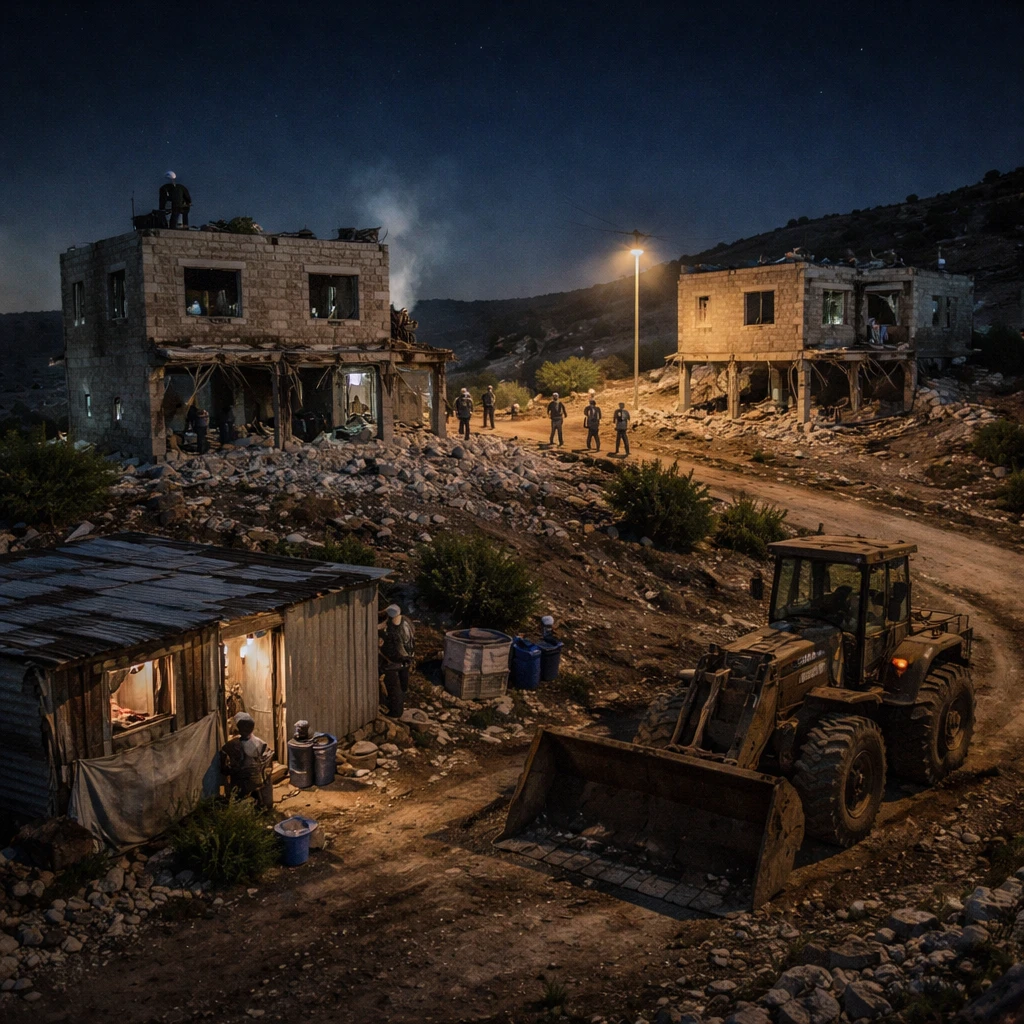
On Nov. 26, in the hilltop village of Jaloud in the West Bank, militant Israeli settlers brought a bulldozer to two adjacent two-storey houses and spent about an hour smashing the concrete foundations, according to on-site accounts and visual recordings of the incident. The homes, which sit on either side of a road, belong to the Tubasi family, who say they were forced out months earlier and have not been able to return.
Security camera footage captured the night operation at around 1 a.m., showing the settlers using the heavy machinery to damage structural elements of the two houses. Subsequent observations at the site found the concrete foundations of the homes partially broken.
Ghiath Nasser, a lawyer representing the owners in court, described the episode as part of a broader pattern of non-enforcement and impunity. He said:
"This latest escalation is a direct consequence of the lack of law enforcement and the sense of impunity enjoyed by the perpetrators."
The attack comes amid a documented rise in settler violence, which has included encroachment on Palestinian villages. United Nations figures cited in statements indicate an average of 53 settler attacks per week since the start of 2026. Rights groups tracking these incidents highlight that in the majority of cases there is no prosecution: one Israeli organization reports that 93.6% of investigations into settler violence are closed without indictments.
Following the foundation-smashing, the Israeli military issued a statement condemning the incident as "a serious criminal act" and said it had opened an investigation. Personnel who appeared to be Israeli security forces were visible visiting the area around the damaged houses. The military did not immediately provide an explanation for why the settlers had not been removed from the site prior to the attack.
Wael Tubasi, one of the owners of the two houses, said the goal of the action was to render the homes uninhabitable so the family could not return. He stated that the deadline set for the military to remove settlers from the area had already passed, yet the settlers remained present throughout the day.
The Tubasi family now live in a small dwelling in Jaloud, near the West Bank city of Nablus, which offers a direct line of sight to the two damaged houses. From that location they report having watched settlers move freely through their properties after they were forced out, while the family occupied a temporary small house behind the two larger structures.
Family members say the state apparatus has not followed through on a court order meant to secure the return of the family to their homes and the removal of settlers from the area. Wael Tubasi said the order required the army to remove the settlers entirely, not only to escort the family briefly back into the houses.
In September, after a court decision in the family's favor, the military escorted the family back to their homes. Family accounts say that roughly ten minutes after they arrived, a group of around 200 settlers attacked, forcing both the soldiers and the family to retreat. The settlers subsequently burned parts of the houses and damaged furniture inside, the family reports, and the Tubasis have not been able to reoccupy the homes since.
Aedah Tubasi, Wael's mother, voiced the family's frustration at what she describes as unequal treatment:
"I'm forbidden from reaching my home, while the settlers have the right to remain inside. What rights are there?"
The family recounts a pattern of harassment and escalation beginning earlier in the year. In April, settlers erected a tent near the family's homes and began a campaign of attacks, including setting fires to the houses, cutting water and electricity supplies, and blocking access roads to the properties. After about three months of pressure, family members say settlers came to their door and gave them an hour to leave under threat of being killed, invoking a past deadly attack on another Palestinian family.
The Tubasis referred to a previous incident in which an 18-month-old child and his parents were killed when settlers set fire to a home in the West Bank village of Duma in 2015. The reference was made by family members recounting the death threat they say they received, a threat that played a role in their decision to leave.
Local observers and human rights organizations tracking settler-related violence underscore the gap between declarations of investigation and the low rate of prosecutions. That disparity contributes, defenders of the Tubasi family say, to a climate in which attacks are repeated and legal remedies are not reliably enforced.
The Jaloud incident highlights ongoing tensions in occupied areas where disputes over property, security interventions, and the enforcement of court orders intersect. The family remains displaced and the structural damage to their homes may present long-term obstacles to their return, pending the outcome of the military investigation and any further legal action.