
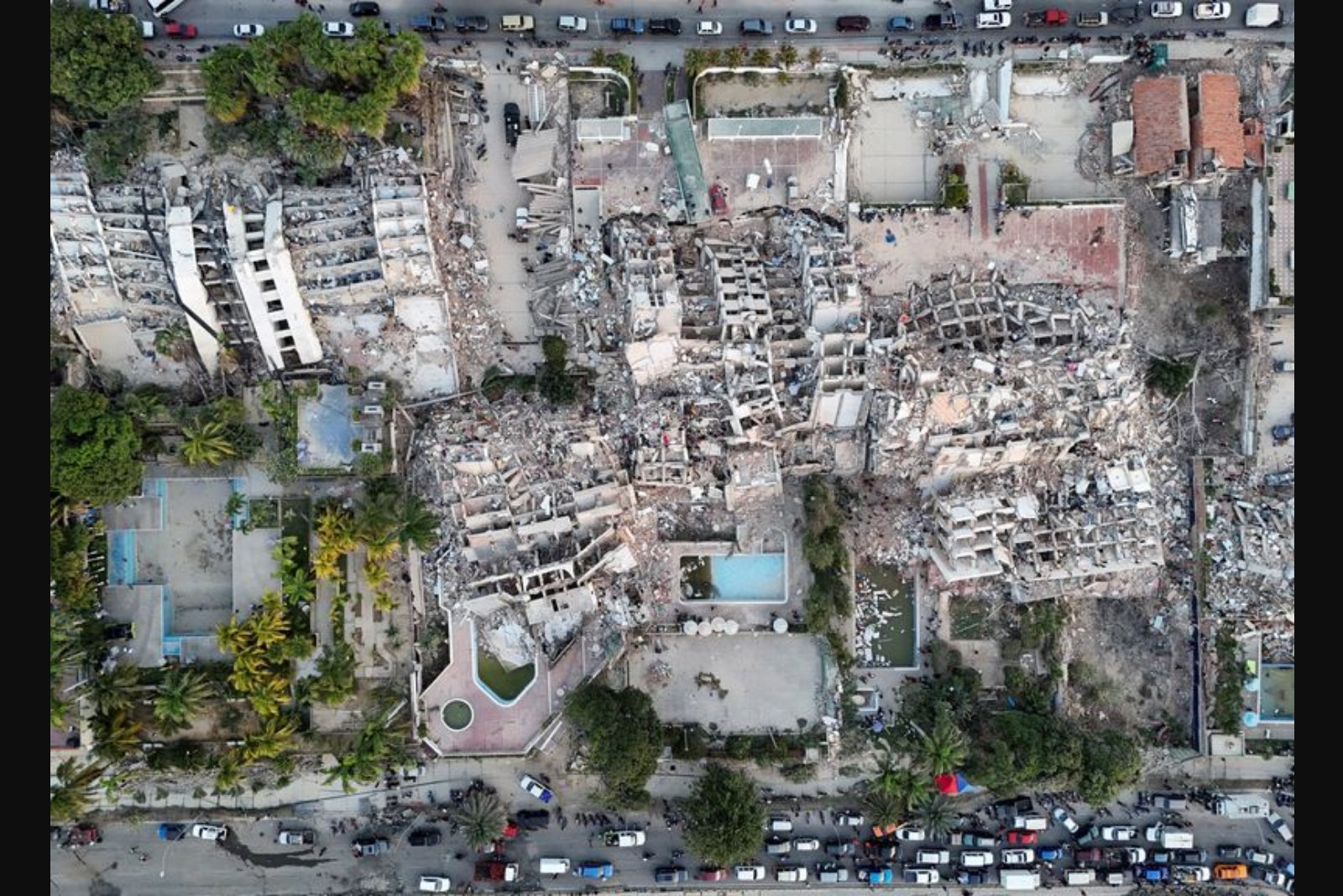
When Hugo Chávez commissioned a coastal housing project that would carry his name, many families displaced by earlier floods saw it as a path to stability. That sense of safety was shattered this week when two consecutive earthquakes caused partial or total collapses across the 1,100-unit complex known locally as 'Los Cocos' in La Guaira state. The calamity has intensified calls from engineers for an urgent audit of similar state-built housing still standing along vulnerable coastal zones.
"I lost my whole apartment," said Yelsa Rojas, who had lived on the second floor of Los Cocos since 2015. She said she believes residents on that floor perished and that the only reason she survived was that she was away for a medical appointment when the quakes struck. Her account underscores the human toll and the precarious position many residents now face amid continuing rescue efforts.
While definitive technical explanations for the structural collapses remain pending, civil engineers and construction specialists interviewed after the disaster highlighted a constellation of factors that very likely compounded the damage. They cited prolonged neglect, historical lapses in enforcing building codes and questionable licensing practices during the administrations of Chávez and his successor, Nicolás Maduro. In addition, they noted that sections of La Guaira rest on soft, unstable soils that amplify seismic shaking, making the coastal strip a particularly hazardous place for dense construction.
As emergency crews and civilians dig through debris to locate those trapped beneath concrete and masonry, professional engineers have offered to assist the government in assessing buildings that survived the initial quakes but may have been compromised. Officials have held meetings with the nation’s primary professional engineering association, yet formal structural evaluations of standing developments had not begun at the time of reporting, a delay that has frustrated some specialists and residents.
Pressure to act
"It is criminal that the government is not taking up offers from engineers and universities more quickly," said Enrique Larrañaga, an architect and urban planner at Simón Bolívar University who has previously advised national development efforts. The Communication Ministry did not provide a response to requests for comment.
On Sunday, interim President Delcy Rodríguez announced the formation of a commission to evaluate damaged housing structures, but she did not indicate when assessments would commence. The government has faced criticism for a slow initial deployment of heavy machinery and professional search-and-rescue teams, leaving many residents to use their hands, shovels and ropes in the crucial early hours after the quakes.
By Saturday, state television footage showed heavy construction equipment working through collapsed brick and concrete. Residents said foreign rescue teams assisted in recovering bodies and called for more reinforcements as the death toll continued to rise.
Historical and institutional concerns
Experts say many of the housing developments erected in recent decades were constructed rapidly and in some cases for political ends, which has contributed to safety concerns. Engineers also point to Venezuela’s broader decline in institutional capacity after an economic collapse beginning in 2013, noting that much technical expertise has been lost over the years.
"They need to give people that have know-how access to information and resources," Larrañaga said, arguing for coordinated technical assistance in the wake of the disaster.
Because the government has not yet begun its own on-site evaluations, volunteer engineers have organized to offer help directly to affected communities. Glennys Gonzalez, an architect and civil engineer coordinating dozens of professionals, said her group's preliminary review indicates that building codes were often not followed. She stressed, however, that careful studies are required to determine why some structures withstood the shaking while others pancaked.
Geological vulnerability
La Guaira has a history of catastrophic natural disasters. In 1999, mudslides and floods devastated coastal communities in the same state, with fatalities estimated between 10,000 and 30,000. The region’s geography - steep mountains that fall abruptly to a narrow coastal plain - tends to channel floodwaters and landslides directly through populated areas. Richard Casanova, director of Venezuela’s College of Engineers, emphasized that the local soil is soft and especially susceptible to severe shaking and ground deformation during earthquakes.
Other civil engineers pointed to the physics of seismic wave propagation in loose soils. Nicolás Labrópoulos, a civil engineering professor at Universidad Católica Andrés Bello in Caracas, explained that the loose sand, gravel and debris beneath developments in La Guaira can slow seismic waves but amplify their intensity, increasing the effective shaking experienced by buildings. Between the sea and mountains, that soil can turn more fluid-like under strong shaking, further undermining foundations and structures.
The twin earthquakes, measured at magnitudes of 7.2 and 7.5, produced intense ground motions. Venezuelan officials reported at least 1,450 dead and 3,150 injured four days after the tremors. Separate citizen-led lists of the missing have collected nearly 50,000 names, reflecting the scale of displacement and uncertainty in affected communities.
Code enforcement and construction practices
Following the 1999 disaster, Venezuela updated construction laws and building codes. Engineers say the rules themselves are not necessarily inadequate; the problem lies in enforcement. Casanova noted that while stricter codes were introduced, enforcement mechanisms have weakened over time, particularly as political centralization under Chávez and later Maduro eroded institutional oversight.
Chávez's government initiated large-scale public housing projects, including complexes like Los Cocos, in the run-up to the 2012 elections. Maduro later expanded the program to broaden access for low-income households. According to engineers and architects, these developments were constructed quickly by a combination of state agencies and foreign contractors from China, Turkey and Belarus, often under military oversight and with limited public disclosure on processes or quality control.
Gonzalez and Casanova argue that lax enforcement on state projects sent a signal to private builders that corners could be cut with impunity. This dynamic, they contend, contributed to widespread deficiencies in both newer public developments and private buildings. Some older structures may not have been retrofitted to reflect updates to the code implemented after the 1967 earthquake, leaving them more vulnerable to modern seismic demands.
Casanova summarized the engineers' assessment in stark terms: "The history of Chávez’s public housing is one of corruption and low-quality constructions built without supervision, inspection or adherence to specific codes in many cases." Independent reviews and reporting in recent years had already documented examples of housing sited in geologically risky locations, as well as buildings with visible defects such as cracks and leaks.
Comparative outcomes and broader implications
Engineers and analysts referenced other devastating earthquakes to illustrate how code enforcement and building practices affect death tolls. They noted that a magnitude-8.8 quake in Chile in 2010 resulted in roughly 525 deaths, an outcome widely linked to stringent building standards and their enforcement. By contrast, a magnitude-7.0 quake in Haiti in 2010 produced catastrophic loss of life in part because of weak construction controls.
While international comparisons are not a direct diagnostic tool, Venezuelan professionals say the pattern is consistent: where enforcement and institutional competence are strong, fatalities tend to be lower even from higher-magnitude events. Where oversight has eroded, the human cost of natural disasters is amplified.
Next steps and outstanding questions
Engineers are pressing the government to allow coordinated assessments by professional associations, university teams and volunteer cohorts so they can identify which buildings remain safe for habitation and which require evacuation or demolition. So far, those offers have not been fully accepted, and a nationwide audit of similar complexes has not begun.
Rescue operations continue under difficult conditions, with heavy equipment gradually taking a larger role in recovery efforts. Citizens and foreign teams have aided in some extrications. As the scale of destruction becomes clearer, the interplay between geological susceptibility, construction quality and institutional capacity will remain central to understanding both immediate needs and long-term policy responses.
For now, survivors like Rojas face the immediate realities of loss and displacement, while engineers and planners call for rapid, transparent assessments to prevent further tragedies in a region where steep terrain, soft soils and densely built coastal developments create a recurring risk profile.