
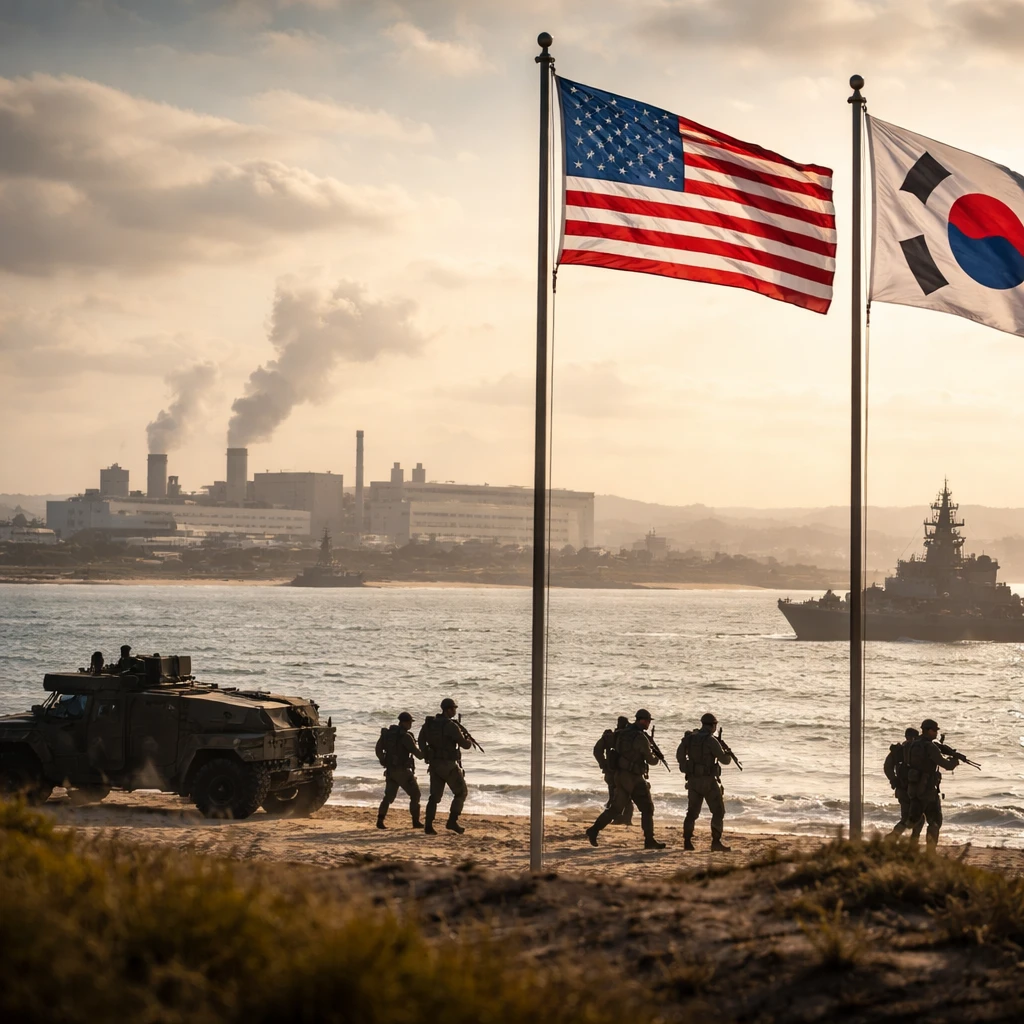
U.S. policy under President Donald Trump has introduced a distinctly transactional tone to relations with South Korea, producing tensions across security, trade and investment arenas while leaving core commitments intact on paper. Actions ranging from the suspension of major joint military drills to repeated tariff threats and heavy emphasis on investment pledges have forced Seoul and Washington to renegotiate elements of their practical partnership even as each side continues to rely on the other for deterrence and economic ties.
North Korea diplomacy and military exercises
Trump’s posture toward North Korea evolved sharply from the combative rhetoric of 2017 to high-profile diplomacy in 2018 and 2019. In 2017 he warned of "fire and fury" toward Pyongyang, but by 2018 he was meeting North Korean leader Kim Jong Un in Singapore, and followed with summits in Hanoi and at the Demilitarized Zone in 2019. Following the Singapore summit, Trump ordered the suspension of the August 2018 Ulchi Freedom Guardian joint exercise with South Korea, criticizing the drills as costly and provocative. Several other joint drills were subsequently cancelled or reshaped.
Those diplomatic talks ultimately stalled. The Hanoi summit ended without a denuclearisation agreement, and North Korea expanded its missile and nuclear programs thereafter. In response, allied exercises have since been scaled back up and broadened in scope to include non-traditional threats such as drones and cyberattacks. Trump’s most recent order to reduce certain military exercises evokes the same first-term approach, but arrives amid a different strategic environment: North Korea has a larger arsenal, continues missile testing and has developed closer military ties with Russia. Despite these developments, Trump has continued to describe his relationship with Kim as good and has called North Korea "unthreatening and respectful" during his presidency.
Security commitment and alliance modernisation
Washington currently maintains roughly 28,500 U.S. troops in South Korea - a long-standing element of the bilateral security posture. Trump has repeatedly questioned the financial burden of that presence while simultaneously affirming Seoul’s importance as an ally. The president’s second term also emphasizes "modernising" the alliance, seeking to give U.S. forces greater operational flexibility to confront challenges beyond the Korean Peninsula, notably those posed by China.
Such an expansion of mission scope creates friction for Seoul. South Korea depends on the U.S. role to deter North Korean aggression but is wary of being pulled into any broader conflict over Taiwan. Negotiations with Trump have advanced certain South Korean defence priorities: the U.S. president last year backed Seoul’s pursuit of nuclear-powered submarines. Seoul has also sought wider authority to enrich uranium and reprocess spent fuel, along with a faster transfer of wartime operational control. At the same time, South Korean President Lee Jae Myung has pledged higher defence spending and a larger security role for Seoul while stressing that U.S. defence commitments to South Korea remain firm.
Burden-sharing disputes
Questions about how much Seoul should contribute to stationing U.S. forces on the peninsula have been a persistent irritant. During his first term, Trump pressed for a substantial increase in South Korea’s payments, raising concern in Seoul that the president might reduce U.S. forces if an agreement was not reached. The allies did settle a cost-sharing framework covering 2026 to 2030. Under that agreement, South Korea will contribute about 1.52 trillion won - roughly $1.1 billion - this year toward the upkeep of U.S. troops.
Despite the formal deal, Trump has continued to argue South Korea’s contribution remains insufficient, while Seoul insists the negotiated arrangement should be honoured.
Trade tensions and tariff negotiations
Trade policy has been another major front of contention. The Trump administration renegotiated a bilateral free trade agreement during its first term and imposed tariffs on South Korean steel. In the current term, tariff pressure broadened. Washington initially threatened 25% tariffs before agreeing to a 15% levy in exchange for commitments from Seoul, including major investment pledges. At times Trump again threatened higher tariffs, accusing South Korea of moving too slowly to implement the agreement.
U.S. concerns have also extended to how South Korea regulates American technology firms. The treatment of U.S.-listed e-commerce company Coupang in Seoul has become a particular bilateral irritant.
Investment as a bargaining chip
South Korean companies have made significant investments in U.S. industries such as semiconductors, batteries, electric vehicles and shipbuilding. In the context of tariff negotiations, Seoul pledged $350 billion for U.S. projects in return for tariff relief. Disagreement followed over the mechanics of that promise after Trump characterised the sum as payable upfront. Seoul clarified that the commitment would take the form of loans, guarantees and equity rather than a single cash transfer, warning that an immediate cash payment could destabilise its economy.
Commercial frictions have at times threatened the smooth flow of these projects. The detention of hundreds of South Korean workers during a 2025 immigration raid at a Hyundai-LG battery project in Georgia alarmed Seoul and prompted warnings that companies might reconsider their U.S. investments.
Political management and channels to the White House
Political alignment in Seoul has shifted across successive governments, and U.S. policy under Trump has intersected with these domestic dynamics. Trump’s two terms largely coincided with liberal South Korean administrations that tend to favour engagement with Pyongyang. Former South Korean president Moon Jae-in helped facilitate Trump’s early diplomacy with Kim, though differences over sanctions and inter-Korean cooperation occasionally produced friction.
The conservative Yoon Suk Yeol government earlier adopted a tougher stance toward North Korea and deepened security coordination with Washington and Tokyo. Trump’s second term has again coincided with a liberal government under President Lee, who similarly favours reducing tensions with Pyongyang.
Trump’s personalised style of diplomacy prompted Seoul to develop unconventional channels into the White House. During the 2025 tariff negotiations, South Korean officials engaged directly with White House Chief of Staff Susie Wiles to try to clarify the U.S. president’s intentions. The appointment of Seoul-born former Republican congresswoman Michelle Steel as ambassador created an envoy politically aligned with Trump as the two governments navigate differences over North Korea, defence costs, tariffs and investment.
Where the relationship stands
Over the course of Trump’s terms, the alliance has demonstrated resilience but also stress. Military, fiscal and commercial disagreements have required repeated negotiation. The partnership now combines renewed large-scale exercises addressing expanded threats, formal cost-sharing commitments for stationing troops, high-stakes tariff-and-investment bargaining, and direct diplomatic engagement intended to bridge gaps between Washington and Seoul.
For now, both capitals continue to manage a complex mix of shared interests and disputes, keeping alliance mechanisms active while recalibrating aspects of cooperation in response to evolving security and economic priorities.