
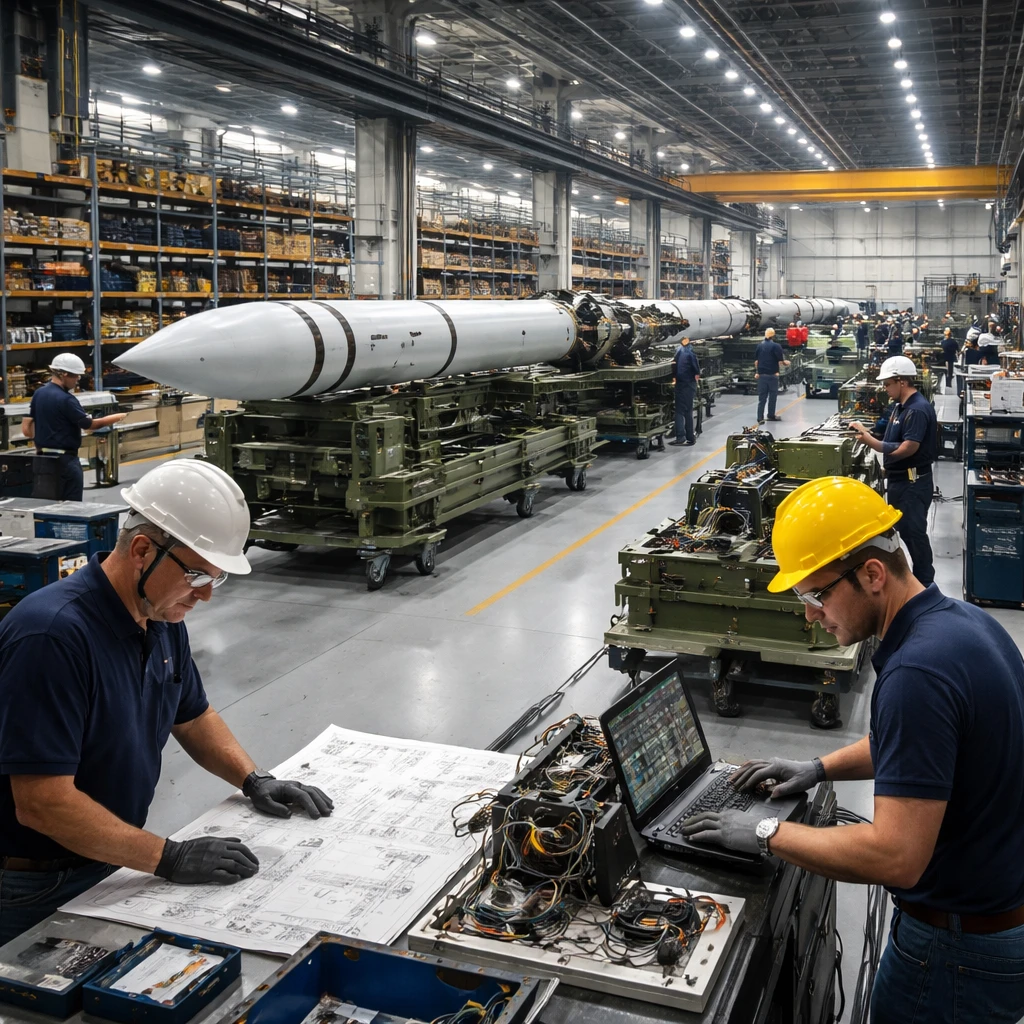
The U.S. Army has awarded Lockheed Martin a draft contract with a ceiling of $58.6 billion to produce Patriot interceptor missiles, according to Pentagon announcements. The agreement converts a prior one-year contract valued at $4.7 billion, creating a multiyear procurement framework to cover interceptor purchases from fiscal 2026 through fiscal 2032.
Officials cited strains on U.S. munitions inventories as a key driver for the expanded agreement. Recent military operations in Iran and extensive weapons transfers to allies have stretched supplies of critical air-defense and precision-guided munitions, prompting efforts to enlarge production runs and accelerate deliveries.
Under the revised deal, Lockheed Martin will pursue higher PAC-3 MSE output rates. The company has said that the funding will enable it to keep a previously announced plan to triple PAC-3 MSE production capacity by the end of 2030. That plan includes boosting annual interceptor production to levels Lockheed earlier disclosed - expanding production capacity and increasing workforce at key sites.
Lockheed stated the contract would support a 50% increase in workers at its Camden, Arkansas, missile plant, taking staffing from about 1,200 to roughly 1,850 employees. The company also confirmed plans to invest between $8 billion and $9 billion through 2030 to modernize more than 20 U.S. facilities, including new munitions centers in Alabama and Arkansas.
PAC-3 MSE is a hit-to-kill interceptor component of the Patriot air-defense system, designed to defeat ballistic missiles, cruise missiles and aircraft. Capacity concerns are underscored by recent estimates from a Washington-based think tank showing the U.S. military holds fewer than 1,000 Patriot interceptors and under 250 THAAD interceptors - both systems that have experienced significant use in the Middle East.
Pentagon negotiators have been pressing defense contractors to ramp up production rates. Earlier this year tentative production agreements were central to efforts to increase missile output across the defense industrial base. Executives in the industry have welcomed such frameworks, but note that congressional appropriations must precede heavier investments in component supply chains and production capacity.
The current administration has also placed explicit pressure on contractors to prioritize production over shareholder payouts. In January, the President signed an executive order directing agencies to identify contractors viewed as underperforming on government contracts while continuing to distribute profits to shareholders. That policy push is part of broader efforts to ensure manufacturers focus on throughput and capacity expansion.
Exact contract terms and many delivery schedules remain under negotiation between the Pentagon and industry. A comparable framework agreement was reached earlier with RTX's Raytheon business to expand Tomahawk cruise missile production - mapping a path from roughly 60 units per year to an eventual target of 1,000 annually. The Lockheed award follows that same drive to scale output for high-demand munitions.
Context for markets and industry
- Defense prime contractors and their suppliers are positioned to see sustained demand as the Pentagon seeks higher production runs.
- Large multiyear awards are intended to provide revenue visibility to justify capital investments in plants, tooling and workforce expansion across the defense manufacturing supply chain.
- Timely congressional funding decisions will be critical for translating procurement frameworks into concrete capacity increases and component-buy contracts.