
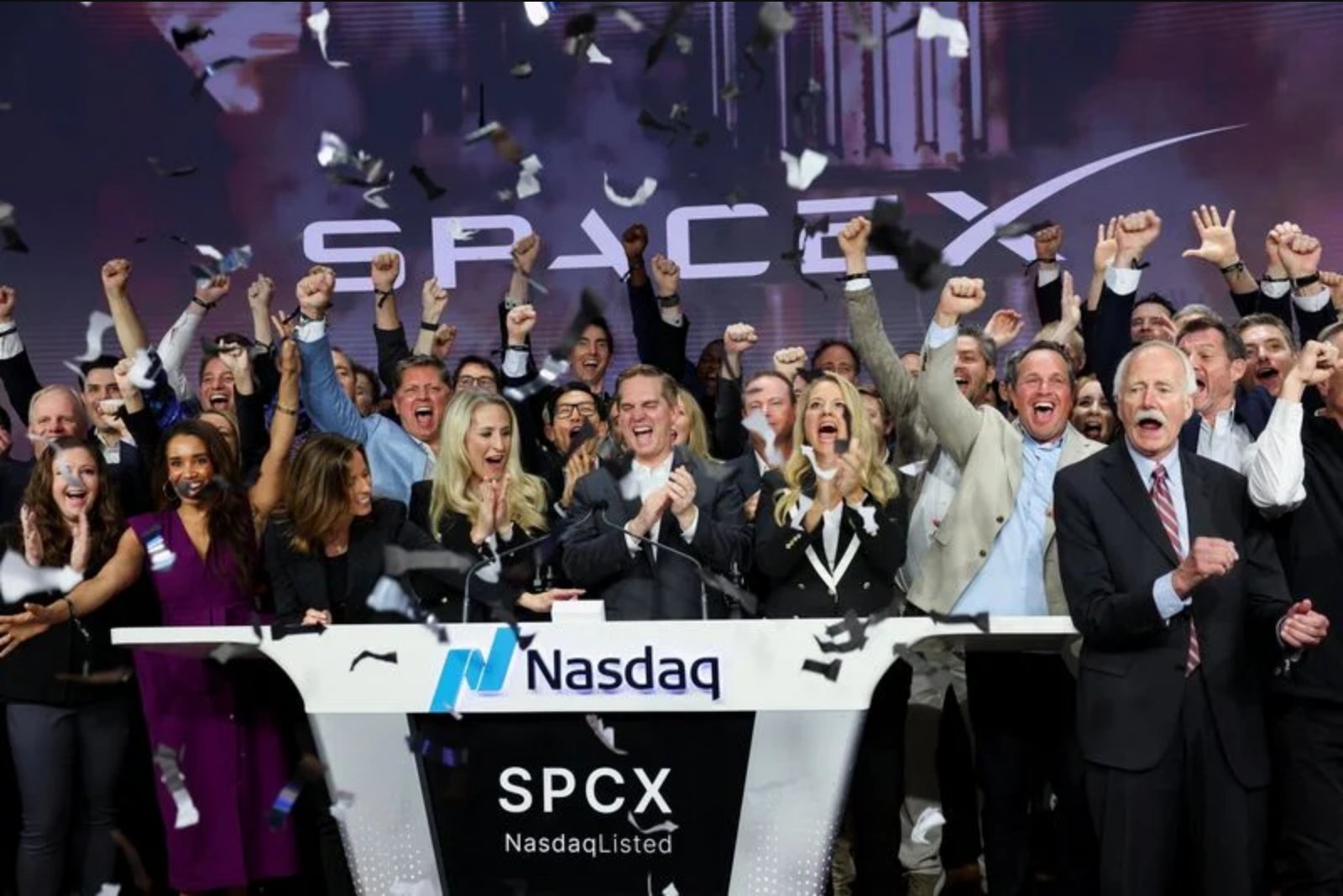
NEW YORK, June 12 - SpaceX shares traded higher in their Nasdaq debut on Friday, following the company’s record-setting $75 billion initial public offering the previous day. The IPO had been priced on Thursday at $135 a share, giving the company a $1.77 trillion valuation at the time of pricing. Activity in early trading on Friday pushed that valuation above $2 trillion.
Market action in the listing was notable for an initial pop in price when trading began. SPACEX shares opened at $150 late on Friday morning, representing an 11% increase from the $135 pricing on Thursday, and subsequently moved up to $156.
At the same time, U.S. stock indexes did not move in lockstep with SpaceX’s debut. The Nasdaq was down fractionally while the Dow Jones Industrial Average was up about 0.6% during the session.
Market reaction and structure
Observers pointed to the IPO’s structure when assessing the early trading behavior. Ben Ritchie, head of developed market equities at Aberdeen Investments in Edinburgh, emphasized the impact of a deliberately constrained free float and allocations that favor retail investors. He said: "The important thing to note is the relative free float of the IPO is small. The IPO has been constructed to give it the best possible chance not only of achieving a high valuation, but also of trading well initially, a relatively tight float and also a healthy allocation to retail."
Ritchie added that these elements help build confidence and that high valuations and positive first-day market responses play a role in attracting capital for the firm’s continued build-out. "This is a dynamic that’s based on the pillars of confidence, and achieving a high valuation and a successful first day market response is important in driving that confidence. And because we’re at the heavy investing stage of this build-out cycle, and it needs to attract capital. Having those positive share price responses, but also high valuations, are critical ultimately to being able to fund that."
Volatility and investor behavior
Several market professionals cautioned that early trading moves may not indicate how the stock will behave over the medium term. Don Calcagni, chief investment officer at Mercer Advisors in Denver, observed: "First day IPOS are generally pretty volatile. … The first day’s performance doesn’t necessarily predict how the stock will perform in the medium-term. Volatility starts to come down as time goes on, but that volatility can easily persist for a full quarter."
Calcagni explained that the immediate volatility reflects strong pent-up demand and investor attempts to assess the new listing. "The volatility is always highest fresh out of the gate because you have all that pent up demand and investors just trying to figure it out. That’s why people get excited, they see this huge pop and want a piece of it. If they buy it today, they might not be getting that huge pop themselves, but they are funding the exponential returns of all the early investors."
Broader supply-demand dynamics for public equities
Scott Chronert, U.S. equity strategist at Citi in Novato, California, framed the SpaceX listing within wider themes affecting demand for equities and the supply of public companies. He highlighted a paucity of IPOs during much of the current cycle and factors that kept companies private longer, including large pools of private capital and low interest rates. He said: "The key from here is investor demand and the amount of available capital/portfolio space for new opportunities."
Chronert noted that while those dynamics can support equity demand, they also introduce headwinds tied to fundamental performance and funding. "While those storylines set up well for equity demand, they must be balanced with headwinds. As mega IPOs come to market, the de-equitization story will reverse as the cashflow funding narrative continues to weaken. Combined, this puts more pressure on fundamentals to deliver, especially for AI monetization, as it helps future funding, which filter into broader fundamentals."
Views on the IPO cycle and valuations
Shivaram Rajgopal, professor of accounting and auditing and chair of the accounting division at Columbia Business School in New York, characterized 2026 as notable for large listings. He said: "2026 will go down as the year of the mega IPO. This might even suggest the peak of the bubble fueled by low interest rates since the financial crisis, private credit boom and the unreal expectations from AI companies."
Political commentary
Senator Elizabeth Warren of Massachusetts, the ranking Democrat on the Senate Banking Committee, criticized the regulatory approval of the IPO in strong terms, declaring: "Trump’s SEC greenlit an IPO with numbers analysts have called ‘nonsensical.’ The world will get its first trillionaire while Americans across the country are scraping together every dollar to save for retirement. Rather than changing the rules to rush SpaceX into Americans’ retirement portfolios, index providers should ensure they do their part to protect American families’ investments. And the SEC should do its job and ensure Elon Musk does not rip off investors."
Contextual note on trading and investor tools
Market participants navigating the listing are weighing entry timing and the potential for continued volatility in the near term. Several commentators underscored that initial-day performance is frequently erratic and that clarity on longer-term trajectory may require several weeks to a quarter of trading data.
As SpaceX’s shares continued to trade, the market will be watching investor demand, available float, and how the company’s growth and monetization plans translate into fundamentals that support its valuation.