
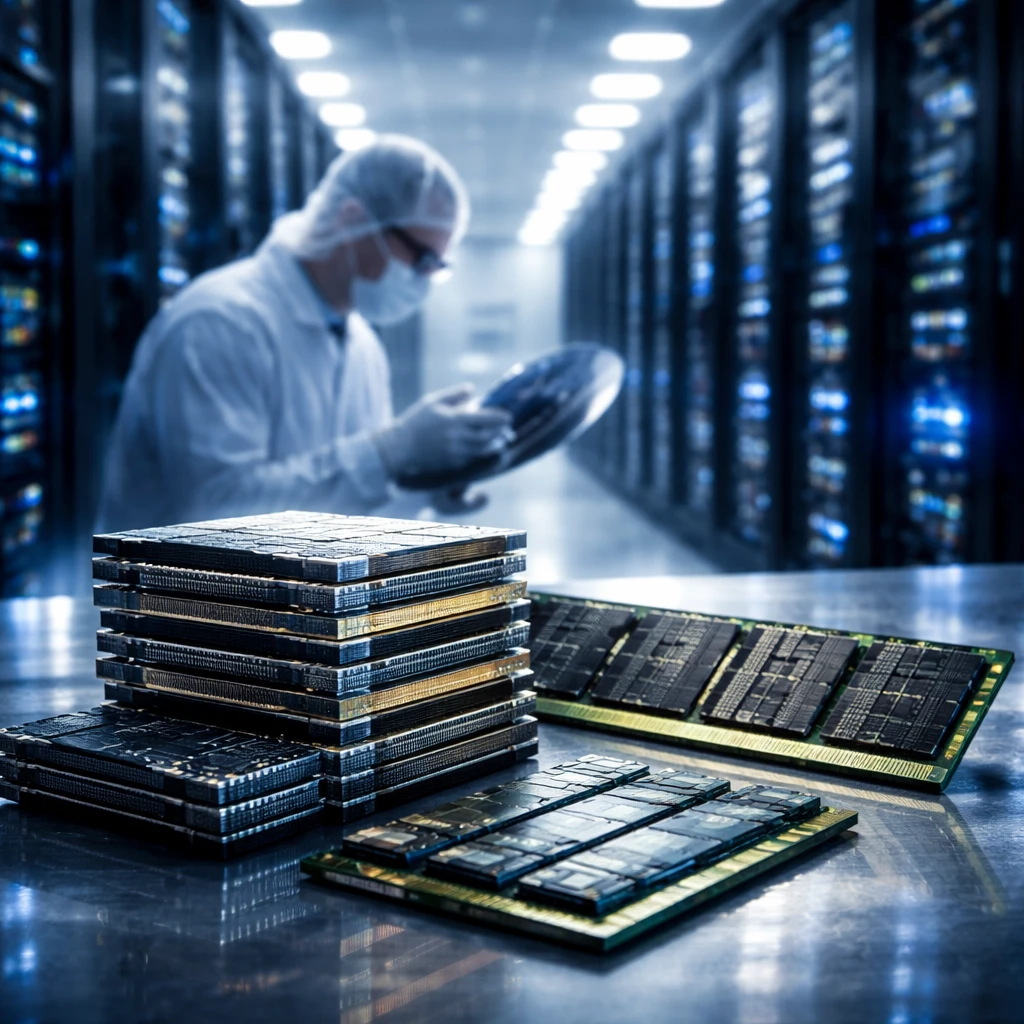
SK Hynix's $26.5 billion Nasdaq debut on July 10, 2026 - the largest U.S. listing by a foreign company and the second largest initial public offering in history - sharpened a critical industry question: as AI spending accelerates and high-bandwidth memory (HBM) demand surges, which supplier will secure the lion's share of the gains, the Korean incumbent or its U.S. rival Micron?
Both companies are central to the ongoing AI infrastructure buildout and to geopolitical contests over advanced semiconductors. This analysis examines how the two firms compare on three axes that matter most to investors: demand dynamics, product and customer positioning, and valuation amid shifting trade and industrial policy.
Demand far outstripping supply
The macroeconomic backdrop confronting both vendors is unusually unambiguous. UBS projects total memory industry revenues of $992 billion in 2026 and $1.76 trillion in 2027, and industry observers expect the DRAM market to remain structurally undersupplied through at least 2028. These projections point to more than a short-term inventory swing; they imply a multi-year rebalancing in which capacity fails to keep pace with demand growth.
SK Hynix's chief executive framed the situation bluntly in a July 10 interview: "We forecast that next year will be the worst year in the industry's history from the supply perspective. Our customer demand continues to go up, while our capacity has limitations. We still forecast that customer demand will remain higher than our supply capacity even beyond 2030." Such candid acknowledgement from an incumbent CEO underscores that capacity, not demand, is the binding constraint—and it is likely to support pricing power across the sector.
HBM market positions and customer ties
On HBM specifically, SK Hynix held a commanding market share in early 2026. In Q1 2026 the company controlled roughly 56%-58% of the HBM market, with Samsung and Micron each at about 21%-22%. That dominance is underpinned by a close partnership with Nvidia, the largest buyer of HBM for AI accelerators. It is important to note, however, that SK Hynix's HBM share has fallen from 69% a year earlier, signaling that competitors are closing the gap as Samsung ramps HBM4 production and Micron expands HBM capabilities.
Micron's recent financials illustrate the magnitude of the demand-driven earnings upswing. The company reported fiscal Q3 2026 revenue of $41.46 billion, a 346% year-over-year increase, and delivered EPS of $25.11, with a gross margin of 84.9%. These results reflect powerful pricing leverage and a customer mix shifting toward higher-margin HBM and data-center DRAM.
Valuation divergence
Despite SK Hynix's HBM market leadership and its massive U.S. listing, the two companies trade at different forward multiples. SK Hynix is priced at roughly 5.8 times forward earnings while Micron trades at around 7 times. Micron commands a premium even though it is materially smaller in HBM share.
Several structural forces underlie that gap. First, Micron's U.S. domicile provides a geopolitical advantage as allied export controls and semiconductor industrial policy elevate the relevance of national security and domestic sourcing. U.S. officials have urged Korean firms to expand domestic output even as Micron increases its own U.S. investment plans. Micron has raised planned U.S. investment to more than $250 billion through 2035 and aims to produce 40% of its DRAM domestically. For institutional buyers constrained by national-security screens or domestic-content mandates, Micron is the more directly accessible equity exposure.
Second, currency reporting differences complicate direct financial comparisons. SK Hynix reports in Korean won, which makes immediate dollar-equivalent margin comparisons with Micron less precise. Some investors value the reporting transparency of a U.S.-reported EPS stream, and SK Hynix's U.S. listing is in part intended to reduce that so-called "Korean discount."
"Made in the USA" as a structural differentiator
Micron's U.S. manufacturing footprint has moved beyond rhetoric and into customer allocation decisions. Hyperscalers and companies operating in defense-adjacent technology spaces face increasing pressure to source from allied or domestic suppliers, and Micron's status as the largest American memory manufacturer cannot be easily matched by a Korean rival.
In July 2026 Micron announced plans to invest up to $3 billion to bolster the U.S. semiconductor supply chain, supporting wafer-manufacturing expansion and longer-term supply assurance. Its New York facility, underwritten by more than $6.1 billion in CHIPS Act funding, is on track to become the largest chip manufacturing site in U.S. history. Those initiatives feed into a strategic narrative that is attractive to customers and certain investor groups alike.
That said, SK Hynix's existing collaboration with Nvidia - including early entry into HBM4 qualification - is a counterweight. If Nvidia's next generations of accelerators continue to prefer SK Hynix's HBM architecture, the Korean firm's technological and allocation lead could be durable.
Capacity is the constraining variable
Both management teams have sounded an identical alarm: supply will struggle to meet demand for years. SK Hynix's CEO has warned that 2027 will be the most severe memory supply crunch in industry history, with demand outstripping capacity through 2030 and beyond. Micron's leadership expressed comparable uncertainty on a post-earnings call, noting they do not know when output will finally align with customer requirements.
SK Hynix plans to allocate its $26.5 billion in IPO proceeds toward a new semiconductor fabrication plant and an advanced chip-packaging facility in South Korea, and to invest 11.9 trillion won in EUV lithography equipment. Even so, company executives caution that capacity additions will lag demand for multiple years.
Micron's capacity response takes a different form: accelerated domestic expansion. Its planned U.S. manufacturing growth - including a new Boise fab expected to deliver first chips in 2027 - positions Micron to serve domestic demand that Korean suppliers may find harder to access in a geopolitically tense environment.
Investor watch points
For Micron shareholders the near-term inflection to monitor is fiscal Q4 2026 results, tentatively scheduled for late September. Management has guided to roughly $50 billion in revenue and EPS around $31, both materially above consensus Wall Street estimates of $43 billion and $25.31. The company also cites 16 strategic customer agreements that lock in a minimum of roughly $100 billion in revenue at floor prices, supported by $22 billion in customer deposits. This level of forward revenue visibility is uncommon in the cyclical memory business.
SK Hynix investors will focus on the firm's first earnings release after the U.S. listing, scheduled for July 29, 2026. Analysts anticipate record operating profit of 63.45 trillion won. Market participants will scrutinize dollar-equivalent margin trends given won movements, and watch whether the U.S. listing helps narrow the valuation gap with Micron.
Bottom line
Neither company is an unambiguous winner. SK Hynix brings the stronger HBM share, a close Nvidia relationship and a lower forward multiple, but it also carries currency exposure, geopolitical complexity and the uncertainties of a new American depositary receipt instrument. Micron offers a "made in the USA" positioning that aligns with policy and customer sourcing preferences, superior near-term earnings momentum and a geopolitical valuation premium, while lagging SK Hynix in HBM share and trading at a higher multiple.
The larger, uncontested point is that the cycle itself is overwhelmingly positive for memory suppliers: managements across the industry expect demand to exceed supply for years. The remaining question for investors is tactical: which stock - the HBM leader trading at a discount or the U.S.-based frontrunner trading at a premium - better captures the extended upside. Each case has defensible merits and risks that will play out as capacity additions, customer allocations and policy decisions evolve.
Data and tickers
Referenced market items and tickers in this analysis include MU, 000660, SKHY and USD/KRW. The stock and currency movements that accompanied the coverage underline how sensitive memory equities are to company-specific news and macro currency dynamics.