
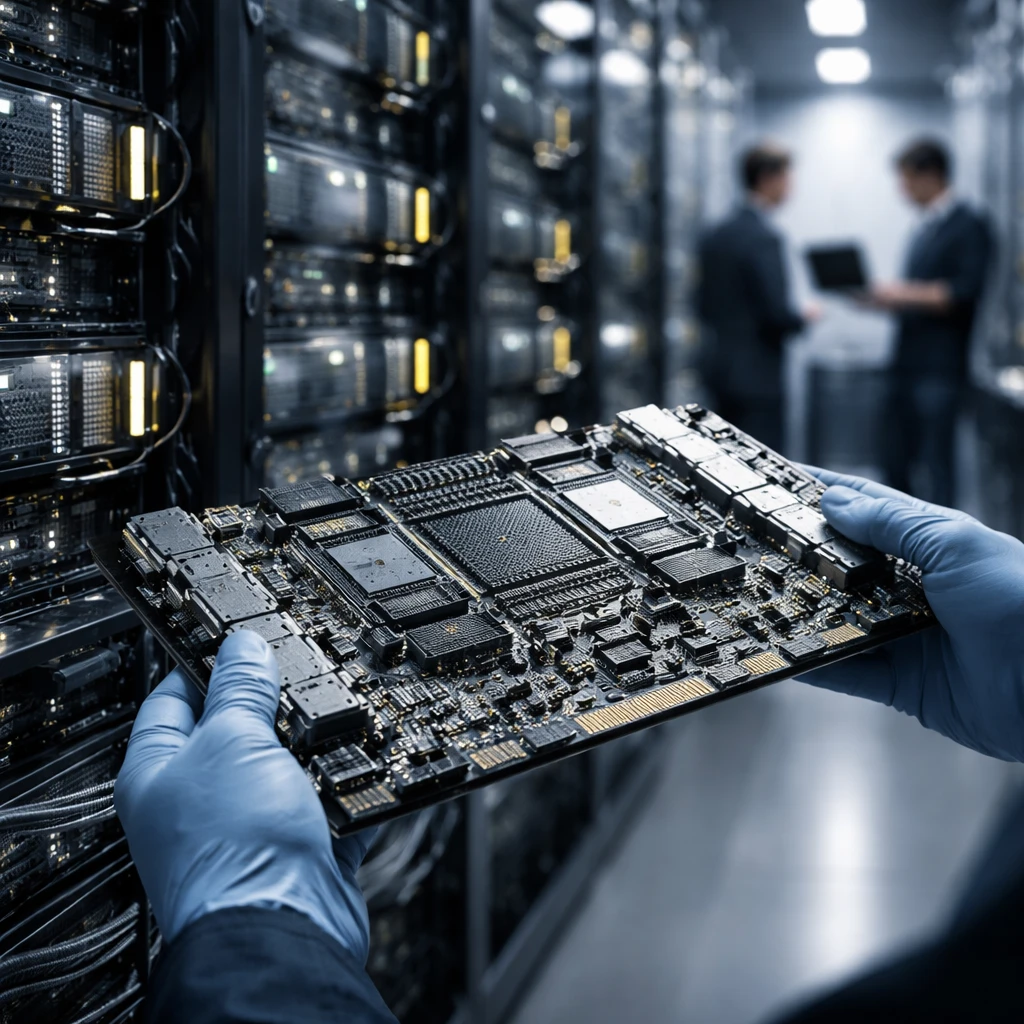
Nvidia Chief Executive Jensen Huang directly disputed a recent analysis that suggested the company's next-generation Vera Rubin AI accelerator system had been held up by manufacturing problems, saying at a Tokyo developer event that "Vera Rubin is already in production. Giant amounts of production incoming." The remarks were given on the sidelines of the event and were aimed at a report from research firm SemiAnalysis that had flagged a possible delay tied to a specialized circuit-board manufacturing challenge.
The SemiAnalysis note raised concerns about the production of a circuit board that bridges electronic modules inside an AI server rack - a packaging complexity that, the research firm argued, could slow Vera Rubin's ramp. Huang's rebuttal was blunt and concise, beginning with a one-word dismissal of the delay claim before emphasizing forthcoming production volumes.
The dispute matters to investors because any genuine interruption to Vera Rubin's roll-out would amplify competitive pressure from AMD's MI350 and MI400 roadmap, tightening the market dynamics for next-generation AI accelerators. Analysts and market participants have incorporated Nvidia's product cadence into the company's elevated valuation, so an on-the-record denial from the chief executive carries weight for shareholders assessing execution risk.
SemiAnalysis has built a reputation for detailed supply-chain scrutiny of Nvidia, which helps explain why the firm’s findings drew a direct response from Huang. The specific technical challenge cited in the delay report - manufacturing the circuit board that connects electronic modules in an AI rack - points to the sort of high-density packaging issue that has historically posed manufacturing bottlenecks for leading-edge accelerator systems.
The Tokyo venue for Huang's comments coincided with heightened public and private investment activity in Japanese AI and automation. Japan's prime minister has announced a multitrillion-dollar spending plan aimed at spurring private-sector AI investment, and SoftBank Group has disclosed a multibillion-dollar deal to acquire ABB Ltd.'s robotics business. Those developments, along with Japan's demographic pressures that encourage automation adoption, make the market strategically important for Nvidia as it broadens its hardware pitch beyond data-center chips into physical AI and robotics platforms.
Huang also spoke about Nvidia's H200 chip shipments to China, a subject that has drawn heightened investor focus since U.S. export controls were eased. The H200 received export authorization in December from the U.S. administration, and while that clearance has opened the door to sales, Huang said the company "hasn't really started much shipment yet," indicating that volumes so far are limited. A U.S. official overseeing export controls confirmed that a small number of H200 units have reached Chinese customers, signaling that logistics and licensing channels are operational even if large-scale shipments have not yet materialized.
Taken together, Huang's confirmation that Vera Rubin is in production and his characterization of the H200 China ramp as only beginning provide two distinct signals for investors to watch. On Vera Rubin, the lack of a detailed production schedule or explicit volume forecasts from Nvidia means the debate with SemiAnalysis is likely to continue until major cloud providers or hyperscalers confirm receipt of orders or deployment plans. Nvidia has not published formal guidance on Vera Rubin delivery windows nor disclosed customer order commitments tied to the system.
On the China front, the extent and pace of H200 shipments will be monitored closely as a potential revenue driver. China previously accounted for a meaningful share of Nvidia's data-center revenue prior to the imposition of export restrictions, so even a partial resumption of demand could influence near-term results. Key questions for investors include how quickly Nvidia can scale H200 deliveries to Chinese customers and whether any licensing conditions will limit volume growth ahead of the company's next earnings report.
For now, Huang's unequivocal language in Tokyo represents the clearest executive-level signal that Nvidia views Vera Rubin's timeline as intact. That public stance sets up a credibility test between the company and one of the semiconductor sector's most followed independent research outfits, with resolution likely to come only when customers or hyperscale partners put shipments on the record.
Summary
At a developer event in Tokyo, Nvidia CEO Jensen Huang rejected a report claiming Vera Rubin production had been delayed, stating the system is already in production and that large volumes are forthcoming. The rebuttal counters a SemiAnalysis claim that a difficult-to-manufacture circuit board - one that bridges electronic modules within an AI rack - was causing the slowdown. Huang also said shipments of the H200 chip to China have only just begun despite regulatory clearance in December, with only a small number of units reported as having reached customers so far.
Key points
- Huang publicly denied reports of a Vera Rubin production delay, asserting the system is already being manufactured in substantial quantities - impact on semiconductor and data-center markets.
- SemiAnalysis had cited a specific packaging and circuit-board manufacturing issue as the source of potential delay - this points to manufacturing and supply-chain pressures within high-performance computing hardware.
- H200 shipments to China have been authorized for export and a small number have been delivered, but Nvidia says broad shipments "haven't really started much" - relevant to data-center revenue and cloud demand restoration.
Risks and uncertainties
- Verification gap - Nvidia has not published detailed Vera Rubin delivery timelines or disclosed customer commitments, leaving room for continued debate between the company and independent supply-chain analysts - affects investor confidence in semiconductor and cloud infrastructure sectors.
- Manufacturing complexity - the reported circuit-board packaging challenge, if real, could present production bottlenecks even as Nvidia denies a delay - relevant to hardware manufacturers and supply-chain partners.
- H200 scale-up uncertainty - although export clearance exists, the pace at which Nvidia can scale shipments to Chinese buyers remains unclear and could influence near-term revenue recognition for data-center products.
Tags: Nvidia, AI, semiconductors, data-center, robotics