
Rivian Automotive delivered quarterly revenue that beat consensus and updated several of its full-year targets as its lower-priced R2 SUV began customer deliveries and its software business continued to expand beyond the company’s premium models.
Revenue for the quarter rose 27% to $1.66 billion, topping analysts' average estimate of about $1.51 billion. The company reported an adjusted loss per share of $0.46, narrower than the $0.63 loss per share analysts had expected.
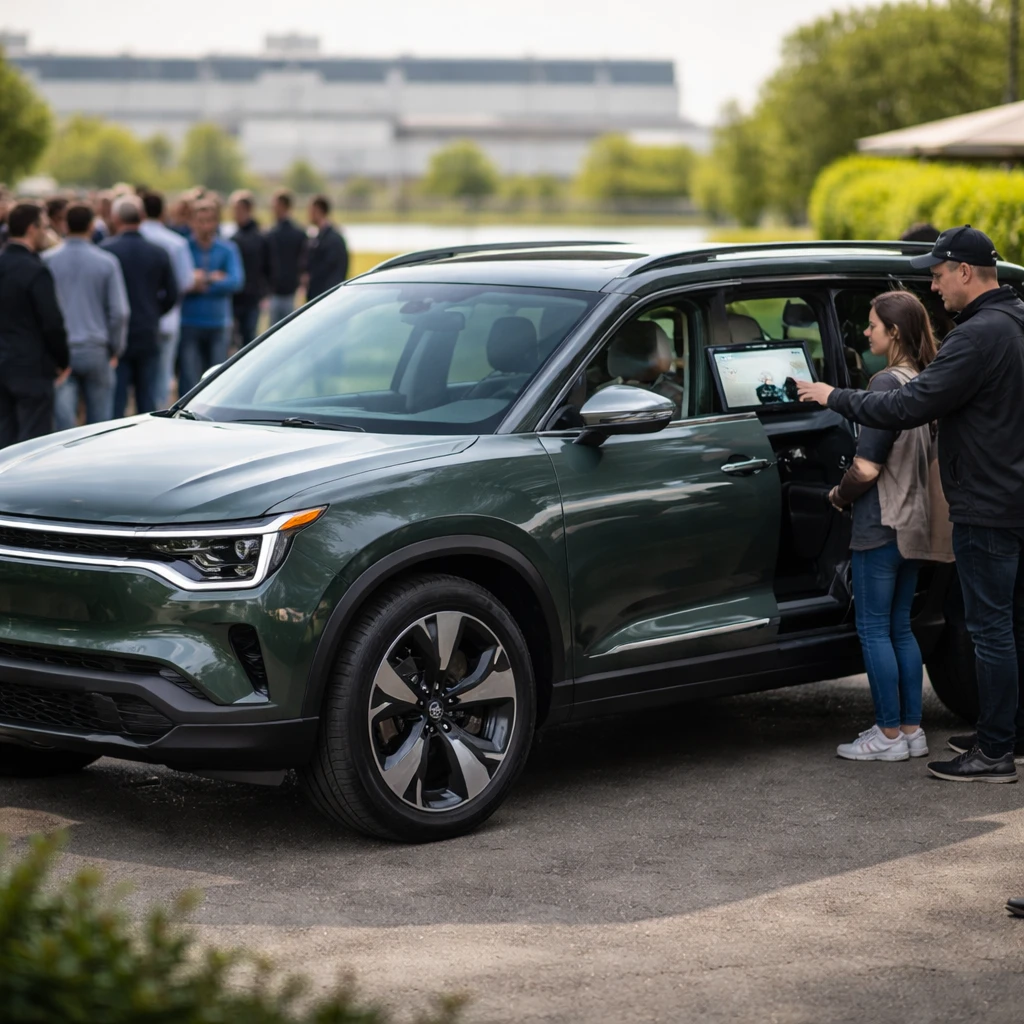
Rivian signaled confidence in demand for the R2, the model positioned to compete with mass-market competitors. It said it hosted a record number of R2 demo drives during the quarter, a metric the company highlighted as evidence of strong customer interest. Management noted that the conversion rate from reservations to orders for the Launch Edition has materially exceeded internal projections.
"We’ve been very positively encouraged by the conversion rate of reservations to orders for the Launch Edition. It is meaningfully above our own internal projections," said CEO RJ Scaringe.
The company expects the R2 to begin contributing positive gross margin in the second half of the year, according to management. That margin inflection is part of Rivian’s broader plan as it shifts into a lower-priced segment while navigating a softer U.S. electric vehicle market.
On the operational front, Rivian raised its full-year delivery forecast to 65,000-70,000 vehicles, up from an earlier range of 62,000-67,000. It also reduced its planned capital spending to a new range of $1.7 billion to $1.8 billion, down from a prior projection of $1.95 billion to $2.05 billion, and indicated it expects a smaller adjusted core loss for the year.
Software and services revenue grew 37% to $515 million during the quarter. Of that total, $308 million was generated through Rivian’s joint venture with Volkswagen, reflecting a growing contribution from software and services beyond vehicle sales.
To support near-term funding needs related to equity contributions tied to a U.S. Department of Energy loan for construction of its Georgia factory, Rivian completed a $1.5 billion share sale earlier in the month.
The results and guidance changes reflect a company in the midst of a strategic transition: expanding its addressable market with the R2 while boosting recurring revenue through software and services. At the same time, Rivian faces an EV market that management described as softer following the expiration of a federal consumer tax credit in September of last year.