
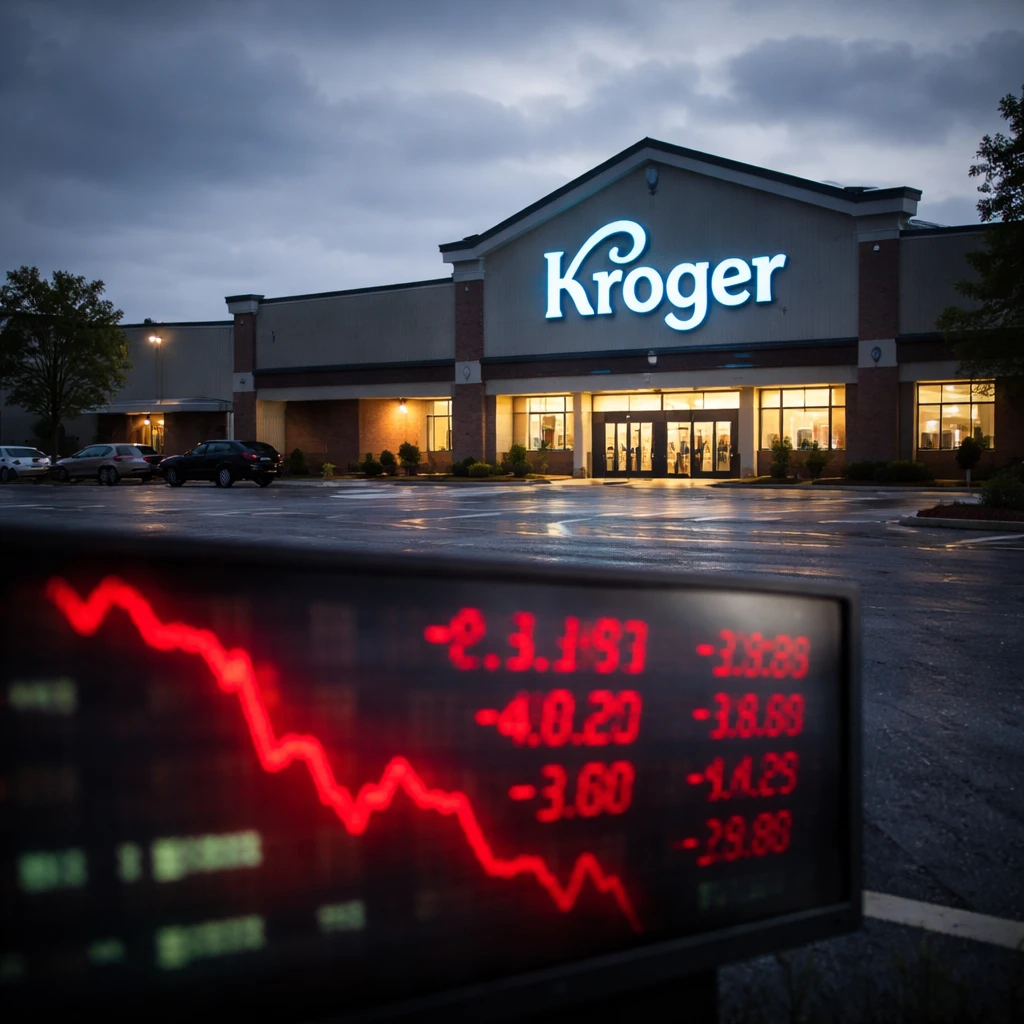
Kroger Co. shares dropped 2.9% in pre-open trading after the grocer announced a definitive agreement to acquire Giant Eagle for a total of $1.65 billion. The consideration includes $1.25 billion in cash and the takeover of about $400 million in outstanding liabilities. The companies expect the transaction to be completed in 2027.
The disclosure of the bolt-on acquisition immediately pressured Kroger's stock, with investors raising questions about both the timing and the price of the deal given the company’s already subdued valuation.
Giant Eagle operates 197 supermarkets and 11 standalone pharmacies across northern Ohio, western Pennsylvania, West Virginia, Maryland, and Indiana. The chain generates roughly $9 billion in annual revenue, a sizable contribution but an acquisition with a significant price tag for a company facing recent negative sentiment from analysts.
Market skepticism toward Kroger had built in the weeks leading up to the announcement. Several Wall Street firms, including Wells Fargo, Barclays, BMO Capital, Morgan Stanley, and Guggenheim, reduced their price targets on Kroger following mixed fiscal first-quarter 2026 results. Those revisions reflected concerns about short-term execution and a slowing trend in same-store sales momentum.
The broader market did not provide cover for Kroger's shares on the day of the announcement. The S&P 500 rose 0.8%, the Dow Jones Industrial Average gained 0.3%, and the Nasdaq climbed 1.5%. Kroger's decline therefore appears to have been driven by company-specific developments rather than a weakness across equity markets.
Adding to investor focus on governance, a regulatory filing effective the same day confirmed that Ronald L. Sargent stepped down as Chairman of the Board. Sargent will, however, remain with the company in a non-executive chair role.
Taken together, the combination of a large, largely cash-and-liability-funded acquisition announced while Kroger's stock was trading near its 52-week low of $54.97, ongoing analyst skepticism, and a positive market backdrop created the conditions for a marked pre-market selloff. Kroger traded at $53.92 in the pre-market session, representing the stock’s lowest level within the current 52-week range.
What this means
- The deal enlarges Kroger's footprint by adding a regional chain with nearly $9 billion in annual revenue.
- Investors appear concerned about the premium paid and the financing mix of the transaction given the company's current valuation.
- Recent analyst downgrades and mixed quarterly results had already created a cautious backdrop prior to the acquisition announcement.