
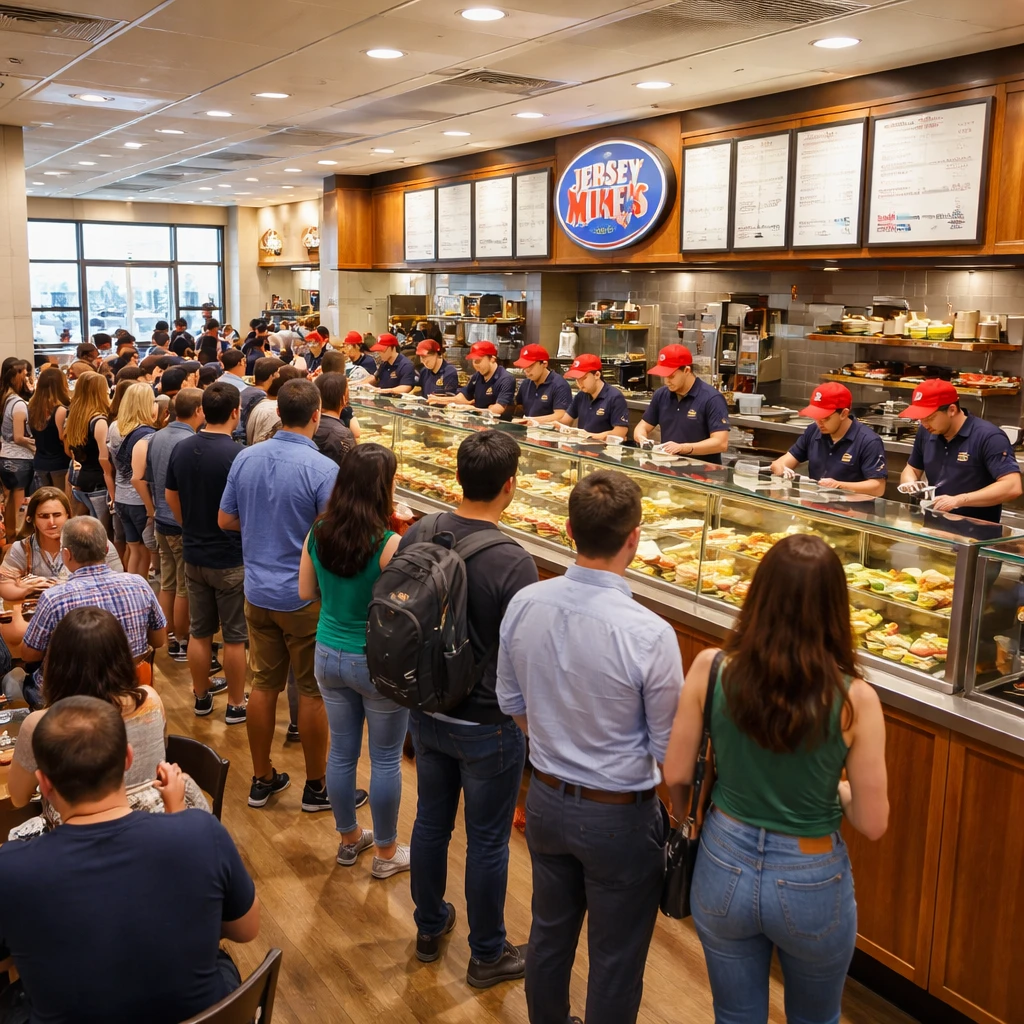
Summary: Jersey Mike’s stock began trading on the New York Stock Exchange opening 8.7% under its initial public offering price, giving the franchise a market value of roughly $6.7 billion. The company sold about 43.5 million shares at $23 apiece, raising approximately $1 billion. Its public debut arrives as retail and restaurant issuers weigh renewed investor demand amid a pickup in U.S. initial public offerings.
Jersey Mike’s opened publicly on Thursday with an initial trading price that represented an 8.7% discount to the IPO level, placing the sandwich chain’s market capitalization near $6.7 billion on its New York Stock Exchange debut. The offering, which priced at the midpoint of the company’s marketed range, involved the sale of roughly 43.5 million shares at $23 each and produced proceeds in the vicinity of $1 billion.
The Tinton Falls, New Jersey-based operator of fast-casual submarine sandwich restaurants runs more than 3,300 locations across the United States and Canada. Its public listing stands out as one of the larger restaurant initial public offerings in recent years and serves as a visible measure of investor sentiment toward retailers and food-service companies contemplating market entries after a prolonged slowdown.
Market activity this year has shown a revival in U.S. IPO issuance, with proceeds surpassing $140 billion, according to Renaissance Capital, which tracks IPOs and manages related ETFs. That momentum follows a brief pause earlier in the year when heightened geopolitical tensions involving the U.S. and Iran prompted some issuers to delay market plans, though many are now proceeding despite near-term volatility.
Investor interest in retail listings is being closely watched as a handful of other consumer-facing companies make filing moves. Inspire Brands, the owner of Dunkin', Arby’s and Jimmy John’s, reportedly made a confidential filing for a U.S. IPO earlier this year, and recent filings this month include gas station operator Cumberland Farms and apparel retailer Tailored Brands. The market for new retail and restaurant offerings will likely observe Jersey Mike’s performance for signals about appetite in the sector.
The restaurant industry is operating under pressure from higher interest rates, rising operating costs and constrained consumer budgets - headwinds that many food-service businesses must navigate. The Dow Jones U.S. Restaurants & Bars Index, which tracks major chains such as McDonald’s, Starbucks and Chipotle, has declined by more than 1% year-to-date while the broader market has advanced about 7% over the same period. High-profile recent public listings have had uneven receptions; for example, Suja Life, which listed in May, has fallen by more than half of its value since going public.
Jersey Mike’s was acquired last year by private equity firm Blackstone in a transaction valued at about $8 billion. The company has announced plans to expand internationally through a program that would open 400 outlets across the United Kingdom and Ireland in partnership with founder and former CEO Peter Cancro. Cancro purchased Mike’s Subs in Point Pleasant, New Jersey, in 1975 at age 17 and began franchising the concept in 1987; the brand later rebranded as Jersey Mike’s and expanded into one of the largest sandwich chains in the United States.
Key points
- Jersey Mike’s IPO priced at $23 per share, selling about 43.5 million shares and raising roughly $1 billion.
- The stock opened 8.7% below the IPO price, valuing the company at about $6.7 billion on its NYSE debut.
- Listing will be observed as a test of investor appetite for retail and restaurant IPOs amid a broader U.S. IPO rebound that has generated over $140 billion in proceeds this year.
Risks and uncertainties
- Elevated interest rates and higher operating costs could pressure restaurant profitability and expansion plans, affecting companies in the food-service sector.
- Stretched consumer budgets may constrain demand for discretionary retail and restaurant spending, impacting comparable company performance.
- Recent volatility in public listings and uneven post-IPO performance could dampen investor confidence for future retail and restaurant offerings.