
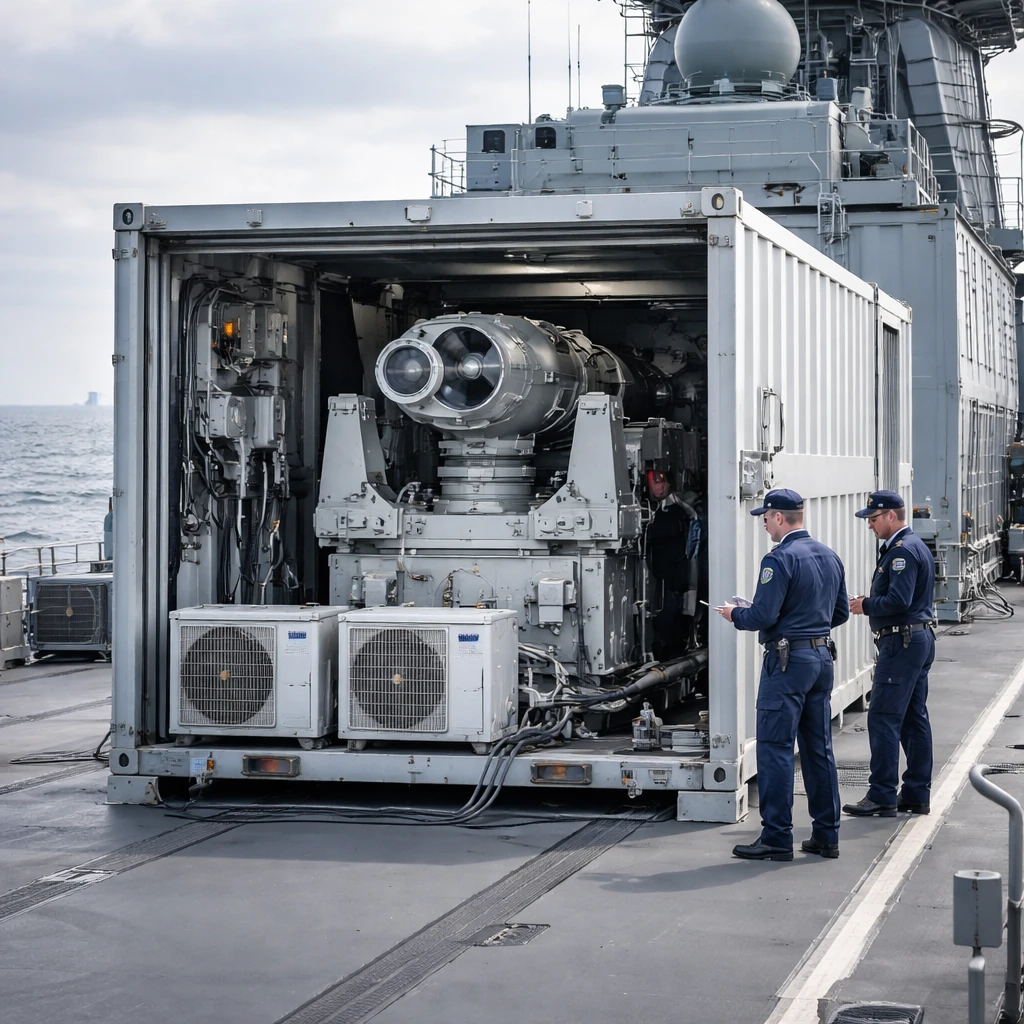
German lawmakers are preparing to approve a contract that would provide Rheinmetall AG up to €462 million to deliver a shipboard laser weapon system, according to a confidential procurement document reviewed by Bloomberg. The system, produced jointly by Rheinmetall and MBDA Deutschland, is intended to defeat small, agile threats such as drones at short and medium ranges on frigate-sized vessels.
The expected approval for the laser is included within a broader slate of more than a dozen military procurement measures that together exceed €12 billion in value. Members of Chancellor Friedrich Merz's ruling coalition indicated they would attach conditions to the defense ministry's proposal for the laser, but they declined to outline what those conditions would be.
Under the plan, the first laser unit is slated to be available in 2029. The procurement document lists NKT Photonics Technology GmbH and Trumpf SE as additional subcontractors on the program. The weapon, described in the document as shipping container-sized, had originally been intended for the F126 frigate program before that project was cancelled.
The federal government cancelled the F126 frigates last month. Rheinmetall had been pursuing the opportunity to assume the role of main contractor on the F126 program from Dutch shipbuilder Damen Shipyards Group NV prior to the cancellation.
Separately, lawmakers are advancing approval of an approximately €12 billion order for up to eight MEKO A-200 frigates from TKMS AG & Co. KGaA. That purchase, one of the navy's largest procurement decisions of the year, would acquire smaller submarine-hunting frigates. Some legislators involved in the deliberations have expressed doubts that the German Navy will possess vessels large enough to accommodate the container-sized laser weapon.
Context and program details
- The laser is a joint development between Rheinmetall and MBDA Deutschland designed for short- and medium-range defense against small, agile targets such as drones.
- Delivery timing in the procurement paperwork lists the first system as available in 2029, with NKT Photonics Technology GmbH and Trumpf SE identified as subcontractors.
- The system's form factor is described as roughly the size of a shipping container and was initially intended for the now-cancelled F126 frigate program.
Stakeholders
- Rheinmetall AG and MBDA Deutschland - prime developers of the laser system.
- NKT Photonics Technology GmbH and Trumpf SE - named subcontractors on the contract.
- TKMS AG & Co. KGaA and Damen Shipyards Group NV - referenced in relation to naval ship procurements and prior contractor discussions.