
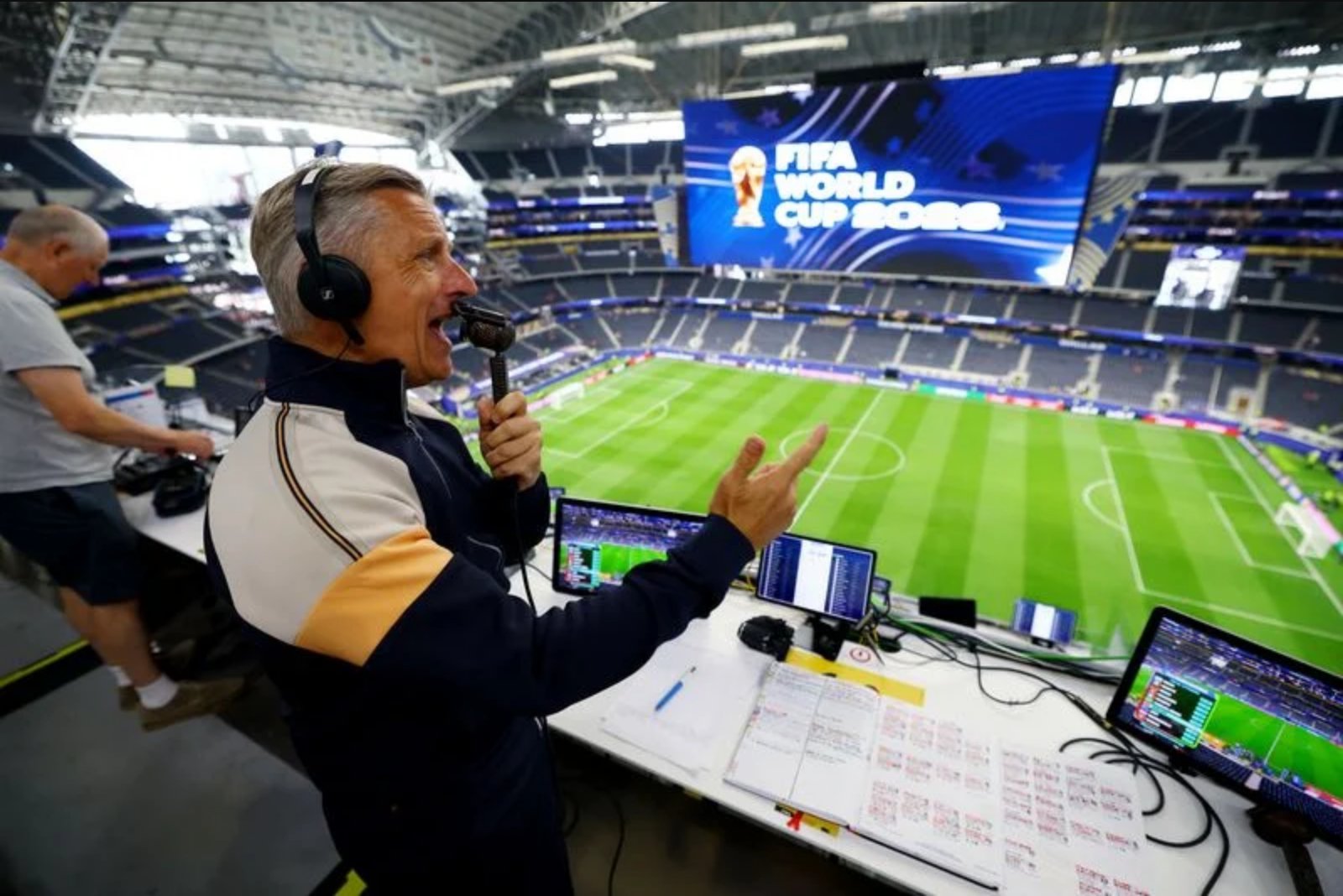
The enlarged World Cup schedule - 104 matches staged across 39 days and three host countries - has not only taxed the players but also placed intense demands on broadcasters and the teams that produce live coverage. Networks around the globe are operating at a scale few events demand, with more than 100 different broadcasters transmitting to 223 territories and FIFA projecting over six billion media engagements, roughly one billion more than the previous tournament.
Delivering coherent, cross-platform coverage of a 48-team tournament requires a large, coordinated effort. Commentators have emerged as a highly visible example of the strain. Many are moving constantly among the 16 host cities, preparing hours of pre-match research to tell each team and player story to audiences counted in the millions.
BBC commentator Steve Bower described the workload after covering his ninth game so far, a run that has taken him to six cities in two countries. "This tournament is crazy," he said. Bower framed the tournament's scale as a professional stress test, noting that the sheer number of teams, the heavy cadence of matches and the travel required have challenged broadcasters in ways he has not experienced in his three decades in the profession.
Those challenges are practical and specific. Some commentary positions are located high in large NFL stadiums, making visual identification of players harder. Uniform choices, such as several players wearing the same fluorescent pink boots, can complicate quick recognition. Simultaneous matches and rapidly changing group-stage calculations add pressure, particularly under the new format that allows the best third-place finishers to qualify for later rounds.
Behind composed on-air delivery are moments of pressure and nerves. Bower said experience helps handle tight moments, but the obligation to keep viewers oriented rests with the commentators. "The adrenaline gets you through the broadcast, but there is always a degree of nervous energy," he said.
Host-nation broadcasters have had to expand operational capacity to maintain continuous, high-quality coverage. The tournament spans four time zones, incorporates an additional 16 teams compared with past editions and adds 40 more matches to the schedule. Such expansion has required broadcasters to boost personnel and infrastructure on an unprecedented level.
U.S. Spanish-language broadcaster Telemundo is an example of that scale. It is operating World Cup studios in Mexico City, Miami and New York, deploying 80 on-air staff, roughly 1,400 production employees, plus reporters and dozens of cameras across the 16 host cities.
In Canada, Bell Media, which runs TSN, began preparing in 2023. Its on-site footprint includes sets in Vancouver, Toronto and Montreal, a team positioned at FIFA's broadcast mission control in Dallas and multiple production crews designed to sustain a 39-day coverage schedule. Shawn Redmond, a Bell Media vice president of sports, described the event as likely the largest media undertaking Canada has hosted. "It is a tremendously logistics-heavy operation," he said. "There is a responsibility and an obligation that we take seriously to get it right and do right by Canada."
In the United States, Fox Sports reported record viewership, averaging five million American viewers per group-stage match, a 92 percent increase from the Qatar tournament. To support comprehensive coverage across 104 games, Fox has deployed 12 former top players as studio analysts and nine commentary pairings.
Among Fox's on-air talent are Darren Fletcher and Owen Hargreaves. The pair operate from a Dallas base while flying to several host cities, including Toronto, Guadalajara, New York, Houston and Atlanta. Fletcher, who also contributes to Britain's TNT Sports, described preparation as essential. He reviews replays of his broadcasts to refine his commentary and compiles detailed pre-match notes, including phonetic spellings of player names that he prints and laminates to avoid mispronunciation. He recounted an incident in which a drink ruined prior notes, prompting his current more resilient approach.
Fletcher emphasized adaptation to different audience expectations and the need to map all plausible in-game eventualities. "You have to be across it. There is nothing genius about it," he said, acknowledging the heavy lift required to anticipate evolving match contexts.
For many commentators, the workload comes with an upside. Bower called his role a privileged vantage point and "the best job in the world." Fletcher echoed that sentiment, noting the advantage of close-up access to major moments and reflecting on the way broadcasters enter viewers' living rooms. He observed too that soaring ticket prices have excluded many fans from stadium attendance, intensifying the public's reliance on broadcasters to bring the experience to remote audiences. "We have the best seats in the house," he said. "We are privileged and it is such a buzz."
Financial and market details woven into coverage reflect the event's commercial magnitude. A graphic accompanying coverage referenced BCE Inc and Fox A with intraday moves shown as BCE at minus 3.45 percent and FOXA at plus 3.87 percent. Those notations sit alongside discussion of broadcasters' large operational footprints, sizeable on-air teams and extensive production supply chains.
Overall, the expanded World Cup has forced broadcasters to scale people, production and logistics in real time while managing the editorial challenge of keeping viewers informed across an unprecedented match calendar. The result is a demonstration of how a major sporting event pushes live media operations into new levels of complexity and reach.