
Stock Markets April 29, 2026 04:22 PM

Boeing's ViaSat-3 F3 Reaches Space, Heads for Geostationary Orbit

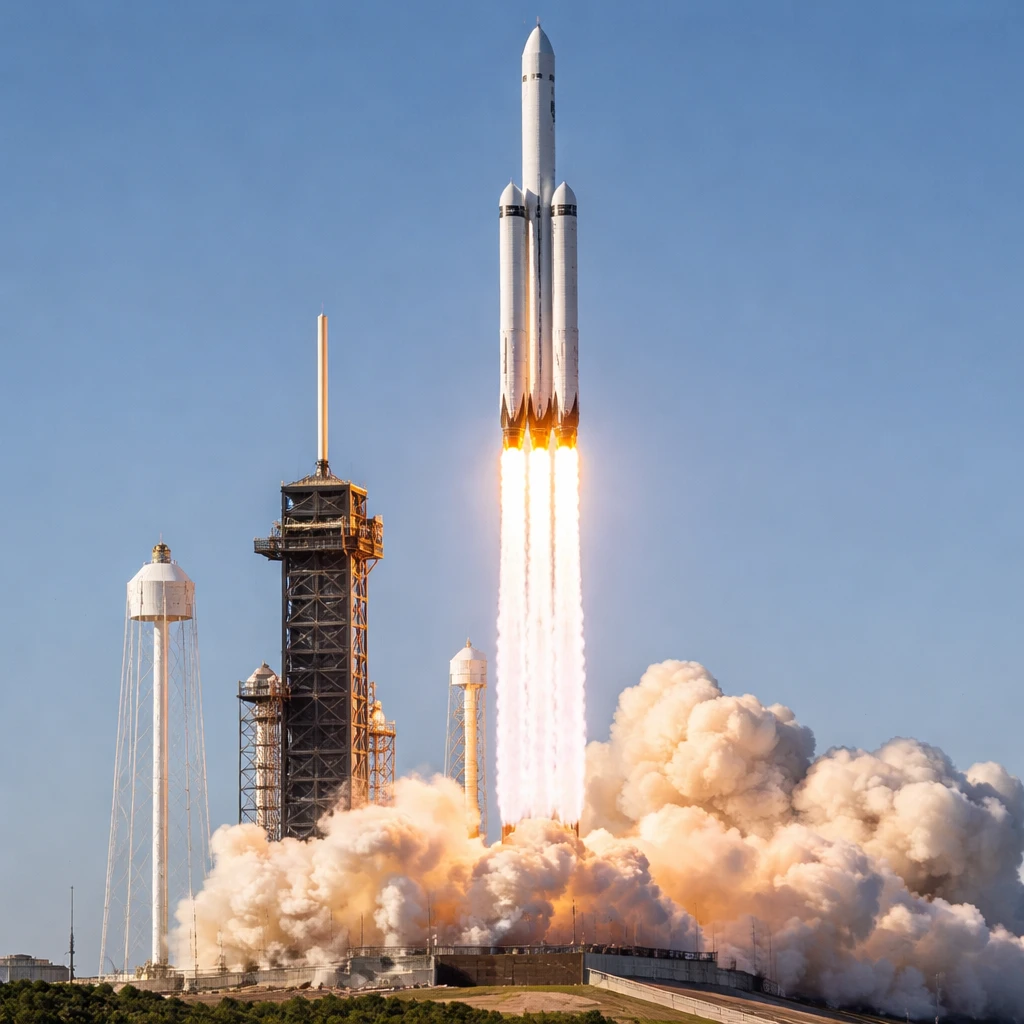
Falcon Heavy deploys Boeing-built spacecraft bound for Asia-Pacific broadband coverage

By Leila Farooq
Share
Twitter Reddit Facebook LinkedIn
BA VSAT

Boeing's ViaSat-3 F3 satellite launched from Kennedy Space Center aboard a SpaceX Falcon Heavy rocket and is operating normally as it travels to geostationary orbit. The spacecraft separated from the rocket about five hours after liftoff and has been acquired by Boeing’s Mission Control in El Segundo, which began initialization steps ahead of orbit raising and handover to Viasat after on-orbit testing.

Boeing's ViaSat-3 F3 Reaches Space, Heads for Geostationary Orbit
BA VSAT
Summarize with
ChatGPT Perplexity Claude Grok Gemini

Key Points

  • ViaSat-3 F3 launched from Kennedy Space Center aboard a SpaceX Falcon Heavy at 10:13 a.m. ET and is en route to geostationary orbit approximately 22,000 miles above Earth.
  • The satellite separated from the rocket about five hours after launch and was acquired by Boeing’s Mission Control in El Segundo, which began initialization and commanded operations.
  • Built on Boeing’s 702MP+ platform with electric propulsion and Spectrolab solar arrays, ViaSat-3 F3 is intended to provide broadband to commercial mobility, fixed services and defense customers across the Asia-Pacific region.

Boeing’s ViaSat-3 F3 satellite lifted off Wednesday from NASA’s Kennedy Space Center in Florida atop a SpaceX Falcon Heavy vehicle at 10:13 a.m. ET and is reported to be functioning normally as it makes its way toward geostationary orbit, roughly 22,000 miles above the Earth’s surface.

Mission teams confirmed the spacecraft detached from the rocket approximately five hours after launch. Following separation, Boeing’s Mission Control in El Segundo, California acquired the satellite’s signal and established command capability. Controllers then began initial spacecraft activation and configuration tasks.

The ViaSat-3 F3 is the third satellite to fly for the ViaSat-3 program and is configured to supply broadband services across the Asia-Pacific region. Its capabilities are intended to serve commercial mobility customers, fixed service subscribers and defense users. The satellite is built on Boeing’s 702MP+ platform.

Ryan Reid, president of Boeing Satellite Systems International, characterized the project as a significant step in Boeing’s relationship with Viasat, saying: "The launch of Viasat-3 F3 marks a major milestone in our partnership with Viasat. By combining Boeing’s best-in-class satellite platform with Viasat’s innovative payload, we’re delivering the highest capacity communication satellites ever launched."

The 702MP+ bus incorporates upgraded structural, power, thermal and attitude control systems designed to support demanding payloads. The satellite will use electric propulsion to reach geostationary orbit, a choice noted for its greater fuel efficiency compared with conventional chemical propulsion.

Before initiating orbit raising maneuvers, Boeing controllers will deploy solar arrays produced by Spectrolab, a Boeing subsidiary, and a radiator panel. Once the spacecraft arrives in its geostationary slot and completes the scheduled on-orbit testing sequence, Boeing plans to transfer operational control of the satellite to Viasat for entry into service.


Next steps: completion of solar array and radiator deployment, orbit raising via electric propulsion, on-orbit testing, and transfer to the service operator.

Risks

  • On-orbit testing and subsequent commissioning are still required before the satellite is transferred to Viasat for service entry - until those steps are completed the satellite is not yet in operational service. (Impacted sectors: satellite operators, broadband services, defense communications)
  • Deployment and successful operation of key hardware - including solar arrays and radiator panel deployment - must proceed as planned to enable orbit raising via electric propulsion. (Impacted sectors: aerospace manufacturing, satellite services)

More from Stock Markets

Qantas’ 20-hour gamble: engineering comfort with light, meals and cabin design Jun 18, 2026 U.S. Officials Question Whether ASML’s Top EUV System Has Reached China Jun 18, 2026 Hyundai to Acquire Remainder of Boston Dynamics From SoftBank for $325 Million Jun 18, 2026 U.S. Futures Pull Back After Stocks Rally on Iran Deal and Chip Strength Jun 18, 2026 Hyundai to Acquire SoftBank’s Remaining Boston Dynamics Shares for $325 Million, Report Says Jun 18, 2026