
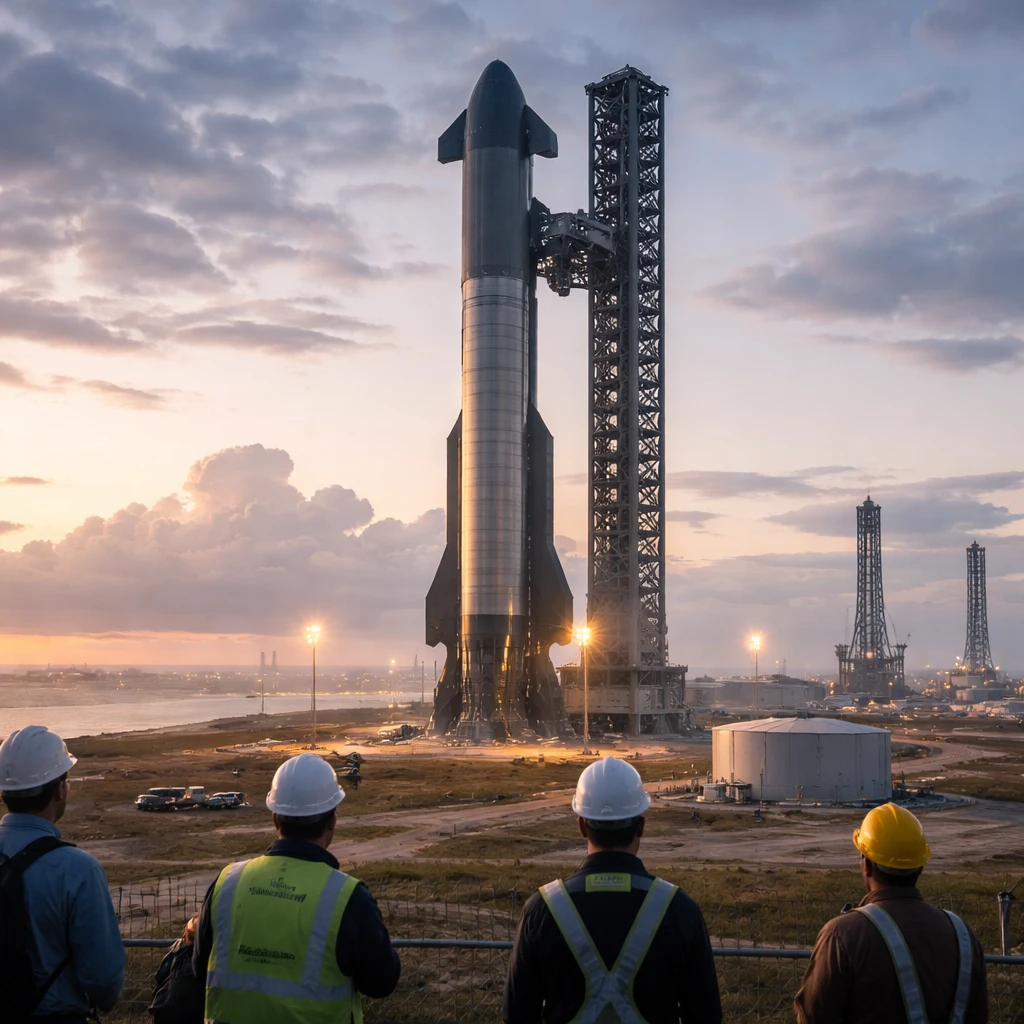
Bernstein’s entry into coverage of Space Exploration Technologies Corp (SPCX) frames the investment case around a quartet of execution risks and infrastructure challenges that must be resolved for the firm’s projection to hold. The investment bank began coverage with an Outperform rating and a $239 price target, and in a preview of SpaceX’s first quarterly earnings on August 4 the analysts said management’s stated conviction on growth matters more than the near-term results.
Four areas of focus
The analysts distilled their view into four core topics they view as essential for the company to achieve the scale embedded in Bernstein’s model: rapid full reuse of the Starship vehicle, securing substantial semiconductor capacity, navigating regulatory clearances at scale, and delivering massively increased compute in orbit.
1. Starship rocket reuse
Bernstein frames the economics of SpaceX’s long-term plan around Starship reusability. Their model assumes roughly 3,600 launches in 2031, a cadence that the analysts say is feasible only if both stages of the vehicle are fully reusable. Current operational milestones fall short of that requirement: the firm notes SpaceX has landed Starship V2 boosters on the launchpad but has not yet landed V3 boosters.
The preview references Launch 13 on July 20, when some engines failed to light. Even so, Bernstein’s base case assumes booster landings with subsequent reuse will ultimately be achieved. Reaching the 3,600-launch target implies a very high flight frequency - effectively at least daily launches - and launch frequency will be linked to pad count. Today there are two launchpads; SpaceX plans to add two more and is negotiating with state governments about sites for an additional five or six pads.
2. Semiconductor capacity needs
A potential constraint highlighted by investors is semiconductor capacity. Bernstein models approximately 20 GW of incremental orbital capacity to be deployed in 2031. Translating that into hardware, the analysts estimate close to 170,000 satellites would be required if each satellite consumes roughly 120 kW, which in turn would need about 2.8 million wafers of annual production capacity.
That translates to approximately 50,000 wafer starts per month - the equivalent of about five dedicated semiconductor fabs solely producing for SpaceX - a buildout Bernstein believes would cost in excess of $160 billion and take several years to execute.
3. Regulatory considerations
Regulatory approval is another central factor. As of the preview, SpaceX has not been cleared for orbital Starship flight. Bernstein notes environmental and safety considerations are material, even as the Federal Aviation Administration has indicated it will relax some restrictions to enable a higher cadence of launches. Those regulatory shifts should help increase the number of Starship flights, the analysts say, but they also caution that scaling to thousands of launches could encounter headwinds - particularly if a less supportive administration were to take power.
In addition, telecommunications-related regulatory regimes differ by country, meaning global deployment of satellite services will face a mosaic of national rules rather than a single, uniform path.
4. Compute volume required
A fourth pillar in Bernstein’s framework is compute capacity in orbit. Elon Musk has suggested a long-term aspiration of launching 1 terawatt of compute into space annually, but Bernstein observes current plans are modest compared with that scale. The analysts argue that the orbital data center program’s viability depends on achieving a very large volume of compute power; there is no historical precedent for a market with a sustained surplus of compute capacity delivered in this form.
Bernstein also flags a timing risk: the rush to add capacity to power AI models may be rapid, and that pace could outstrip the ability to deploy orbital compute efficiently. The analysts note there could be merit in finding lower-cost ways to obtain the compute capacity needed.
What Bernstein says about near-term reporting
In sum, Bernstein’s preview argues the upcoming quarterly report will be most valuable as a signal of management’s confidence in delivering on these four technical and regulatory milestones, rather than for its immediate financial content. The firm’s valuation assumptions rely on large-scale reuse, extensive semiconductor supply, regulatory pathways that permit thousands of launches, and very high volumes of orbital compute.
Summary
Bernstein, after initiating coverage of SPCX with an Outperform rating and a $239 price target, set out four critical topics that will determine whether SpaceX can realize the scale assumed in its model: Starship reuse, semiconductor capacity, regulatory approvals at scale, and sufficient orbital compute. Management tone on the company’s growth trajectory will likely matter more in the near term than the raw quarterly numbers.
Key points
- Bernstein’s model assumes about 3,600 launches in 2031, requiring full two-stage Starship reuse and effectively at least daily launches - linked to a growing number of launchpads.
- Deploying ~20 GW of orbital capacity in 2031 implies close to 170,000 satellites and roughly 2.8 million wafers of annual production capacity, equating to about five dedicated fabs and over $160 billion in cost and several years of build-out.
- Regulatory clearances and the availability of very large volumes of compute in orbit are material constraints that will influence the feasibility of Bernstein’s valuation case.
Risks and uncertainties
- Execution risk on Starship reuse - achieving reliable booster landings and reuse at the frequency implied by Bernstein’s model remains unproven and will directly affect launch economics and cadence. (Aerospace sector)
- Semiconductor supply limitations - the significant wafer capacity and fab investment required pose a large capital and time constraint that could delay satellite deployment and service scale-up. (Semiconductor and satellite hardware sectors)
- Regulatory and geopolitical risk - scaling to thousands of launches depends on approvals that vary by jurisdiction and could slow dramatically under less supportive regulatory environments. (Aerospace and telecommunications sectors)