
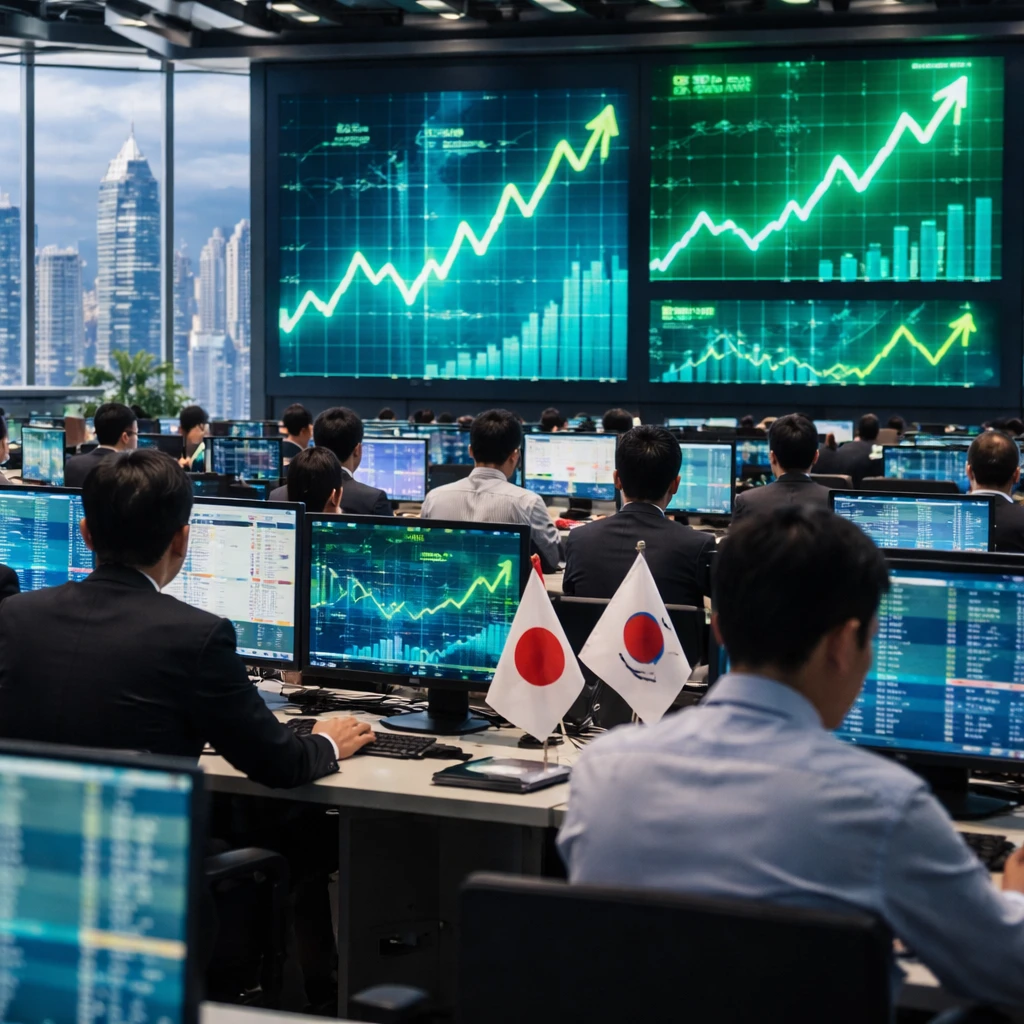
Most Asian equity markets moved higher on Thursday, buoyed by reports that the United States and Iran had signed a preliminary memorandum of understanding aimed at ending an almost four-month war. The news lifted risk sentiment across the region, though pockets of weakness remained, most notably in Hong Kong.
S&P 500 futures climbed nearly 0.9% in Asian trade after reports said U.S. President Donald Trump and his Iranian counterpart had remotely signed the framework agreement. The preliminary deal would halt hostilities in the Middle East and reopen the Strait of Hormuz, though Trump warned that the U.S. could resume attacks if Iran failed to comply. The two sides are set to enter 60 days of negotiations to pursue a more detailed accord, with Iran's nuclear program flagged as a central topic for further talks.
Market leaders: Japan and South Korea
Japan's benchmarks led gains across the region. The Nikkei 225 surged nearly 2% to a record 71,477.0 points, while the broader TOPIX also rose about 2% to a fresh high. South Korea's KOSPI advanced nearly 1% to reach a record 8,976.55 points. Market participants attributed the outperformance largely to strength in chipmakers and stocks linked to artificial intelligence, as investors priced in continued demand from AI-driven applications.
SK Hynix Inc (KS:000660) stood out in Seoul, jumping 5% to a record after the company said it had shipped samples of an advanced memory chip to major customers. In Tokyo, chip component maker Murata Mfg Co (TYO:6981) and electronics supplier Aibiden were among the top performers on the Nikkei, and SoftBank Group Corp. (TYO:9984) climbed about 3% after a run of heavy losses in recent sessions.
Other regional moves
Not all markets were upbeat. Australia's S&P/ASX 200 declined 0.5%, while Singapore's Straits Times index inched up about 0.2%. Futures for India's Nifty 50 rose around 0.6%, with the report noting that falling oil prices had helped lift optimism about an economic recovery in India. In mainland China, the Shanghai-Shenzhen CSI 300 added roughly 0.1%, while the Shanghai Composite slipped about 0.4%.
Hong Kong lags as internet names slide
Hong Kong's Hang Seng index underperformed regional peers, dropping 1.8% to its weakest level since July 2025. Large local internet and technology firms fell broadly, with Alibaba Group (HK:9988), Tencent (HK:0700), Baidu Inc (HK:9888) and Xiaomi Corp (HK:1810) all down between about 1% and 3%.
Traders said the weakness in Hong Kong's top internet stocks reflected a rotation toward AI and hardware-exposed names across Asia, where chipmakers in Japan, South Korea and Taiwan have seen stronger buying recently. That shift, combined with concerns over Beijing's tightening of rules on mainland investments in Hong Kong, suggested a reduction in capital flows from wealthy mainland investors. Companies with significant wealth management and brokerage exposure were particularly impacted, with insurers and brokerages such as AIA and Prudential registering steep losses through June.
Despite the broader weakness in Hong Kong tech, some AI-focused names bucked the trend. Knowledge Atlas Tech Joint Stock, trading as Zhipu (HK:2513), jumped roughly 15%, while MiniMax Group Inc (HK:0100) rallied about 9.6%.
Outlook and positioning
Regional markets largely brushed off a negative lead from Wall Street, where equities fell overnight after the Federal Reserve signaled that an interest rate increase could be possible later in the year. In Asia, however, the ceasefire reports and the prospect of reopened key shipping lanes helped underpin risk assets and encouraged buying in sectors tied to chips and artificial intelligence.
Investors remain attentive to the progress of the 60-day talks between Washington and Tehran and to how conditions around energy markets and central bank messaging evolve, given their potential to influence regional market momentum.