
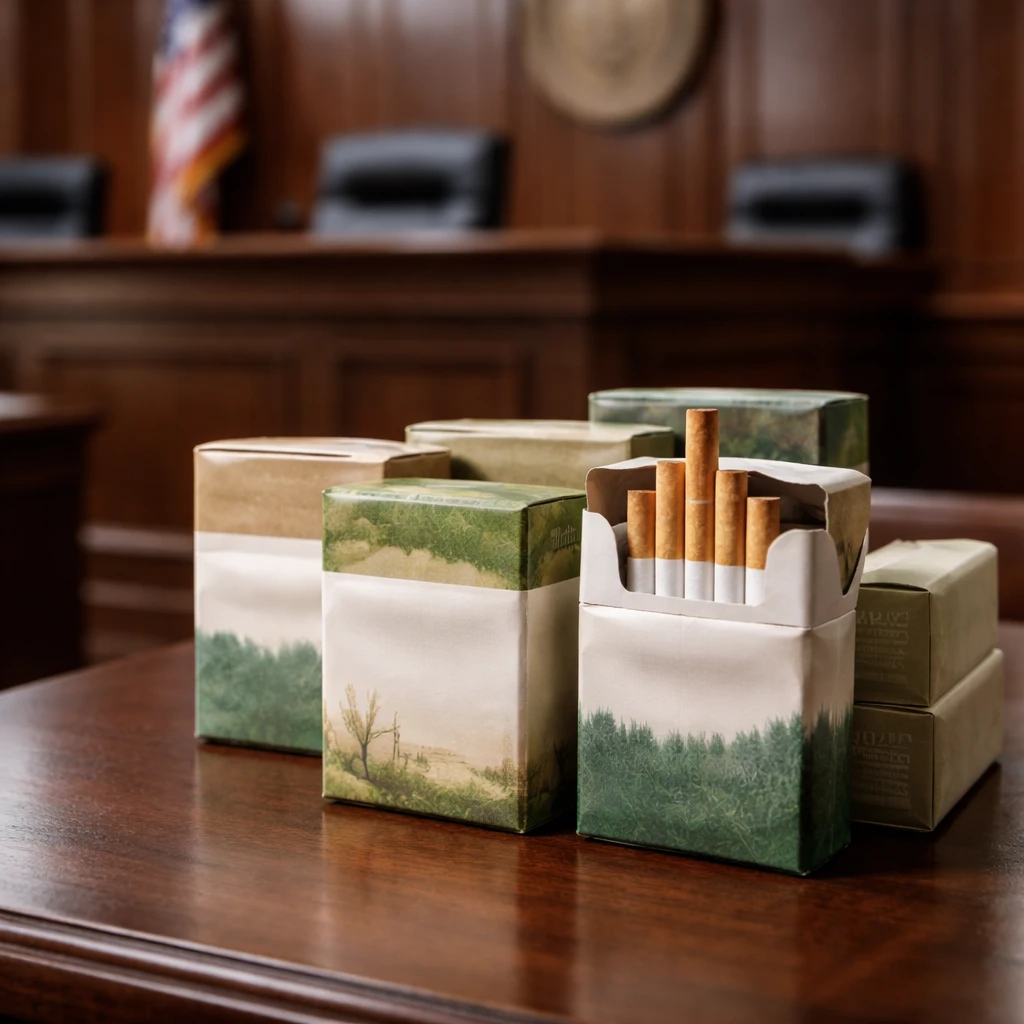
A federal appeals panel in Denver on Wednesday allowed consumers to pursue class-action litigation against British American Tobacco's U.S. operations and affiliates over labeling for Natural American Spirit cigarettes, finding the proposed classes should not have been rejected in full at the certification stage.
The 2-1 ruling by the 10th U.S. Circuit Court of Appeals lets purchasers press claims that labels using terms such as "100% Additive-Free," "Natural" and "Organic" falsely conveyed that the cigarettes were safer than other brands and contained no additives, despite a label disclaimer stating that the absence of additives "does NOT mean a safer cigarette." The court also maintained certification for separate class claims focused on menthol cigarettes, premised on the theory that menthol is an additive.
Defendants named in the decision include Reynolds American - the principal U.S. subsidiary of British American Tobacco PLC - as well as R.J. Reynolds Tobacco and Santa Fe Natural Tobacco. Company representatives declined to comment on the pending litigation, while plaintiffs' counsel did not immediately respond to requests for comment.
Scope of the litigation and plaintiffs
Consumers from 12 states brought the claims: California, Colorado, Florida, Illinois, Massachusetts, Michigan, New Jersey, New Mexico, New York, North Carolina, Ohio and Washington. The plaintiffs say they overpaid for the cigarettes because the labeling communicated a mistaken impression of relative safety and additive-free composition. Separate class claims were certified for consumers who purchased menthol cigarettes on the theory that menthol qualifies as an additive.
District court history
In an extensive 423-page ruling in 2023, U.S. District Judge James Browning in Albuquerque declined to certify a 12-state class based on the "safer cigarette" theory, concluding that individual issues would overwhelm class-wide claims. Judge Browning did, however, certify an eight-state class - covering California, Colorado, Florida, Illinois, New Jersey, New Mexico, New York and North Carolina - tied to the menthol theory, reasoning that individual inquiries would be limited and damages easier to calculate.
Appeals court reasoning
Circuit Judge Veronica Rossman, writing for the majority, concluded that Browning erred in two key respects. First, she found the district court improperly applied the Supreme Court's 2013 Comcast decision to reject the proposed damages model for the 12-state class. Second, Rossman said the district court prematurely resolved a merits question by assessing the label disclaimer's likely effectiveness rather than treating the matter as a factual dispute suitable for class certification analysis.
"Whether a reasonable consumer would have interpreted the labels to mean something other than health benefits is a factual dispute about how and whether the label was misleading," Rossman wrote. "At the certification stage, (courts) must focus on how - not whether - plaintiffs will prove their claims." The appeals court also rejected defense arguments that administratively managing the proposed classes would be infeasible.
The panel returned the case to Judge Browning for additional proceedings consistent with its rulings.
Dissent and concerns
Circuit Judge Timothy Tymkovich dissented, arguing that neither class should have been certified. He criticized the plaintiffs' damages model for the safer cigarette claims as failing to identify how much consumers overpaid specifically because they read the labels. Tymkovich warned the certification could allow so-called "uninjured" class members who never viewed the labels to recover damages.
"Courts must be vigilant in ensuring that [a federal class certification rule] is not weaponized with classes that are overinflated or only theoretically exist," Tymkovich wrote. He also urged clearer Supreme Court guidance on how administrative feasibility should be applied to class actions, warning that current uncertainty could encourage forum shopping by plaintiffs seeking favorable class-certification rulings.
Judicial appointments and panel makeup
Judge Rossman was appointed to the 10th Circuit by former President Joe Biden. Judge Tymkovich was appointed by former President George W. Bush. The other judge in the majority, David Ebel, was appointed by former President Ronald Reagan.
The appeals court decision preserves the menthol-based class certification and revives the broader "safer cigarette" certification for further litigation, leaving the parties to press their arguments on remand.