
Ford Motor drew two outright analyst upgrades in the span of a single week after reporting second-quarter results and raising full-year targets for 2026 a second time. Jefferies upgraded the stock from Hold to Buy with a $17.50 price target, up from $14.50. Citi moved from Neutral to Buy and set a $20.00 target, up from $19.00. Investors responded by bidding the shares up 5.17% to $15.73.
Both broker moves came after the earnings release and share a central argument: Q2 represented a margin trough rather than an early-stage warning sign of sustained weakness. That view hinges on several company-specific dynamics that analysts say should support profitability and cash generation through the remainder of the year.
How the Street is positioned
Beyond Jefferies and Citi, several broker-dealers maintain constructive medium-term views on Ford, while others remain cautious. Recent published price targets and ratings include:
- JPMorgan - Overweight, $17.00 target (prior $16.00)
- Piper Sandler - Overweight, $17.00 target (prior $16.00)
- RBC Capital - Sector Perform, $15.00 target (prior $13.00)
- TD Cowen - Hold, $15.00 target (prior $13.00)
- Morgan Stanley - Equalweight, $15.00 target (prior $14.00) citing a 2027 EBIT growth path
At the current share price of $15.73, Jefferies' $17.50 target implies about 11% upside; Citi’s $20.00 target implies roughly 27% upside.
Q2 results and guidance that moved markets
Ford reported second-quarter adjusted earnings per share of $0.42, beating the $0.35 expectation by 20%. Reported EBIT was approximately $2.5 billion, an increase of about 17% year-over-year on revenue of $48.3 billion, which declined roughly 4% versus the prior year.
The company raised full-year 2026 EBIT guidance to a range of $10–$11 billion, up from $8.5–$10.5 billion, marking the second guidance increase in 2026. Free cash flow guidance was also raised to $6–$7 billion.
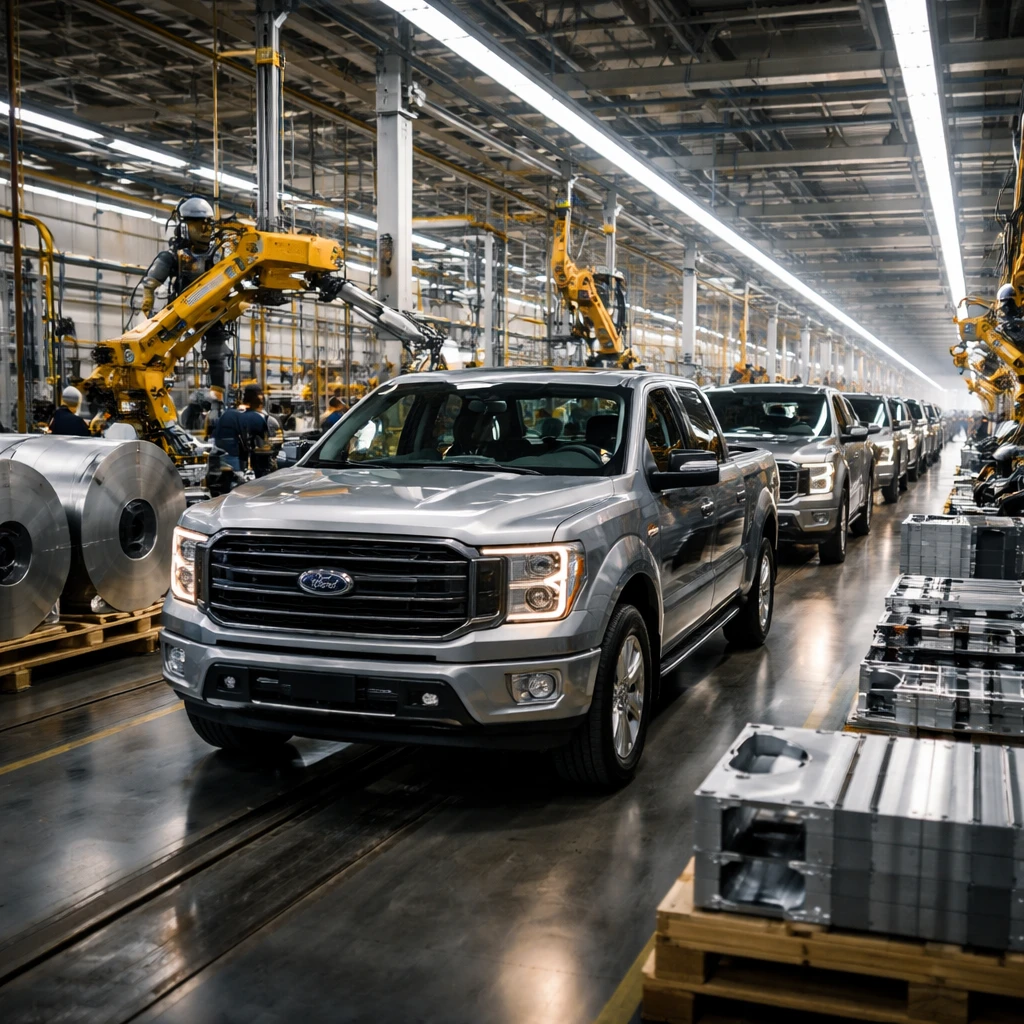
Analysts described the revenue drop as largely noise tied to an input constraint: a Novelis aluminum facility fire limited F-Series production. As that supply issue eases, Citi projects F-Series production to climb about 28% in the back half of the year.
Three analytical pillars shaping the upgrades
- Warranty expense improvement - Warranty accruals in the first half fell by roughly $1 billion year-over-year. Citi expects a full-year reduction of $1.5 billion, a material alleviation of a long-running margin headwind for the automaker.
- F-Series premium mix and production rebound - Models including the Ford Bronco, F-150 Raptor and three-row SUVs supported higher-margin pricing. Management and analysts are watching F-Series output normalization closely as a key driver of H2 profitability.
- Recurring revenue from connected services - Ford reported connected-service subscribers grew 20% year-over-year to 1.6 million in Q2, adding a recurring-revenue element that is often underweighted in traditional vehicle valuations.
Insider activity was also noted: Executive Chair William Clay Ford Jr. purchased 140,000 shares recently, a signal cited by some analysts as aligning management and shareholder incentives.
Where skepticism remains
Despite the recent upgrades, the broader market view is mixed: the consensus breakdown sits at seven Buy recommendations, 14 Hold ratings and one Sell. InvestingPro's model-derived fair value for Ford stands at $10.80, implying the stock currently trades at about a 46% premium to that intrinsic-value estimate.
Analysts warn of several risks that could blunt the upside case. These include the possibility of F-Series overstock emerging in late 2026 into 2027 that could pressure EBIT, continued losses at the Model e division (profitability is targeted by 2029 and an $8.5 billion impairment has already been recorded), intensifying competition from Chinese EV makers in global markets, and execution risk from multiple concurrent platform launches.
Snapshot
At $15.73, Ford trades about 10% below its 52-week high of $17.78. The stock's 52-week range is $10.68 to $17.78, with a one-year return of +41.79% and year-to-date performance of +19.20%. The Street consensus target range sits between $15 and $20. Citi's $20 target would push the shares into fresh all-time-high territory if realized.
The dual-upgrade narrative can be summarized succinctly: the worst appears priced in, and analysts are positioning for recovery. Whether that recovery materializes depends materially on F-Series production ramping in the second half as Novelis-related supply constraints abate, and on warranty costs remaining on their improving path.