
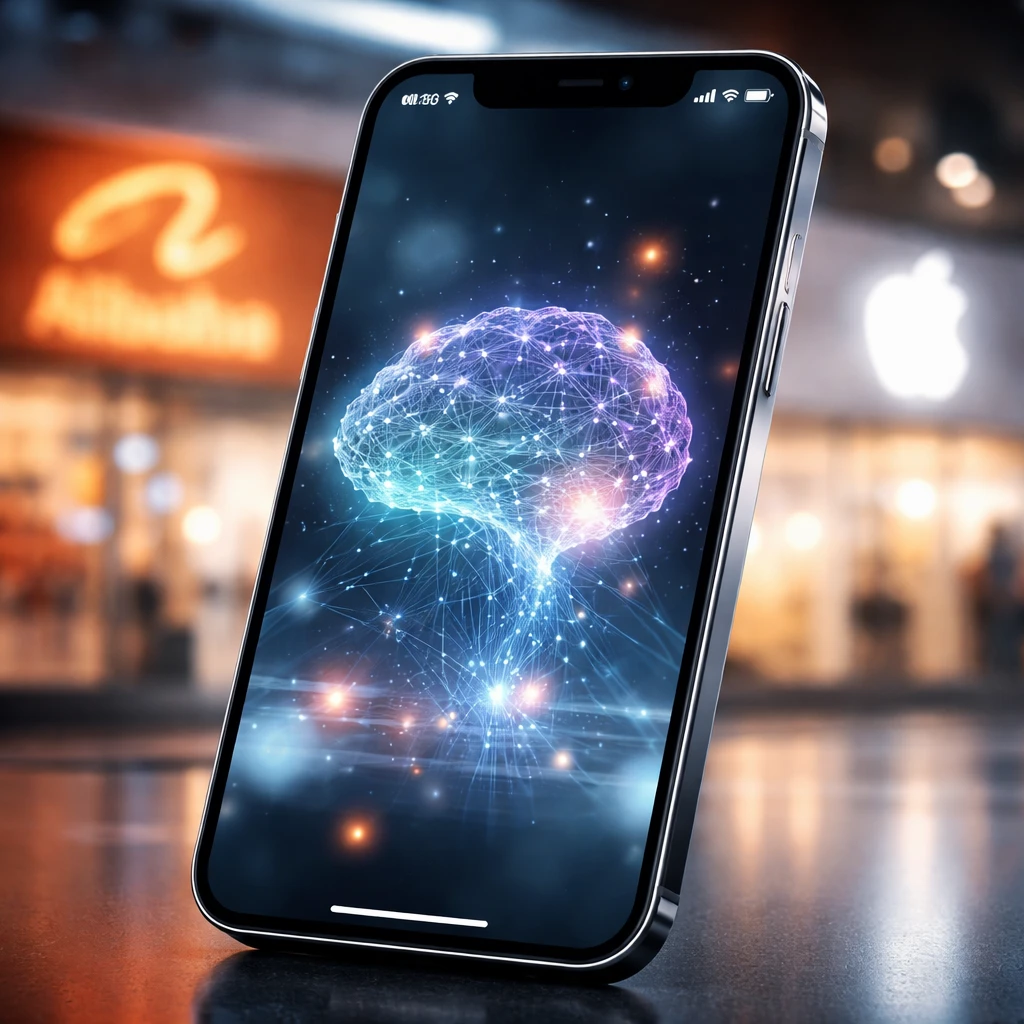
Shares of Alibaba Group in U.S. trading rose by roughly 5% in premarket activity after Chinese authorities granted approval for Apple's on-device artificial intelligence services to operate in the country. The clearance links Apple’s new AI suite with Alibaba’s Qwen model for users inside China’s smartphone market. Apple shares also ticked up, gaining close to 1% in pre-open trade.
The Cyberspace Administration of China on Wednesday placed Apple’s generative AI services on a list of newly approved providers. The regulator’s decision puts Apple alongside domestic firms such as Huawei Technologies and Xiaomi Corp as an authorized provider in China.
An Alibaba spokesperson said Qwen AI will be made available to users on iOS, iPadOS and macOS in China, enabling capabilities for text recognition and generation as well as image recognition and generation.
Apple Intelligence was initially unveiled in 2024 but only recently received regulatory authorization to operate in China after an extended delay. The product suite has been substantially reworked in the interim; the company shifted its underlying technology and rebuilt the system on top of Alphabet’s Google Gemini models.
The approval grants Apple formal access to a large cohort of Chinese consumers interested in AI-enabled features. The rollout is expected to support Apple’s recent recovery in China as the company works to close the gap with market leader Huawei, according to the information in this report.
For Alibaba, the development cements the company’s strategy of consolidating its AI initiatives under the Qwen brand. Alibaba has been integrating Qwen more deeply across its ecosystem, including applications on Taobao, Tmall and other platform services, and positioning Alibaba Cloud as key infrastructure for China’s AI expansion. The Apple arrangement introduces Qwen into a new distribution pathway beyond Alibaba’s own apps, making it accessible to hundreds of millions of iPhone users in China.
Separately, media reports cited early-stage discussions between Apple and PrismML, a Caltech spinout backed by Khosla Ventures, about compression technology that could shrink Alibaba’s open-source Qwen 3.6 model from roughly 54 GB to under 4 GB. That reduction would enable a 27-billion-parameter model to run entirely on an iPhone 15 or newer device, according to the reporting.
PrismML’s CEO Babak Hassibi was quoted as saying, "They're really evaluating our technology right now. Things are progressing nicely." The discussion over compression technology is described as early-stage; neither Apple nor Alibaba provided a timeline for when the AI features enabled by the regulatory approval would begin appearing on consumer devices.
Implications for markets and sectors
- Smartphone sector - increased competition as Apple gains regulatory clearance to offer on-device AI in China.
- Cloud and infrastructure - Alibaba Cloud’s positioning as AI infrastructure could receive a visibility boost.
- AI models and on-device compute - interest in model compression and device-level inference is highlighted by ongoing technical talks.