
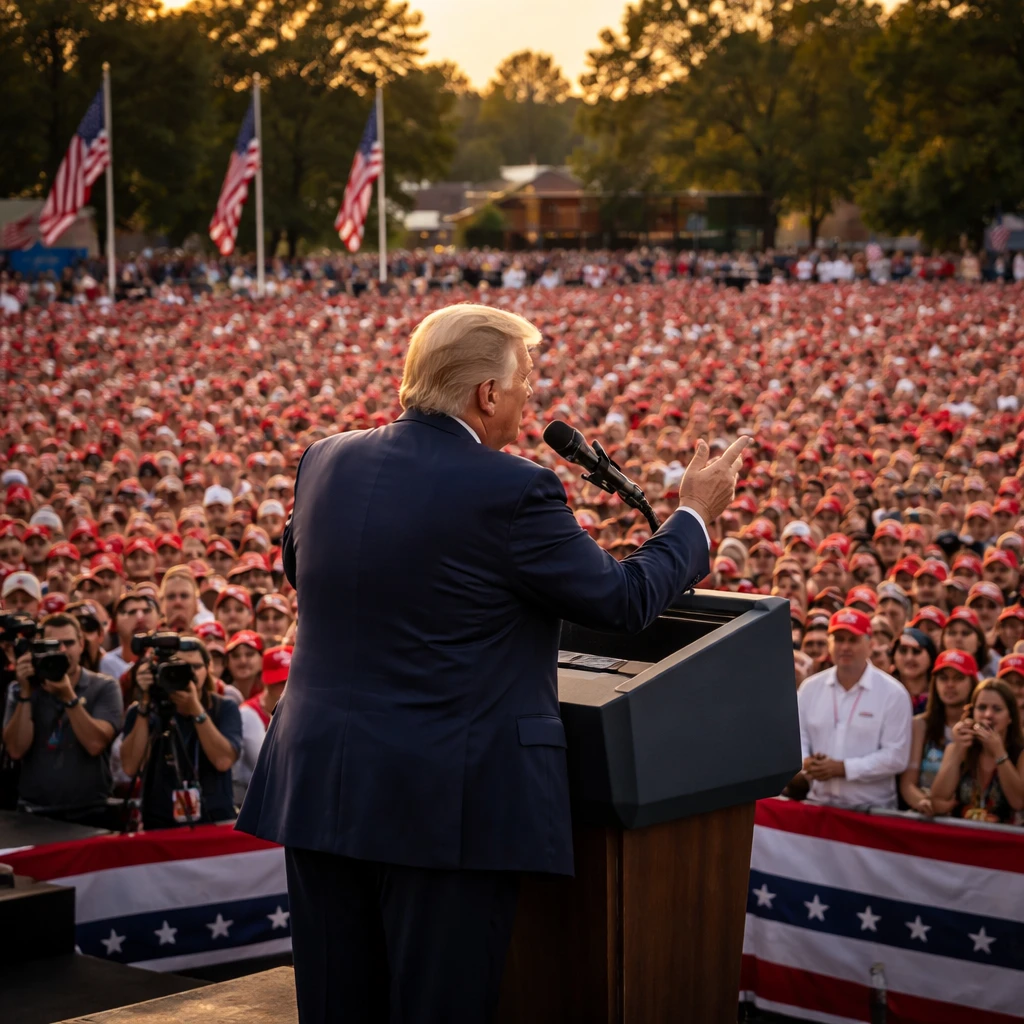
President Donald Trump returned to Georgia on Wednesday, delivering remarks in Marietta that pressed for national tightening of voting rules and amplified longstanding criticisms of the state's election administration. The visit followed a prime-time address in which he questioned the security of U.S. elections and came after a ceremony honoring four U.S. service members killed in recent attacks in the Middle East.
At the Marietta event, held in the politically competitive suburbs of Atlanta, Trump urged his audience to contact Senate Majority Leader John Thune and press him to advance his administration’s election bill, which would impose stricter voting requirements across the country. The speech built on months of attacks on Georgia’s election system that the president has launched since his 2020 defeat in the state.
According to a Reuters review cited at the rally, Trump has publicly questioned Georgia’s voting processes at least nine times so far this year. In recent months he has repeatedly characterized the 2020 result as illegitimate; on a June podcast he said the 2020 election in Georgia was rigged, and days later during a telephone rally for a Republican gubernatorial candidate he stated, "Our elections are corrupt."
On Wednesday, Trump cautioned supporters that some Republican wins in the state could face obstacles, saying they were "not going to be that easy with the cheating and everything else going on." He used the platform to cast the matter of election security as central to the upcoming midterms.
Election debate tied to tight Senate race
The debate over voting rules is playing out against the backdrop of a competitive Senate campaign in Georgia. Incumbent Democratic Senator Jon Ossoff is seeking reelection against Republican U.S. Representative Mike Collins. A Fox News poll in July showed Ossoff leading Collins by 13 percentage points among registered voters.
Ossoff has publicly challenged the president’s claims about the 2020 vote and has labeled Trump the "world’s most famous sore loser." Collins has aligned with the president’s push for tougher voting requirements and told CNN in June that he believes Trump won Georgia in 2020. At the rally, Trump framed Collins as a dependable ally who supported tax cuts for Georgians and would help attract federal investment.
Trump also used personal attacks against his Democratic opponent, calling Ossoff a "terrible" senator and repeating his claim that some progressive Democrats are "communists."
Republican concerns about turnout
Despite support for stricter voting rules among many Republicans, some party officials and conservatives in Georgia are uneasy about the political consequences of Trump's rhetoric. They worry the president’s persistent questioning of election integrity could reduce turnout among his base in November, potentially undermining Republican prospects in races that will help determine control of Congress.
"President Trump’s supporters are less likely to turn out when he casts doubt on the validity on the election process," said Eric Johnson, the former Republican leader of the Georgia Senate and state chair for RightCount, a conservative group that defends state-run elections.
At the Marietta rally, several Republican attendees said they still harbored doubts about the security of the voting system in Georgia despite the state’s existing identification rules and the post-2020 changes enacted by Georgia Republicans that limited ballot drop boxes and absentee ballots.
"Republicans are frustrated because they don’t see the reason to vote because they know there’s going to be cheating," said Rita Rohrssen, an 80-year-old retired registered nurse from Woodstock, Georgia. "But you have to vote anyway."
Campaign logistics and positioning
Wednesday’s rally was the president’s first dedicated campaign event since his recent prime-time White House address on election security. Collins did not attend the Marietta event, saying he remained in Washington to cast votes; Trump praised that decision from the podium and urged voters to back Collins in November.
Georgia already requires voters to show identification at the polls, and state Republican leaders enacted additional voting restrictions after the 2020 election. Still, the president and some attendees at the rally signaled continued distrust of the system.
What remains uncertain
The longer-term effects of Trump’s election-focused messaging on turnout and the broader trajectory of the Senate race in Georgia remain uncertain. Party officials contend the rhetoric could suppress participation among his supporters; at the same time, the president and his allies view tighter federal voting rules as a necessary response to perceived vulnerabilities.
How those dynamics will translate into votes in the midterms, where control of Congress is at stake, is unclear based on the information available at the event and in polling cited at the rally.