
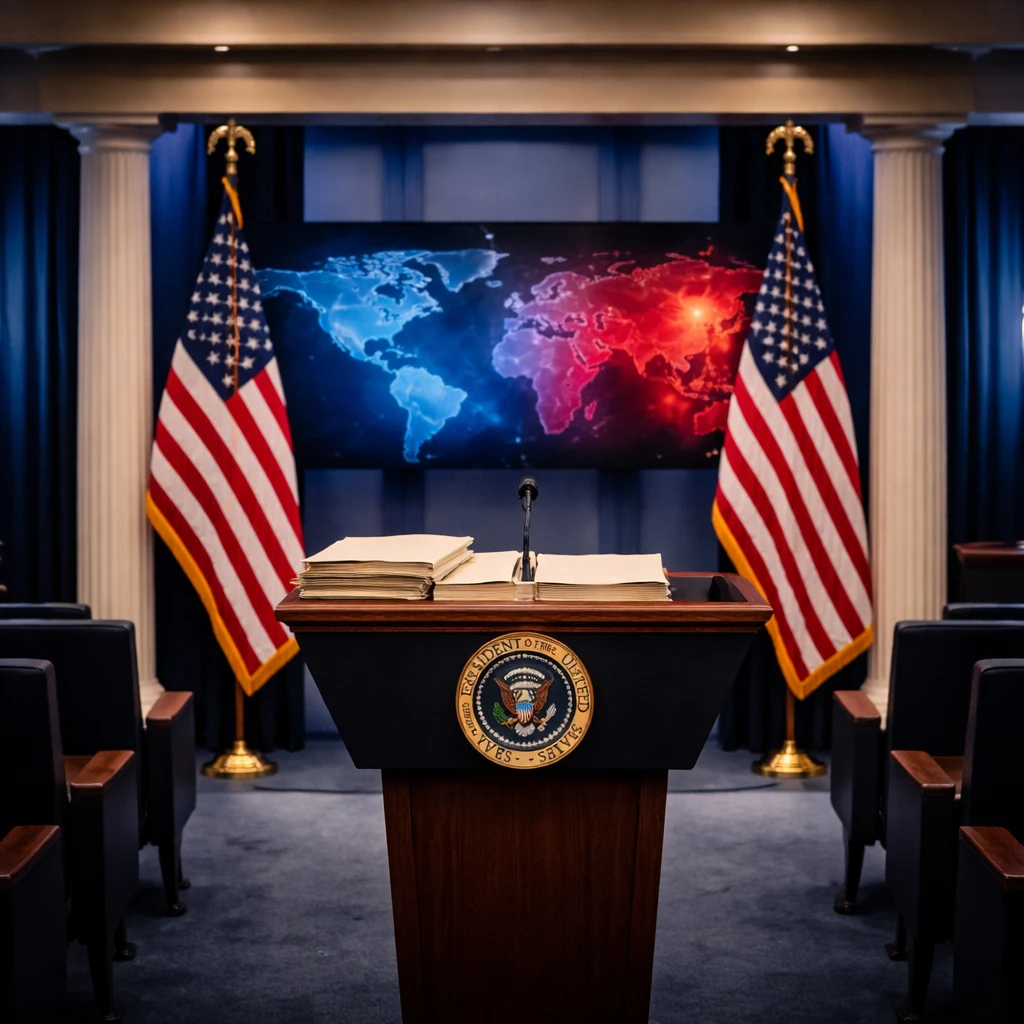
President Donald Trump elevated election security to the core of his midterm message in a nearly 30-minute prime-time address from the White House on Thursday, pressing Republicans to back legislation that would tighten voter identification and citizenship requirements and alleging that China had illicitly acquired vast quantities of U.S. voter data.
The speech combined reminders of domestic policy achievements with renewed allegations about the integrity of U.S. elections. The president said he was declassifying material he characterized as exposing "shocking vulnerabilities," and he repeated long-standing claims that U.S. voting systems and processes are unreliable. At the same time, critics and some of the declassified documents cited in the address appeared to undercut the assertion that foreign actors successfully altered vote counts or technical aspects of the 2020 presidential election.
Legislative push
Mr. Trump used the address to urge Congress to pass the SAVE America Act, legislation that would impose new voter identification and citizenship verification measures. The bill has stalled in the Senate amid strong Democratic opposition. The president framed these legislative changes as necessary to shore up election integrity, even though established findings have found voter fraud to be rare.
He also reiterated allegations about non-citizen voter registrations, saying his administration had uncovered more than 275,000 non-citizens registered to vote across four states. The president did not provide documentation that any of those registrations translated into illegal ballots cast. Observers note that citizenship-verification systems have in prior cases incorrectly flagged some naturalized citizens as non-citizens, and broader studies have found instances of non-citizen voting to be exceedingly uncommon.
Declassified material and intelligence assessments
The administration released documents it said showed China had obtained 220 million U.S. voter files, including names, addresses and other data. Two people familiar with the matter told officials that the voter data obtained by China was not confidential, noting that voter files are routinely purchased by political consultants and are not in themselves manipulable.
Critically, an unclassified U.S. intelligence assessment from 2021 found no indications that any foreign actor attempted to or succeeded in altering "any technical aspect" of the 2020 presidential election, including voter registrations, ballots, tabulations or results. That assessment was conducted under John Ratcliffe, then the director of national intelligence and now serving as director of the Central Intelligence Agency, according to the administration's public materials.
Several of the documents cited during the speech did not appear to provide direct evidence of vote tampering. Among those released were:
- A CIA document prepared last month that focused on Venezuela’s electoral environment rather than U.S. infrastructure.
- An assessment stating, "We assess that vote tabulation systems would be difficult to manipulate on a wide enough scale to compromise election results."
- A CIA analysis describing Chinese intelligence efforts to target one campaign and noting that Beijing "does not currently intend to covertly interfere to try to sway the outcome of the election."
Political context and reactions
The speech came at a politically fraught moment for Republicans and the president. Party leaders are anxious about the prospect of losing one or both chambers of Congress in November, and some have urged the president to focus on bread-and-butter issues that matter to voters, such as rising living costs. The president briefly referenced the ongoing Iran war, declaring the U.S. was "winning big," and recited domestic policy accomplishments including tax cuts and an immigration crackdown before turning to the theme of election security.
Democratic critics pushed back sharply on the administration’s characterization of the declassified material. Senator Mark Warner of Virginia, vice chair of the Senate Intelligence Committee, called the president’s claims "totally bogus" in a public statement during the address, reiterating that intelligence agencies had concluded China did not attempt to change a single vote in 2020.
Despite the absence of confirmed vote manipulation, elements of the president’s narrative have resonated with his base. A Reuters/Ipsos poll conducted in April and cited by administration statements found that 63% of Republicans believe the 2020 election was stolen, reflecting substantial partisan divergence over the election’s legitimacy.
U.S.-China relations and trade considerations
Mr. Trump’s forceful language on China carries diplomatic risk. The president’s remarks about Beijing came even as U.S.-China relations had steadied after last year’s trade dispute, and they arrive ahead of a planned September meeting the president hopes to hold with Chinese President Xi Jinping to discuss trade. A spokesperson for the Chinese embassy, Liu Chang, issued a denial prior to the speech, saying, "China has never and will never interfere in the presidential elections of the U.S."
Assessment limitations and outstanding questions
While the administration presented the declassified materials as revealing significant vulnerabilities, many of the documents were described by analysts and critics as inconsistent with the claim that foreign actors altered vote tallies in 2020. The 2021 unclassified intelligence assessment remains a central counterpoint to assertions of technical manipulation, stating plainly that there were no indications of foreign actors changing the technical aspects of the vote. The administration’s figures on data collection and non-citizen registrations were presented without accompanying proof that ballots were changed or that the registrants cast illegal ballots.
As Republicans consider election-security messaging ahead of November, the debate over the interpretation of intelligence material, the content and prospects for federal voting legislation, and the political calculus of emphasizing alleged vulnerabilities will continue to shape the campaign season.
Summary
President Trump made election security the centerpiece of a prime-time address, unveiling declassified documents he said show China collected massive U.S. voter data and calling for passage of the SAVE America Act. Critics and existing U.S. intelligence findings say the materials do not demonstrate that foreign actors altered votes in the 2020 election, and key documents appeared to contradict claims that vote tabulation systems were widely vulnerable to manipulation.