
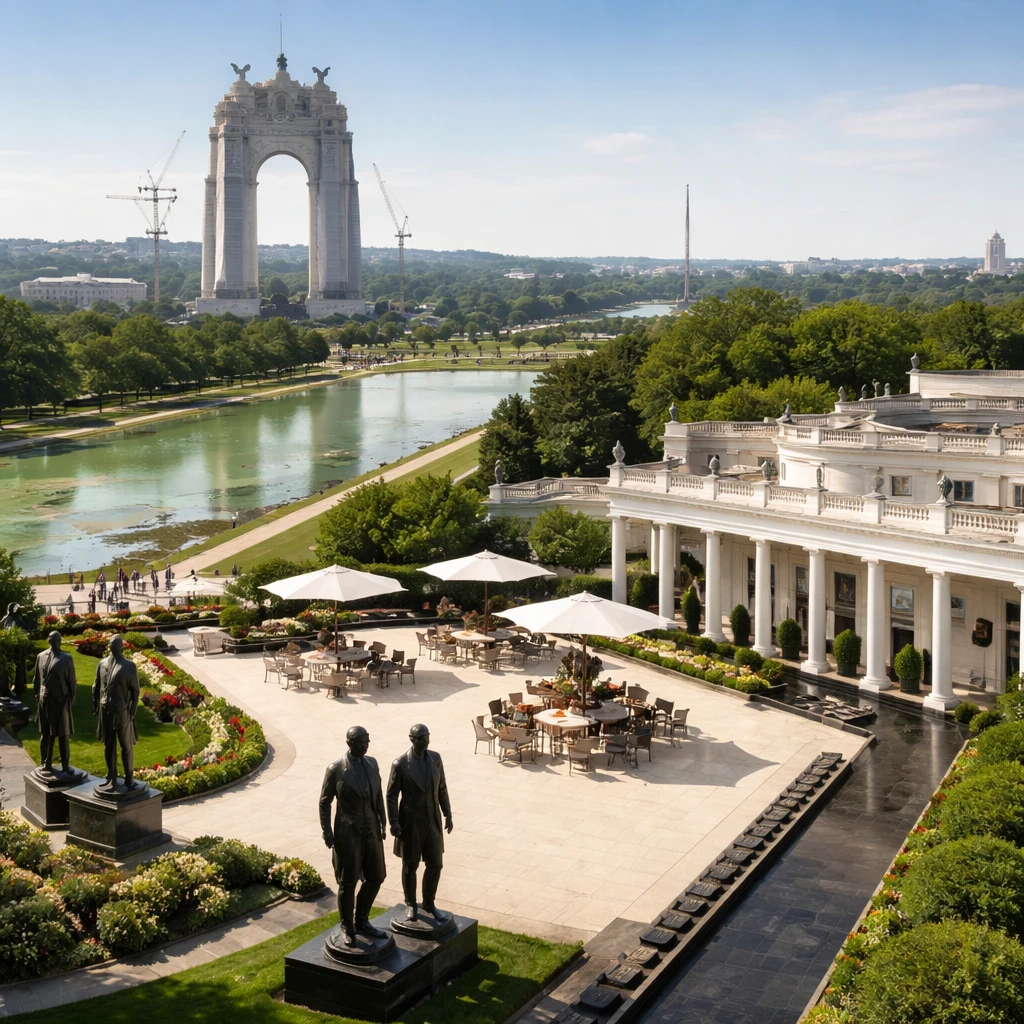
As of Aug. 3, President Donald Trump is pressing forward with an expansive program of changes to public spaces and cultural institutions in Washington, D.C., advancing plans that include a new White House ballroom, a dramatic triumphal arch near Arlington and major alterations to the Kennedy Center and the National Mall area. The initiatives span construction, cultural programming and large-scale new statuary, and have generated criticism from preservationists, legal challenges and questions about procurement, funding and construction quality.
Scope and public reaction
The president's portfolio of projects has prompted sharply divided responses. Supporters endorse the upgrades as bold physical statements, while opponents argue the undertakings risk historic fabric, exceed executive authority and distract from economic concerns that resonate with ordinary Americans. Several plans have become the subject of litigation, temporary court orders and federal filings that highlight both procedural and technical problems.
Reflecting Pool
In April, President Trump announced a renovation of the Lincoln Memorial Reflecting Pool, the long, shallow pool near the site of Martin Luther King Jr.'s 1963 "I Have a Dream" speech. The president said the pool would be remodeled, and the work proceeded as a more-than-$16 million project on the 2,000-foot basin. Contractors were not selected through a competitive bidding process, according to accounts of the work.
Trump declared the project complete on June 6. Almost immediately following that announcement, observers noted peeling paint and an algal bloom that turned the pool's waters from the intended clear blue to green. Administration officials, including the president, attributed the deterioration to vandalism, an assertion made without cited evidence in public statements. Authorities arrested a former U.S. Olympic canoeist on charges of vandalizing the pool; the individual denied the accusations and the Department of Justice later moved to drop the charges.
In a court filing on a Friday, U.S. Attorney Jeanine Pirro and Assistant U.S. Attorney Michael Spence wrote that the evidence available to them "indicated a rushed and flawed installation process, with repeated failures of the lining during the installation process, and extensive peeling of the lining throughout the Reflecting Pool." The filing framed the observed damage as stemming from construction and installation shortcomings rather than solely from external interference. The president has publicly disagreed with that reading, reiterating his view that vandalism was the principal cause of the problems.
White House ballroom
One of the most ambitious undertakings at the White House is a planned 90,000-square-foot ballroom that the president has described as "the greatest of its kind ever built." Designed to match the White House in height and scale, the structure is intended to seat approximately 1,000 guests. The president at first indicated he and wealthy donors would cover the costs for what was initially estimated at $400 million. The administration later sought $1 billion from Congress, framing the request as necessary to strengthen security features and construct an underground bunker.
Congress did not appropriate the $1 billion the administration sought, but construction on the ballroom has continued. Administration statements indicate the project is scheduled for completion before the end of the president's four-year term. The construction required the removal of the historic East Wing, which traditionally housed the first lady's offices and the White House movie theater. Preservationists and opponents contend that demolition exceeded executive authority and have filed a lawsuit seeking to halt the project; federal judges heard arguments in the litigation in June.
Kennedy Center
The John F. Kennedy Center for the Performing Arts, an institution established by Congress to honor the late president, has been the focus of substantial administrative and programmatic changes since the president took office in 2025. The administration moved to replace the center's leadership, altered programming, and appointed a board whose actions included adding the president's name to the building - a change that a judge later ordered removed.
The president defended the changes, telling reporters in February 2025, "I want to make sure it runs properly. Some of the shows were terrible. They’re a disgrace that they were even put on." Following the leadership changes and programming shifts, the center recorded a wave of cancelled performances, staff departures and a drop in ticket sales.
In February of the current year, the president announced the Kennedy Center would close for a two-year period beginning on July 4 to undergo a major overhaul. In May, a judge issued a temporary block on the planned renovations. The president later said he would transfer control of the Kennedy Center to Congress, although how such a transfer would be executed was left unclear in public statements. A tarp has been installed over the center's facade, covering the removal of the president's name from the building.
Oval Office and interior redecorations
When he returned to the White House in January 2025, the president undertook an extensive redecorating of the Oval Office. The room was outfitted with gold accents and statuettes, and a number of portraits pulled from storage were rehung, including images of Americans described as famous but some of whom are not readily identifiable to casual observers. A framed copy of the Declaration of Independence was placed on a wall in the room. Additionally, busts of Abraham Lincoln and Benjamin Franklin were set on tables close to the presidential desk. The president has made the redecorated Oval Office available for tours by visitors.
Rose Garden and White House grounds
The landscape immediately outside the Oval Office has been reshaped. The Rose Garden's grass lawn was removed and replaced with a white stone patio furnished with umbrella-covered tables, creating a patio-style environment similar to the president's Mar-a-Lago Club in Palm Beach, Florida. The president said the stone surface was necessary because women wearing high heels would otherwise sink into the soil.
He also added statues of U.S. independence figures Alexander Hamilton and Benjamin Franklin within the Rose Garden, and commissioned a sculpture titled "Freedom’s Charge" that depicts two Revolutionary War soldiers. Adjacent to the West Wing colonnade - a walkway that had been lined for 60 years with Tennessee flagstone - the president removed the flagstone and installed a black granite surface. Along the colonnade wall, portraits of past presidents were hung, each accompanied by a plaque inscribed with the president's view of that individual. Notably, no portrait of Joe Biden, who defeated the president in the 2020 election, was included.
Elsewhere on the White House grounds, new large flagpoles have been erected on both the North and South Lawns.
Triumphal arch proposal
Across the Potomac River from the Lincoln Memorial, near the entrance to Arlington National Cemetery, the president has proposed constructing what he has described as a triumphal arch. The envisioned monument would echo the Arc de Triomphe in Paris in concept but would be significantly larger. The proposed height is around 250 feet, topped with eagle statues and a Lady Liberty-type figure. For scale, that proposed height would surpass the Lincoln Memorial and come close to the height of the U.S. Capitol, which is 288 feet tall; by comparison, the Arc de Triomphe in Paris is 164 feet high.
Whether the arch could ultimately be built at that proposed height remains unclear. The likely location is near the flight path of southbound aircraft on final approach to Ronald Reagan Washington National Airport, a few miles away, and the proximity to aviation corridors raises questions about whether the structure could meet regulatory and safety constraints.
Garden of American Heroes
The president has promoted the idea of a National Garden of American Heroes since his first term in office. In 2025, Congress provided $40 million toward the project, which the president plans to develop at West Potomac Park along the Potomac River as a commemoration timed to the 250th anniversary of U.S. independence. The garden is planned to include statues representing a broad roster of national figures - founding fathers, military leaders, religious figures, civil rights champions, athletes, artists and entertainers.
The project was originally targeted to open on July 4 but the opening has been delayed. Preservation groups have filed lawsuits seeking to halt the garden on legal grounds.
East Potomac Golf Links
The president has indicated an intention to begin renovations to the East Potomac Golf Links, a public course in Washington that is about a century old, with work slated to commence on Sept. 1. As a frequent golfer and owner of multiple private courses, the president has said he hopes renovating the municipal course will enable it to host major tournaments. That plan is also embroiled in legal challenges brought by groups that contend the proposed work violates existing law.
What remains unsettled
Across multiple initiatives, recurring themes include litigation from preservation and civic groups, temporary judicial interventions, questions about procurement and construction practices, and uncertainty around funding. Some projects proceeded without congressionally approved appropriations for the stated security or construction expenditures. Others face logistical constraints - including the proposed arch's proximity to established flight paths - and operational questions about the transfer of control of public cultural institutions. In several instances, federal filings and public statements diverge on the likely causes of visible problems, such as the reflecting pool's lining failures and the presence of algae.
Collectively, the president's remodeling efforts have reshaped visible parts of the capital and generated a sustained debate over the balance between executive authority, historic preservation and public stewardship of national landmarks.