
Overview
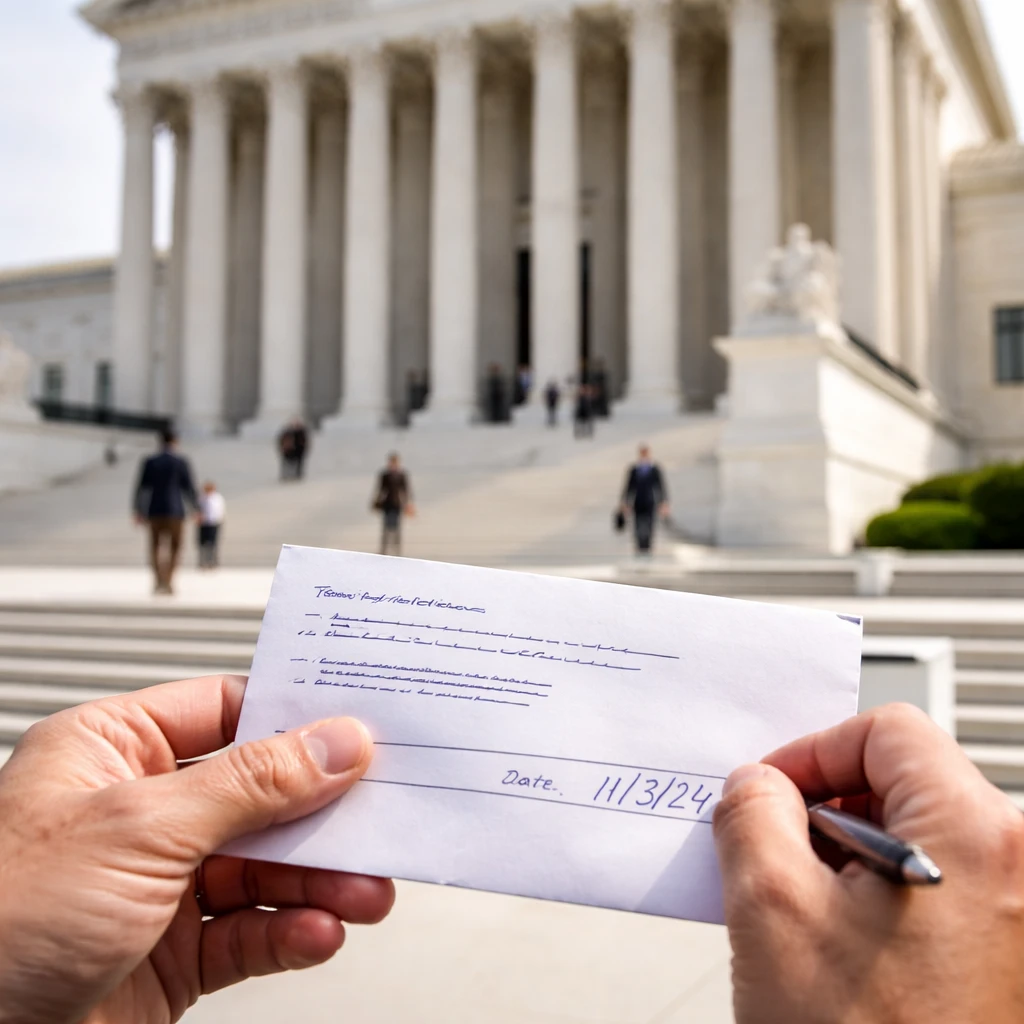
The U.S. Supreme Court has requested the Trump administration’s views on whether the court should take up a Republican appeal involving Pennsylvania’s mail-in ballot envelope date requirement. The question centers on whether election officials may be required to discard mail-in ballots when the voter fails to write a date on the outer return envelope, a mandate that critics say resulted in the exclusion of thousands of legitimate ballots.
Case background and legal posture
The appeal under consideration would overturn a lower court decision that blocked the requirement as unconstitutional. The challenge was filed by Republican Pennsylvania Attorney General David Sunday together with national and state Republican parties, seeking to reinstate the date rule found in Pennsylvania election law. Lower courts had determined that enforcing the requirement violated the U.S. Constitution’s protections tied to the right to vote.
The legal dispute began with a Democratic voter whose mail-in ballot was rejected in the 2022 general election after election officials concluded the outer return envelope lacked a handwritten date. The Democratic Congressional Campaign Committee and other groups joined that voter in challenging the law, arguing the date requirement serves no valid purpose and causes unnecessary disenfranchisement.
The plaintiffs contend the rule does not effectively detect fraud and instead improperly bars ballots. They argued that the rule runs afoul of constitutional guarantees the Supreme Court has previously linked to voting - including protections under the First Amendment for free speech and association and under the 14th Amendment for equal protection and due process.
Court findings and rulings to date
A federal judge concluded that enforcing the ballot-date requirement was unconstitutional, finding the Republican assertion that it promotes election efficiency and integrity was unsupported by evidence. The Philadelphia-based 3rd U.S. Circuit Court of Appeals affirmed that decision in August 2025, stating that "discarding thousands of ballots every election is not a reasonable trade-off in view of the date requirement’s extremely limited and unlikely capacity to detect and deter fraud."
The 3rd Circuit further observed that "Because of the Commonwealth’s date requirement, an inadvertent typographical error or a flipped number or even a stray pen mark in the date field will remove the ballot contained within the return envelope from consideration. And the voter may never be the wiser." That court found the burden on voters and the number of ballots discarded outweighed any marginal benefit in preventing fraud.
In a related procedural development earlier, the U.S. Supreme Court in January 2025 left in place another 3rd Circuit ruling that rejected a separate challenge to the date requirement brought by plaintiffs including the Pennsylvania State Conference of the NAACP. In that earlier case, the 3rd Circuit had rejected the argument that the law breached a federal statute prohibiting the discarding of ballots for paperwork errors that are "not material" to determining voter qualification.
Scope of alleged disenfranchisement
Plaintiffs in the more recent challenge said the date rule led to the rejection of more than 10,000 ballots during the 2022 general election. After the state revised the design of the ballot return envelope, they reported about 4,500 ballots were discarded during the 2024 election because of missing or incorrect dates.
Political context
Pennsylvania is often decisive in U.S. presidential contests, and it again played a central role in the 2024 election when Republican President Donald Trump carried the state over his Democratic rival Kamala Harris, after Trump had lost Pennsylvania to Democrat Joe Biden in 2020. Democratic voters have historically been more likely to use mail-in ballots than Republican voters.
The Republican National Committee and the state Republican party intervened to defend the date requirement in court. Supporters say the mandate helps guard against fraud, while opponents say it is an unnecessary formality that strips valid ballots from consideration.
Federal executive action and related litigation
The Trump administration has pursued other actions aimed at limiting mail-in voting. In March, President Trump issued an executive order intended to restrict mail-in ballots nationwide. That executive order was blocked by a federal judge in Boston on June 25, preventing its implementation while litigation over the measure proceeds.
Next steps
The Supreme Court’s request for the Trump administration’s view is part of the justices’ process for deciding whether to hear the Republican appeal. If the court accepts the case, it would consider whether the date requirement is permissible under the Constitution and federal voting statutes. If the court declines review, the lower court rulings barring enforcement of the date rule would stand.
Key points
- Supreme Court has asked the Trump administration to weigh in on whether to hear Republican appeals to reinstate Pennsylvania’s ballot-date requirement.
- Lower courts blocked enforcement, concluding the date mandate led to thousands of discarded ballots and lacked evidence of fraud-prevention benefits; the 3rd U.S. Circuit Court of Appeals described the rule as an unreasonable trade-off.
- The dispute arises in a politically significant state that favored Donald Trump in the 2024 presidential election, and that Democrats have tended to use mail-in voting at higher rates.
Risks and uncertainties
- Ongoing litigation risk - The Supreme Court’s choice to take up or decline the appeal will determine whether the date requirement can be enforced, affecting electoral administration and legal predictability in Pennsylvania. Sectors impacted: political risk for electoral administration and any firms providing election services.
- Voter disenfranchisement concerns - Continued disputes over ballot-handling rules introduce uncertainty around ballot validity and counting processes, which could affect public trust in election outcomes. Sectors impacted: civic institutions, political consulting, and businesses monitoring regulatory risk.
Conclusion
The Supreme Court’s solicitation of the administration’s view is a procedural but consequential step in a dispute that touches on voting access and election integrity in a pivotal state. The court’s eventual decision on whether to review the case will decide if the date requirement survives judicial scrutiny or remains barred under the rulings below.