
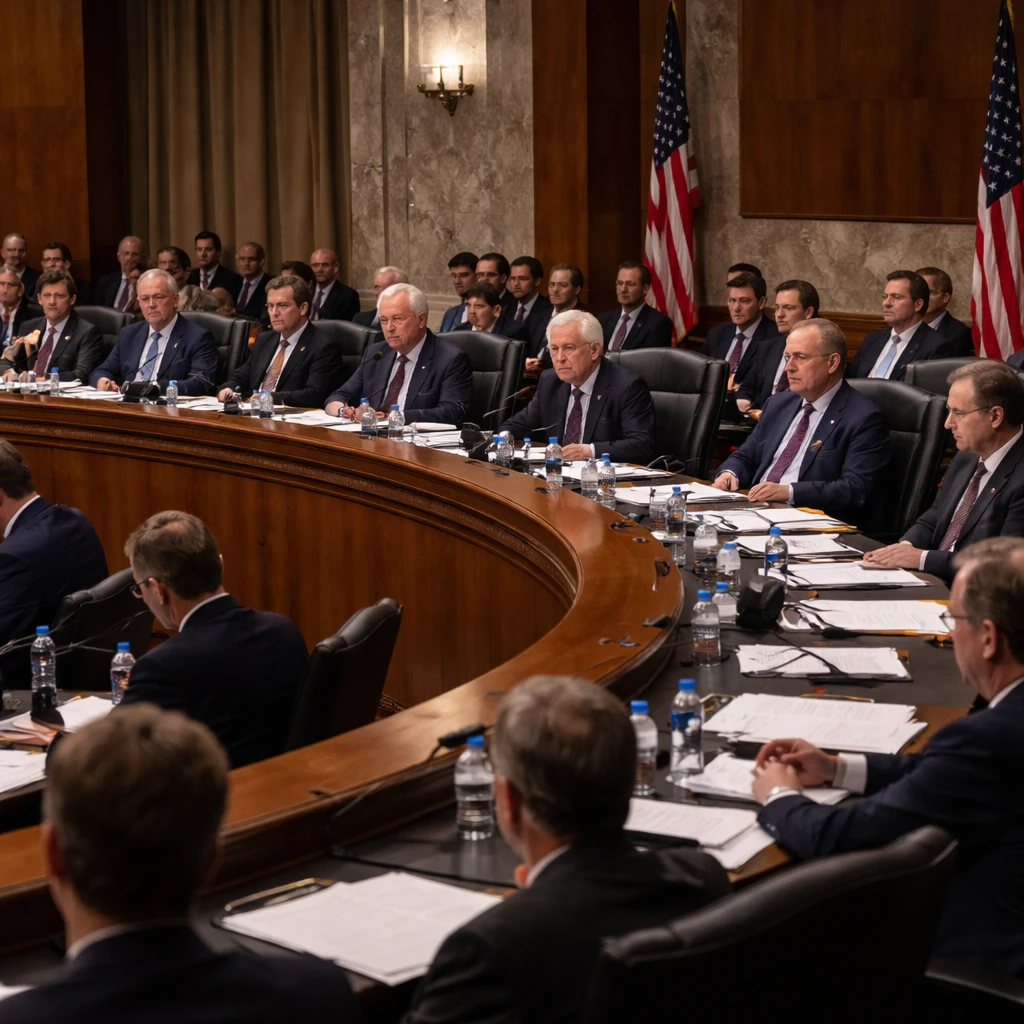
The U.S. Senate Armed Services Committee on Thursday voted to extend security assistance to Ukraine and increase the authorized level of funding for that aid to $750 million, signaling congressional pushback against the administration's decision to scale back support for Kyiv amid its conflict with Russia.
Lawmakers on the Republican-majority panel finished their version of the National Defense Authorization Act, the annual legislative vehicle that sets policy priorities for the Department of Defense. Within the bill text, the committee authorized $750 million for the Ukraine Security Assistance Initiative - the program that channels contracts to U.S. companies to supply weapons and related equipment to Ukrainian forces.
Included in the Senate committee's draft is a provision that renames the Department of Defense to the Department of War. The nomenclature change appears in the bill as presented by the committee.
The broader NDAA approved by the committee endorses $1.15 trillion in total defense spending and addresses an array of traditional Pentagon priorities. The package covers procurement of ships, aircraft and missile systems, contemplates increases in military pay, and sets policies designed to respond to evolving geopolitical threats.
On Ukraine policy, the Senate committee's text contains explicit limits on how funds authorized under the NDAA may be used. The bill prohibits any use of those funds to recognize Russian sovereignty over territory that is internationally recognized as part of Ukraine. In addition, the legislation directs the Department to provide intelligence support to Kyiv for military operations aimed at defending or reclaiming that territory.
The committee action underscores congressional resistance to reductions in security assistance after the administration scaled back direct aid to Ukraine. By preserving and expanding a funding stream that finances U.S. contractors supplying arms to Ukrainian forces, the Senate panel has signaled continued legislative support for Kyiv's defense needs within the scope of the NDAA.
Summary
The Senate Armed Services Committee advanced its NDAA with $750 million authorized for the Ukraine Security Assistance Initiative, a renaming of the Department of Defense to the Department of War, and provisions barring recognition of Russian sovereignty over Ukrainian territory while directing intelligence support to Kyiv.
Key points
- The committee authorized $750 million for the Ukraine Security Assistance Initiative, which pays U.S. companies to supply weapons to Ukraine - impacting defense contractors and procurement pipelines.
- The committee's NDAA endorses $1.15 trillion in overall defense spending, covering procurement of ships, aircraft and missile systems, as well as military pay increases - relevant to the defense industry and federal budget allocations.
- The bill bars use of NDAA funds to recognize Russian sovereignty over internationally recognized Ukrainian territory and directs intelligence support to Kyiv for operations to defend or reclaim that territory - affecting geopolitical and intelligence policy considerations.
Risks and uncertainties
- Political friction between Congress and the administration over levels of aid to Ukraine could create uncertainty for defense contractors and procurement planning.
- The prohibition on recognizing Russian sovereignty and directives for intelligence support carry geopolitical risk, with potential implications for foreign policy and defense strategy sectors.
- Symbolic and policy implications from renaming the Department of Defense to the Department of War may introduce political controversy and raise questions about institutional messaging - relevant to defense governance and public perception.