
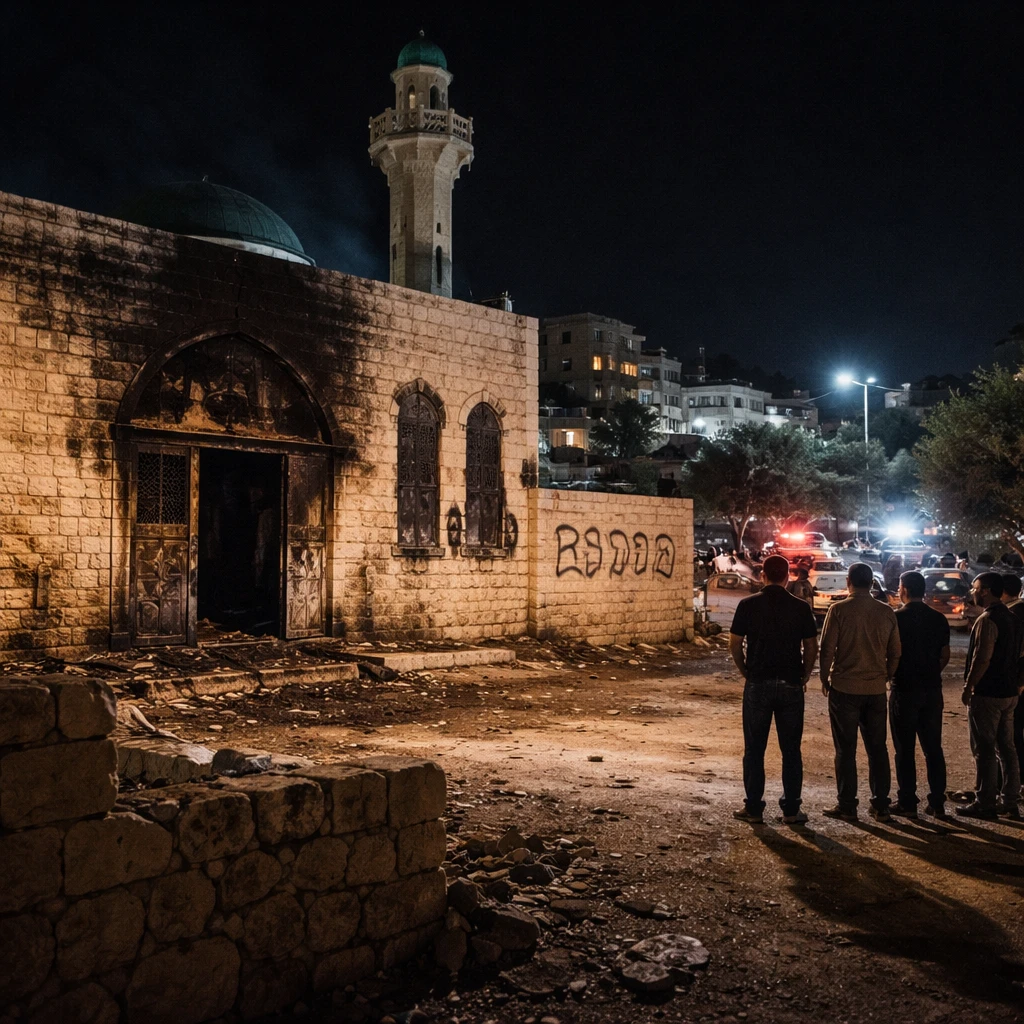
Israeli settlers launched attacks on Palestinian communities in the occupied West Bank in the early hours of Sunday, setting fire to two mosques and painting Hebrew slogans on village walls, according to Palestinian officials and statements from the Israeli military.
The incidents came days after a violent encounter near the Palestinian village of Tal, southwest of Nablus, in which four Palestinians and two Israeli soldiers - one serving as a local security coordinator - were killed. Palestinian accounts say a crowd of settlers entered the vicinity of Tal and villagers came out of their homes to confront them, leading to a shootout that forms part of a series of recent settler-related clashes.
Abdel Azim Wadi, head of the village council in Qusra, southeast of Nablus, said the attackers had burned a newly completed mosque in his village during the early morning hours. He reported that the perpetrators also sprayed slogans in Hebrew across walls, including messages such as 'Jewish revenge' and the name of one of the Israelis killed near Tal.
'The village has faced repeated attacks since 2011, and these attacks have increased since the war,' Wadi said by telephone.
Palestinian officials additionally reported an attempted arson at a mosque near Kour, southeast of Tulkarm. Farid Jiyousi, a member of that village council, said three settlers tried to set the mosque alight at dawn but worshippers extinguished the blaze before it could reach the main prayer area. He added that Hebrew graffiti had been sprayed on that mosque's walls as well and that this was the first attack his village had experienced.
The United Nations and the Palestinian Authority record dozens of Palestinian fatalities and hundreds of injuries this year in clashes involving settlers. Most countries and U.N. bodies view Jewish settlements in the West Bank as illegal, a position Israel rejects; the Palestinians seek statehood in Gaza, the West Bank and East Jerusalem.
The Israeli military said troops deployed to Qusra, located near several large settlements, had discovered graffiti and evidence of arson and were conducting searches for suspects. The military stated that police officers would be deployed to collect evidence from the scene.
'The security forces strongly condemn incidents of this kind, including harm to religious sites, and will continue to act decisively to maintain security and public order in the area,' the military said in a statement.
Following Friday's confrontation, Prime Minister Benjamin Netanyahu - who faces an election in October - ordered reinforcements of troops to the area and announced that more settlements would be authorised to bolster security. Right-wing members of his government, including hardline finance minister Bezalel Smotrich, have pressed for accelerated measures to assert control over the West Bank, which was occupied by Israel after the 1967 conflict.
Context and immediate developments
These attacks are part of a pattern of heightened settler-related violence since October, when Israel launched a military campaign in Gaza against Hamas following an assault by Gaza militants that resulted in heavy Israeli casualties. Palestinian officials and U.N. figures say settler violence in the West Bank has surged since then.
Israeli forces said they had begun an operational response in Qusra, identifying arson and graffiti and initiating searches to locate those responsible. Police evidence-gathering teams are expected to process the sites.
Local leaders in the affected villages reported that the mosques damaged in the incidents were either newly completed or had only suffered partial burning after intervention by residents. The accounts conveyed a sense of escalation in attacks on Palestinian communities in the area.
Immediate humanitarian and security implications
The events underline the fraught security environment in parts of the West Bank where settlements and Palestinian communities are in close proximity. Officials on both sides described the incidents in terms consistent with a widening pattern of settler attacks and heightened military activity in response to deadly clashes.
As Israeli forces pursue suspects and police collect evidence, local councils and residents in the impacted villages face the immediate task of repairing damaged religious sites and responding to a sense of insecurity after the attacks.