
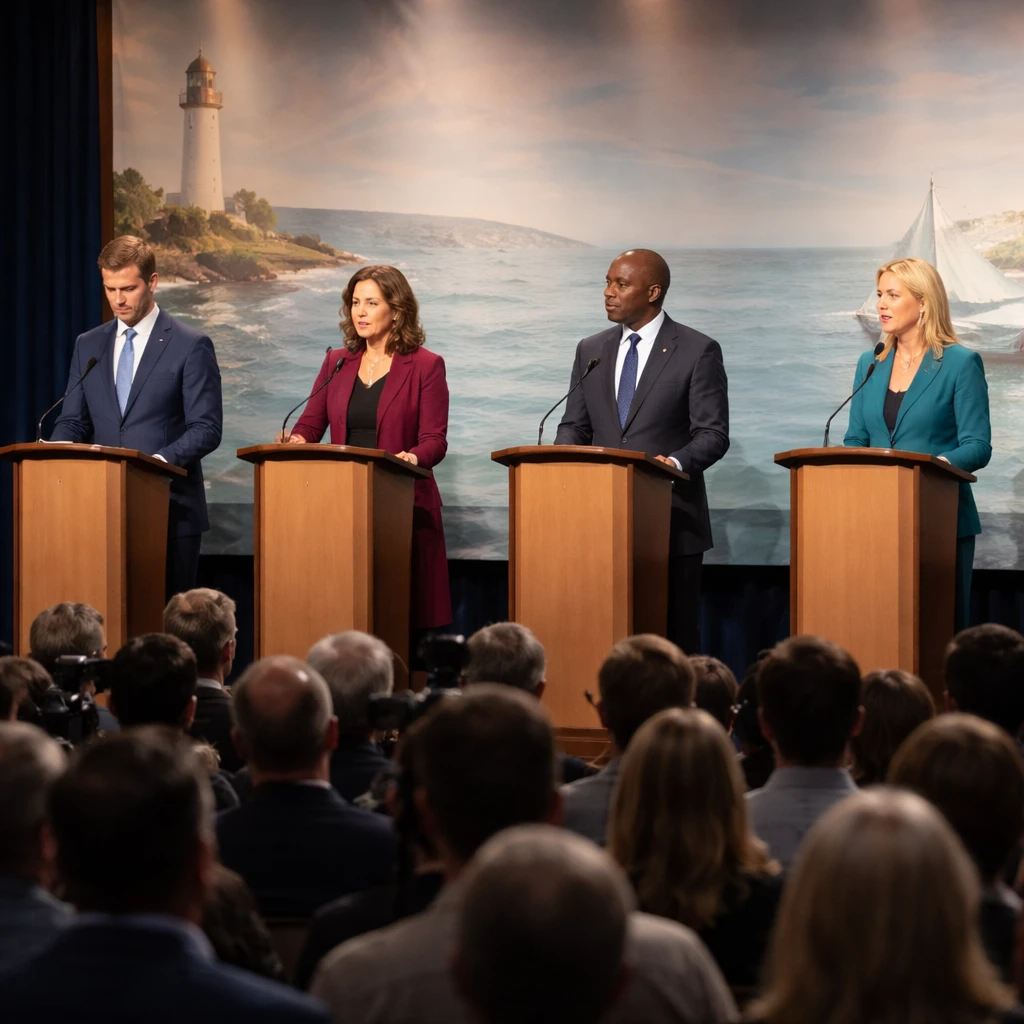
WASHINGTON, July 17 - Four of the leading Democratic contenders vying to become the party’s U.S. Senate nominee in Maine shared the stage Thursday for a debate that emphasized a united front against Republican Senator Susan Collins and the Trump administration’s policies. The hourlong segment featured Secretary of State Shenna Bellows, former Maine Senate President Troy Jackson, former Maine CDC Director Nirav Shah and former congressional aide Jordan Wood.
Throughout the session, candidates repeatedly directed their criticism at Collins and at President Donald Trump rather than at each other, signaling a strategy aimed at consolidating party support quickly behind whoever wins the nomination. That approach reflects the challenge facing Democrats: Collins is a well-funded, moderate Republican who has represented Maine for nearly three decades and retains the ability to win voters across party lines.
Delegates will select the party’s nominee next weekend. Some 600 delegates are expected to make the choice to replace Graham Platner, who withdrew last week after losing widespread support following sexual assault allegations that he denies. Twelve people are competing for the nomination.
Focus on Collins and the administration
On multiple fronts the Democratic candidates framed Collins as an enabler of Trump-era policies. They faulted her support for immigration enforcement funding without legal safeguards, and criticized her vote to advance the One Big Beautiful Bill’s nearly $1 trillion in Medicaid cuts — even as she voted against its final passage. Candidates tied those positions to broader criticisms of the administration’s immigration crackdown, foreign policy and economic decisions.
The debate also featured references to a recent local tragedy: candidates cited the death of a Colombian man in Maine on Monday in the context of a wider critique of immigration enforcement actions.
Nirav Shah highlighted his debate craft and personal narrative
Shah distinguished himself on stage as a polished debater, invoking in his opening remarks what he termed the infuriating "murder" of Joan Sebastian Guerrero by an ICE agent and weaving that incident into a broader critique of federal policy. He drew on his own background as the son of immigrants to connect personally to the issue and to the administration’s crackdown on immigration.
Shah also tied economic grievances to national policy decisions, blaming Collins and Republicans for making life less affordable for Mainers by citing increased costs from tariffs, the Iran war and the loss of Affordable Care Act subsidies. He posed a pointed question about Collins’ continued tenure: "The question we should ask ourselves is not what we can do or how we can live without her," he said. "It’s whether we can afford to live with her for six more years."
Bellows faltered on a foreign policy question
All four candidates expressed opposition to the war in Iran and support for aid to Ukraine. Bellows, however, stumbled on a question regarding the president’s reported raid intended to abduct Venezuelan President Nicolas Maduro. Initially she called for assessing "the facts," saying: "It’s sometimes confusing who’s right and who’s wrong, but what we need in Congress are strong moral compasses to help make that decision." When reminded that Collins supported a Venezuela war powers resolution in the Senate, Bellows asked for the moderators’ indulgence and cited being on vacation: "A week ago, I was on vacation on a river on the Kennebec, and I’ve been running for governor for a long time," she said, adding that she narrowly lost that race.
Jackson said the raid would be "perfectly fine" if based on credible intelligence but added he does not trust Trump or the defense secretary. Shah and Wood opposed the president’s actions, according to their remarks during the debate.
Unified embrace of Platner-style progressive policies
Throughout the night, the Democratic candidates voiced support for many of the progressive policies associated with Graham Platner, the withdrawn front-runner. They criticized the corrupting influence of billionaires, and collectively advocated for sweeping changes including Medicare for All, abolishing Immigration and Customs Enforcement, ending the Senate filibuster and reforming the Supreme Court. Every candidate except Troy Jackson accused the Israeli government of committing "genocide" in Gaza.
The unified acceptance of Platner’s policy palette may create an opening for Republicans to depict the eventual nominee as a radical successor to Platner, whose own campaign faced controversies unrelated to the party’s policy debates. Jordan Wood acknowledged a complicated relationship with Platner’s tenure in the race: "When I got into this race, I was very hesitant to use the word genocide," he said. "Graham got into this race saying, ’This is genocide.’ And I learned that it is so important in these moments to draw those moral lines." Wood described himself as the cleanest break from Platner, noting that he had called on Platner to drop out in October.
Electability arguments and generational contrast
The candidates sparred over who is most electable in a state Democrats view as a critical pickup opportunity. Maine is the only Republican-held Senate seat on the ballot this year in a state the Democrats' 2024 presidential nominee carried, making it a top Democratic target as the party seeks to gain at least four seats to win control of the Senate, where Republicans hold a 53-47 majority.
Shah positioned himself as the most viable general-election candidate, pointing to his status as runner-up in last month’s gubernatorial primary. Bellows emphasized her record of fighting the Trump administration, recounting her defense of voter data: "When Donald Trump came for your voter data, I said hell no," she said. "I fought in court to keep your data safe, and we won." Jackson presented himself as a logger from the same region as Collins who can bring together conservative and liberal voters on shared interests. Wood emphasized generational change in arguing for his candidacy, noting Collins’ age and long tenure: "I was in second grade when Susan Collins was first elected our senator," he said.
What’s next
With the debate serving as an opening salvo, the party’s next steps hinge on the delegate vote scheduled for next weekend. The tone on stage suggested Democratic efforts will focus on rapid consolidation behind the nominee chosen by the approximately 600 delegates who will convene, while Republicans seek to frame the victor as aligned with Platner’s progressive stances.