
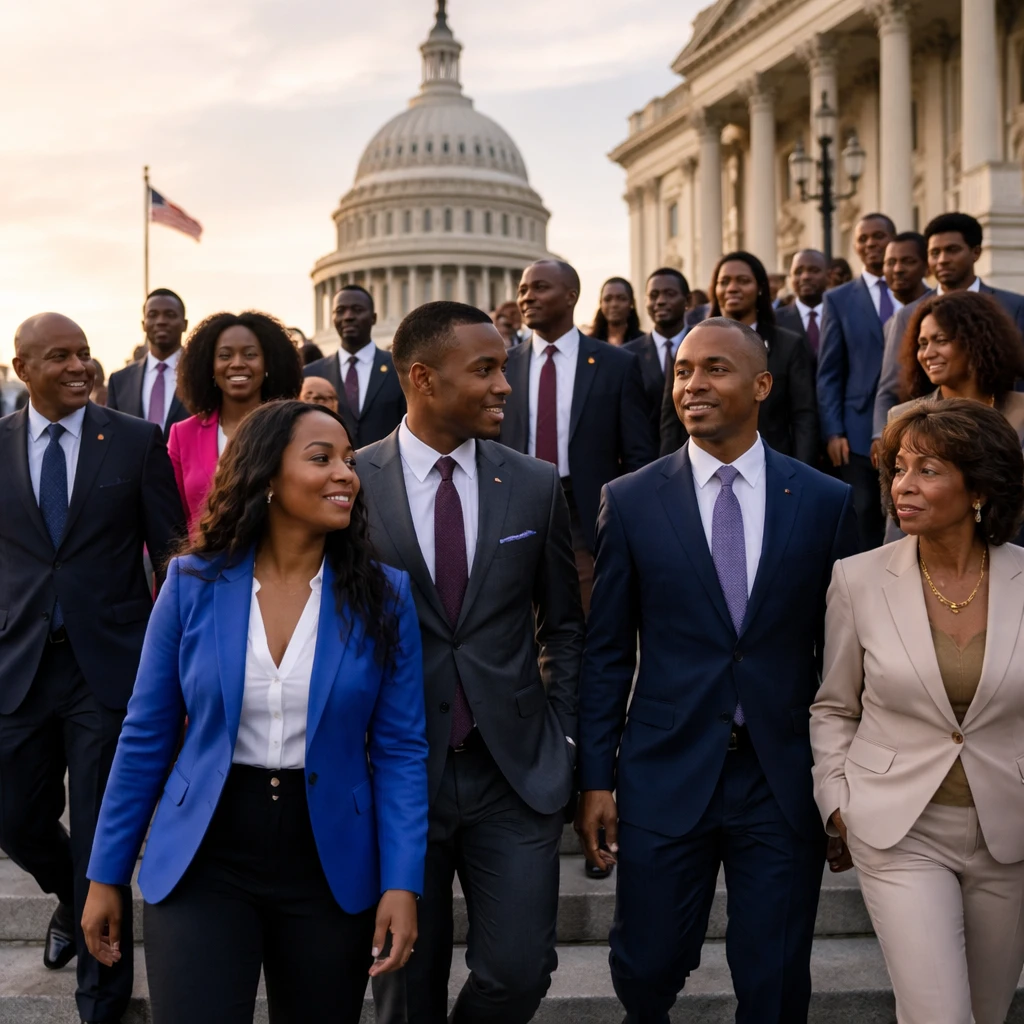
Following November's midterm contests, Congress will welcome an influx of Black Democratic lawmakers in January that federal historians say is the largest first-term group in more than three decades. A Reuters analysis shows 13 newly elected Black Democrats will join the House, marking the largest cohort since 1993. The broader picture also includes an increase in Black representation in the Senate, bringing the total to a high of seven members.
The new arrivals are notable for their youth and recent entry into national office. Four of the incoming Black House members are 34 years old or younger, and more than half of Black House members were first seated in 2021 or later. That generational shift places a younger, less tenured delegation alongside long-serving members, creating a wide range of seniority within Black Democratic ranks.
Political analysts and leaders of the Congressional Black Caucus say the new members could shift legislative priorities toward issues highlighted by the caucus - chiefly voting rights, reducing healthcare costs and addressing economic inequality - but they caution that translating numerical gains into concrete policy wins will not be automatic.
“This points to how important it was for a significant increase in Black representatives and how it pays off 20 to 30 years later,” said Dedrick Asante-Muhammad, president of the Joint Center for Political and Economic Studies, reflecting on parallels to the 1990s when a jump in Black representation later produced influential senior leaders.
Diverse representation and committee leverage
Data from the House historian show that 1993 was a formative year for Black representation, when 16 first-time Black members joined as the new Congress convened, with 17 seated by the end of that term. Several of today's longest-serving Black House members trace their start dates back to 1991 or 1993. Observers point to that prior expansion as evidence that proportional representation can later drive committee placements and policy influence.
“When you have proportional representation in Congress, it does allow for diverse representation across committees. Part of the reason why the Congressional Black Caucus formed is so that they could convince leadership to put Blacks on key committees,” said Andra Gillespie, a professor at Emory University who studies African American leadership in politics.
All current members of the caucus are Democrats. Yvette Clarke, chair of the Congressional Black Caucus and a New York Democrat, said members are being pressed by constituents to adopt bold measures to address affordability and other crises in their communities. Clarke emphasized caucus unity as she outlined priorities she expects the group to pursue once the new Congress convenes.
Redistricting, elections and outstanding runoffs
The larger Black Democratic presence emerged despite Republican-led efforts to redraw district maps following a 2023 Supreme Court ruling that reduced federal protections under the Voting Rights Act. Republican legislatures targeted at least four districts held by Black Democrats in attempts to gain seats, though Republicans have not flipped any of the three decided races mentioned in reporting.
Democrats Shomari Figures and Don Davis won reelection in Alabama and North Carolina respectively, while Leticia Gutierrez, who does not identify as Black, prevailed in a redrawn Texas district previously represented by Democrat Al Green. Two seats in Louisiana remain unresolved and will be decided in December runoffs - outcomes that could affect the final count of Black members in the House.
In one majority-Black Louisiana district that was redrawn in May, Democrat Chauna Banks will face Republican Blake Miguez in a December 12 runoff. In a neighboring district, Democrat Patricia Moore, who led a crowded nine-candidate field with nearly 18% of the vote, will face Republican Gabe Firment, who received 17.2%.
Numbers and balance
For the 120th Congress, Black candidates won 58 seats in the 435-member House, down from 61 in the current Congress, with the two Louisiana races potentially altering that total. Four Black Republicans will leave Congress, leaving US Senator Tim Scott of South Carolina as the only Black Republican in either chamber.
Black representation in the Senate, however, has increased to a record seven members following the election of Democrat Juliana Stratton in Illinois and the upset victory by Mississippi Democrat Scott Colom. These Senate changes occurred alongside the addition of new Black House members and contribute to the overall rise in Black representation on Capitol Hill.
Policy priorities and procedural realities
Advocates and newly elected lawmakers have identified a set of priorities they intend to press when Congress meets in January, including protecting voting rights, addressing healthcare affordability and narrowing economic disparities. US Senator Raphael Warnock, a Georgia Democrat and one of the recent additions to the Senate's Black membership, said lawmakers should begin formulating their agenda ahead of the new session.
Warnock, who campaigned for Scott Colom and donated to his campaign, listed a set of policy goals he intends to pursue, saying, “I’m focused on ending this war, ending these tariffs, and restoring tax credits that will bring people’s healthcare costs down.”
At the same time, institutional and political constraints remain. Major legislation in the Senate typically requires bipartisan support, and a Republican president can veto bills passed by Congress. Those realities mean that even with greater representation, achieving policy objectives will require negotiation and cross-aisle support.
New faces and existing leaders
The cohort of incoming Black House members is noticeably younger in several cases. Melat Kiros, 29, will be the first woman from Generation Z elected to Congress and the first Black woman to represent Colorado. She is among four first-time Black House members who are 34 or younger - joining Darializa Avila Chevalier of New York and Adrian Boafo of Maryland, both 32, and Donavan McKinney of Michigan, 34.
Those newcomers will serve alongside senior Black leaders in the Democratic caucus, including Representative Maxine Waters of California, 88, and Representative Bennie Thompson of Mississippi, 78. The generational and ideological mix within the Democratic ranks - from progressive newcomers to long-tenured lawmakers - is expected to test party cohesion and leadership dynamics.
Reelected Representative Summer Lee, a progressive Democrat from Pennsylvania, characterized her approach as unapologetically progressive and said voters are seeking bold leadership. Observers note that the interplay between progressives and moderates will present a management challenge for party leaders.
At the top of the House Democratic hierarchy, Representative Hakeem Jeffries of New York is the favorite to become House speaker and would preside over a caucus that spans ideological lines. Periloux Peay, a political science professor at the University of Maryland, predicted that Democratic leaders in both chambers will face pressure from a groundswell within their ranks and will need to respond accordingly.
Congressional Black Caucus size and outlook
The Congressional Black Caucus will enter the new session with 64 members, a record, up from 62. Chair Yvette Clarke said she is focused on bridging differences between progressives and moderates within the caucus and expressed confidence in Representative Jeffries' ability to lead the House as required.
The expanded caucus will test its capacity to translate representation into leverage - through committee placements, legislative proposals and coalition building - at a moment when long-standing civil rights protections face legal and political challenges.
What remains undecided
Two House races in Louisiana will be decided in December runoffs and could alter the final tally of Black representation in the House. More broadly, the ability of the new cohort to influence policy will hinge on how many of its members obtain influential committee assignments and whether the Democratic leadership can knit together a legislative strategy that secures the necessary votes in both chambers.
As lawmakers prepare to assume office in January, their numerical gains set up a practical test of whether increased descriptive representation - more Black lawmakers in Congress - will produce stronger substantive representation - tangible policy achievements on the issues Black communities and allied constituencies emphasize.