
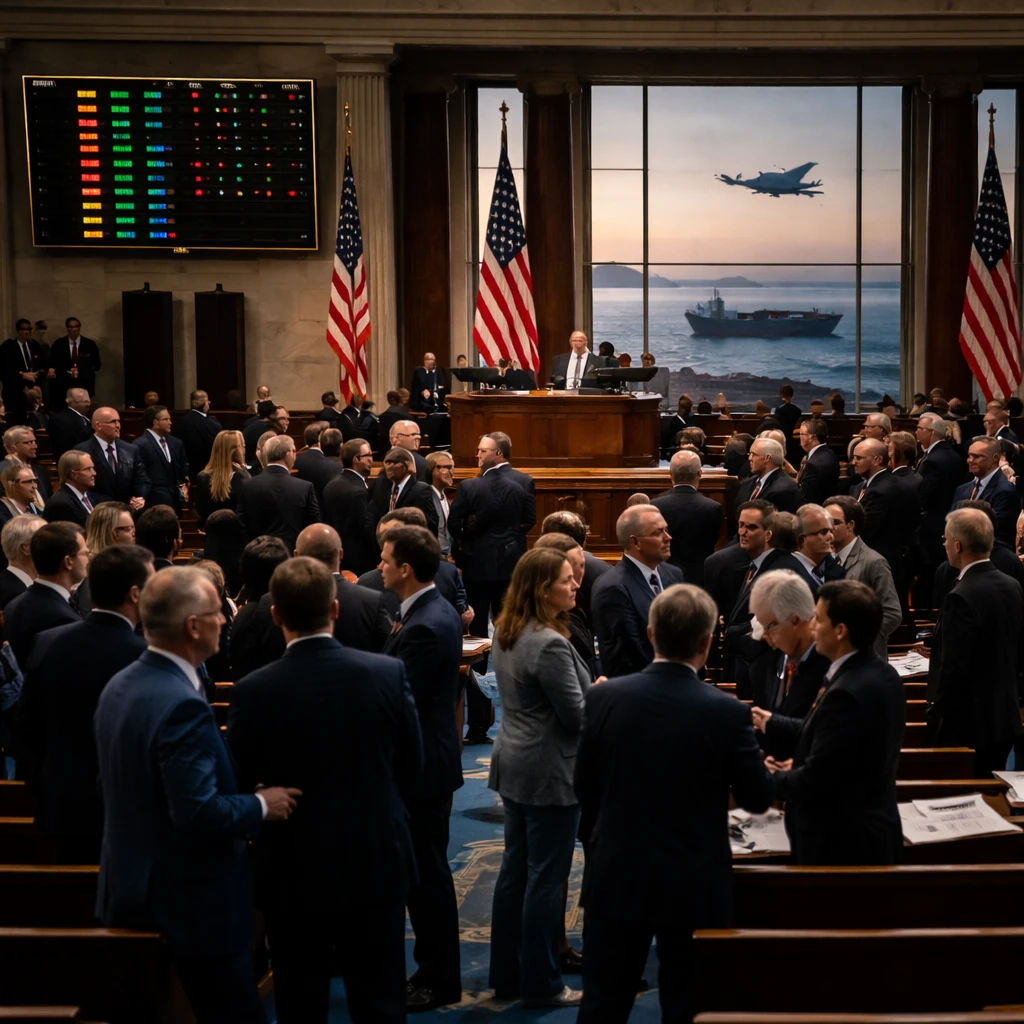
The U.S. House of Representatives on Thursday approved legislation directing the president to stop U.S. military action against Iran, a move that represents a formal rebuke from Congress of the administration's conduct of the conflict. The chamber, under Republican control, passed the war powers resolution by a 214-208 margin.
The measure, introduced by Representative Pramila Jayapal, a Democrat from Washington, instructs the president "to remove the use of United States Armed Forces from hostilities" against Iran unless Congress explicitly authorizes such action. Despite winning the House vote, lawmakers acknowledged the measure is largely symbolic.
Four House Republicans crossed party lines to support the resolution: Tom Barrett of Michigan, Brian Fitzpatrick of Pennsylvania, Warren Davidson of Ohio and Thomas Massie of Kentucky. Republicans hold narrow majorities in both the House and the Senate. The Senate planned to consider a separate but similar resolution later on Thursday.
Observers noted the resolution follows repeated efforts in recent months to constrain executive military action; members pointed out that similar resolutions have passed previously without producing a halt to hostilities. Lawmakers emphasized the distinction between congressional direction and operational decisions being carried out by the military.
The House vote came amid an escalation in regional conflict. President Trump had announced a ramp-up in attacks on Iran and cited the deaths of additional U.S. service members. On Thursday the president pledged "major military punishment" for Iran and for its Houthi allies after fighters from Yemen struck two Saudi oil tankers in the Red Sea. Those strikes extended the Middle East conflict to a second major shipping chokepoint.
In a related development, about two weeks since the effective collapse of an interim truce intended to end the war, U.S. forces launched another nightly series of airstrikes on Iran. Iran responded by firing at U.S. bases in neighboring countries, underscoring the ongoing risk of further escalation in the region.
Key points
- The House passed a war powers resolution 214-208 directing the president to remove U.S. forces from hostilities with Iran absent congressional authorization.
- Four Republicans joined Democrats in voting for the measure: Tom Barrett (MI), Brian Fitzpatrick (PA), Warren Davidson (OH) and Thomas Massie (KY).
- The vote coincided with a U.S. announcement of intensified action against Iran, strikes on Saudi oil tankers in the Red Sea, and reciprocal fire involving U.S. bases and Iran.
Sectors potentially affected - Energy and shipping sectors linked to oil transport through chokepoints; defense and military contractors tied to operations and logistics.
Risks and uncertainties
- Escalation risk: Continued strikes and counterstrikes could further destabilize the region and affect energy transport through key shipping routes.
- Policy impact uncertainty: Despite passage in the House, the resolution is largely symbolic and past similar measures have not halted military operations.
- Operational risk: Ongoing military engagements and reciprocal attacks raise the prospect of additional U.S. service member casualties and disruptions to regional security.