
Politics July 23, 2026 11:36 AM

House Directs Trump to Halt Military Action Against Iran Absent Congressional Approval

Resolution passes narrowly as lawmakers rebuke administration amid rising U.S. casualties and widening maritime attacks

By Marcus Reed
Share
Twitter Reddit Facebook LinkedIn

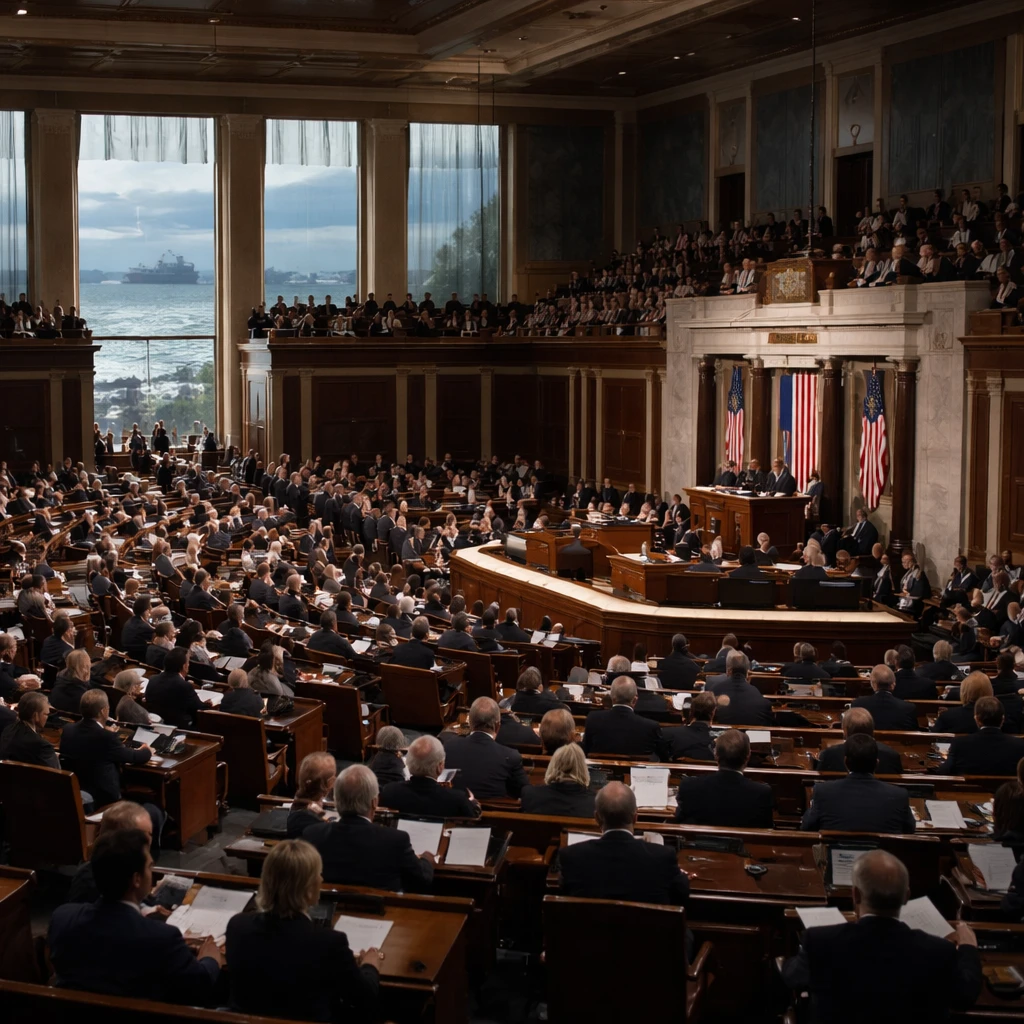
The U.S. House of Representatives approved a resolution instructing President Donald Trump to stop military operations against Iran without authorization from Congress. The measure passed 214-208 with four Republicans joining Democrats. Lawmakers cast the vote after the administration announced increased strikes and additional U.S. service member deaths, and after attacks on two Saudi oil tankers broadened the conflict to a second major shipping route.

House Directs Trump to Halt Military Action Against Iran Absent Congressional Approval
Summarize with
ChatGPT Perplexity Claude Grok Gemini

Key Points

  • House passes war powers resolution 214-208 directing the president to halt military action against Iran without congressional authorization - impacts oversight of defense policy and potential military commitments.
  • Four Republicans crossed party lines to support the measure: Tom Barrett of Michigan, Brian Fitzpatrick of Pennsylvania, Warren Davidson of Ohio and Thomas Massie of Kentucky - highlights intraparty divisions amid narrow Republican majorities in both chambers.
  • Escalation at sea after Yemeni fighters hit two Saudi oil tankers in the Red Sea has widened the conflict to a second major shipping route - relevant to shipping, maritime logistics and energy transport corridors.

The U.S. House of Representatives voted to direct President Donald Trump to cease military action against Iran unless Congress grants approval, delivering a clear rebuke from lawmakers to the administration.

The war powers resolution passed by a 214-208 margin, with four Republican members breaking from their party to join Democrats in support. Representative Pramila Jayapal, a Democrat from Washington, sponsored the measure, which instructs Trump "to remove the use of United States Armed Forces from hostilities" against Iran unless Congress provides authorization.

Lawmakers and congressional aides described the measure as largely symbolic. Members have approved similar resolutions in recent months without halting ongoing military operations, and the text of this resolution does not itself impose new operational constraints on forces in the field.

Republicans who crossed party lines on the vote were Tom Barrett of Michigan, Brian Fitzpatrick of Pennsylvania, Warren Davidson of Ohio and Thomas Massie of Kentucky. Despite these defections, Republicans hold narrow majorities in both the House and the Senate.

The Senate was scheduled to consider a separate but similar resolution later on the same day, underscoring continued congressional attention to the administration's military posture toward Iran.

The House vote came after the Trump administration announced stepped-up attacks on Iran and reported additional deaths among U.S. service members. In response to a strike by Yemeni fighters on two Saudi oil tankers in the Red Sea, the president pledged "major military punishment" for Iran and its Houthi allies, a statement that followed reports of growing hostilities at sea and a widening of conflict to a second major shipping route.

For markets and industries tied to maritime trade and energy shipments, the expansion of hostilities to a second major route presents an added layer of uncertainty. At the same time, defense and logistics networks remain under scrutiny as policymakers debate the scope of military authorization and congressional oversight.


Summary

The House passed a war powers resolution instructing the president to stop using U.S. armed forces in hostilities against Iran without congressional approval. The measure passed 214-208, with four Republicans joining Democrats. The vote followed reports of increased U.S. military action, additional service member deaths, and attacks on two Saudi oil tankers in the Red Sea, which expanded the conflict to another major shipping route. The Senate was set to vote on a similar resolution later the same day.

Risks

  • The resolution is largely symbolic and does not by itself halt military operations, leaving uncertainty about near-term changes to U.S. force posture - affects defense contracting and military logistics planning.
  • Expansion of hostilities to a second major shipping route raises risks for maritime trade and oil transport, potentially disrupting shipping schedules and freight routes - impacts shipping and energy sectors.
  • Ongoing increases in attacks and reported U.S. service member deaths create uncertainty about further escalation and policy responses, with potential implications for markets sensitive to geopolitical risk.

More from Politics

House Passes Measure Ordering Halt to U.S. Military Action Against Iran; Vote Seen as Symbolic Check on President Jul 23, 2026 Sen. Cassidy Signals Backing for Erica Schwartz's CDC Nomination Jul 23, 2026 House Approves $1.15 Trillion Defense Authorization Amid Partisan Rift Over Iran and Israel Provisions Jul 22, 2026 Why New York’s Mayor Says He Cannot Arrest Israel’s Prime Minister Jul 22, 2026 Justice Department Seeks Detailed Records After New Jersey Voting Registration Glitch Jul 22, 2026