
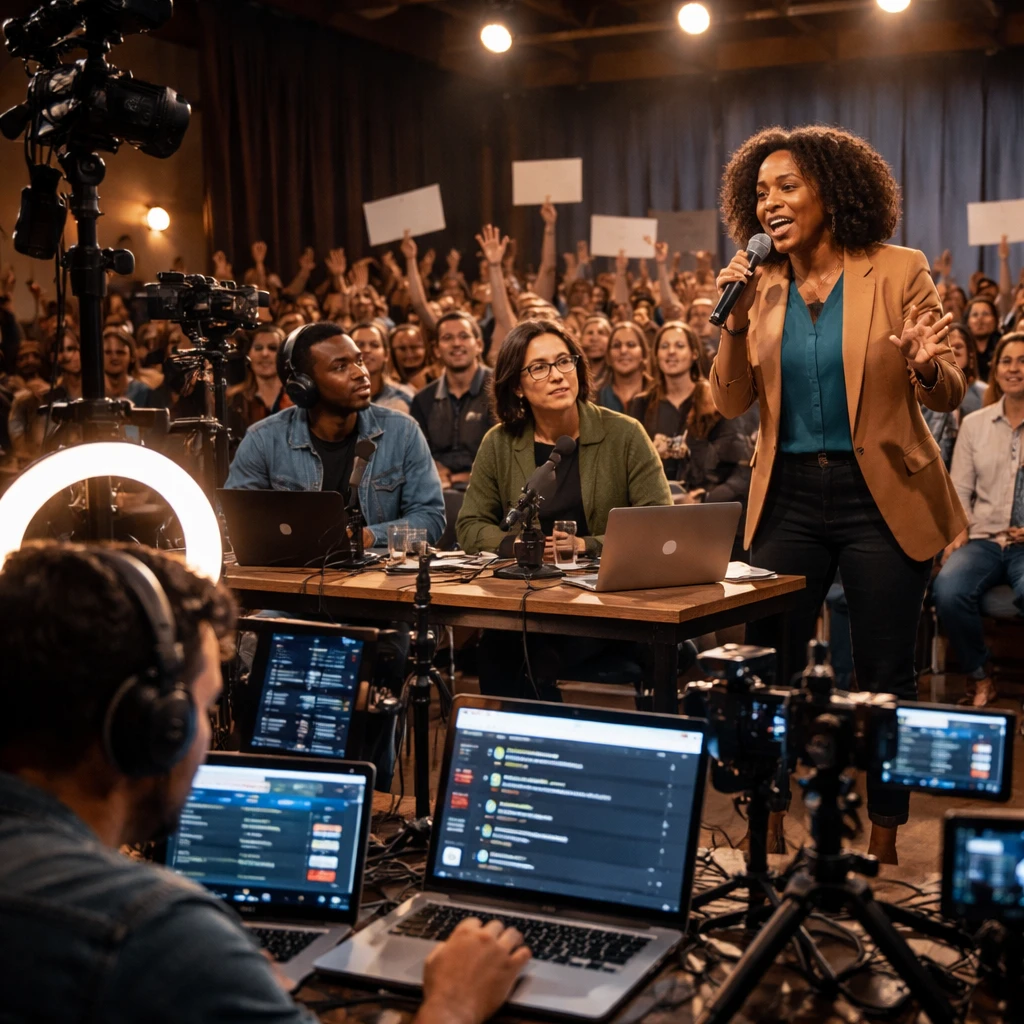
Progressive primary candidates across the United States are increasingly using a burgeoning left-wing media ecosystem to elevate their profiles, connect directly with supporters and raise money without relying on traditional Democratic gatekeepers. That shift has helped insurgent candidates win competitive primaries even when they were heavily outspent on television advertising.
For Pennsylvania state Representative Chris Rabb, a self-described Democratic socialist who recently won a congressional primary against a more moderate opponent, appearances on programs such as "The Majority Report with Sam Seder" and "Breaking Points" were instrumental. "It helps me increase my visibility, validation and ability to raise money,” Rabb said, describing the effect as “a Venn diagram of success.”
This fast-growing media world is made up of websites, podcasts, YouTube shows and livestreamers that blend opinion, journalism and activism. Supporters say the platforms create a sympathetic environment where candidates can elaborate on policy positions, mobilize grassroots networks and generate campaign momentum. Critics and some analysts contend the same phenomenon risks intensifying factional divides within the Democratic Party and making it harder to court moderate voters in general elections.
Primary wins despite heavy TV spending
Observers point to recent primary outcomes as evidence of the media ecosystem’s influence. In Michigan, progressive Abdul El-Sayed narrowly won the Democratic Senate primary against Haley Stevens, who had been the preferred choice of party establishment figures. El-Sayed, a former state health official and a prominent figure in left-wing media, was outspent on television advertising by tens of millions of dollars from pro-Israel and other outside groups, but still prevailed in a swing state that the Republican incumbent carried in 2024.
New media entrepreneurs argue they are filling gaps left by mainstream coverage and are offering sustained attention to ideas that have had limited representation in Washington, such as universal healthcare, abolishing ICE, and a reassessment of military aid to Israel. "There is an audience and a demand and a hunger for different viewpoints," said Mehdi Hasan, who launched his own news organization, Zeteo, in 2024. "The same energy that enabled us to be a success as a media entity has enabled a lot of political candidates to be successes."
Audience growth and platform metrics
While the left’s media network remains smaller and less well-funded than the right-wing media ecosystem, it has grown considerably as audiences shift away from traditional outlets. Zeteo reported 700,000 Substack subscribers, an increase of 50% from a year earlier. "The Majority Report with Sam Seder" has more than 2 million YouTube subscribers, and roughly 75% of its listeners are under the age of 55. Progressive commentator and activist Hasan Piker has amassed more than 3 million followers on Twitch. A separate show started by Jennifer Welch and Angie "Pumps" Sullivan, "I’ve Had It," now reaches an audience of about 5.2 million subscribers and followers across YouTube, Facebook, Instagram and TikTok.
Campaign strategists value the long-form conversations these outlets allow. Unlike brief cable news segments, podcast and stream interviews provide time for detailed policy discussion, direct engagement with voters and the production of shareable clips that campaigns can distribute across social platforms. "I think we help create early enthusiasm," said Sam Seder, noting that his audience includes activists and organizers who in turn amplify candidates. Jesse Lehrich, a Democratic operative and co-host of the political podcast "Nobody Knows Anything," said candidates frequently traverse the same circuit of creators, which helps them gain exposure to sympathetic audiences.
Interconnected media and candidate ecosystems
The relationship between rising progressive politicians and left-wing media can be mutually reinforcing. Prominent media figures lend credibility and reach to candidates, while candidates provide content and visibility that help media hosts build their brands. "It’s interconnected," Mehdi Hasan said. "I don’t think one is necessarily leading the other."
Many of the personalities that have become influential in recent years are unabashedly partisan. For example, Krystal Ball, co-host of "Breaking Points," participated in a livestreamed August fundraiser for El-Sayed and other Michigan progressive candidates. Hasan Piker campaigned in support of Francesca Hong, who seeks to become the first democratic socialist governor of Wisconsin, and joined El-Sayed’s election night gathering in Detroit, writing on X that "The work is only beginning." Piker has faced controversy for prior statements, including comments he later described as "inappropriate." He did not respond to a request for comment.
Those controversies coexist with very engaged audiences. Piker’s daily Twitch streams attract devoted viewers and feature extended, free-wheeling discussions on divisive topics, a format similar in function to other high-engagement podcasts on the right. For hosts such as Seder, the objective is often to educate and energize an already-aligned base rather than to persuade undecided swing voters. "We may be preaching to the choir, but the choir is then going out and preaching to the independents," Seder said.
Mobilization, endorsements and grassroots reach
Candidates who gain traction in this space benefit from enthusiastic activist networks that can translate media attention into volunteer efforts, small-dollar donations, and field organizing. The podcast "I’ve Had It" moved from cultural commentary into political coverage during the 2024 presidential campaign, securing interviews with national figures and attending the party convention in Chicago. Host Jennifer Welch described listeners as turning to their show for both news and opinion. Welch endorsed El-Sayed on-air and called the decision a "layup," arguing the Democratic base has moved further left than some establishment actors realize. "I think candidates like Abdul are the future of the Democratic Party if we are to be an opposition party," she said.
Analysts’ caution on party unity and general election dynamics
Political scientists and party strategists warn that media-driven insurgency can have trade-offs. Hans Noel, a professor of government at Georgetown University, said these creators and outlets "energize voters who find the party’s platform too lukewarm or uninspiring." At the same time, Noel added, "factional voices are not always interested in compromise," which could complicate post-primary efforts to broaden appeal.
That potential for alienating moderates is a recurring concern because some recent primary winners who succeeded inside the left’s media ecosystem now face the task of building a wider coalition in general elections. The interplay between new-media influence, traditional television advertising funded by outside groups, and voter preferences will be an area to watch as nominees seek general election viability.
As the left’s digital media ecosystem continues to expand, its role in shaping candidate visibility, fundraising and activist mobilization will likely remain central to progressive primary strategies. The same networks that raise up insurgent candidates may also test party cohesion and influence how nominees approach more moderate constituencies in subsequent campaign phases.