
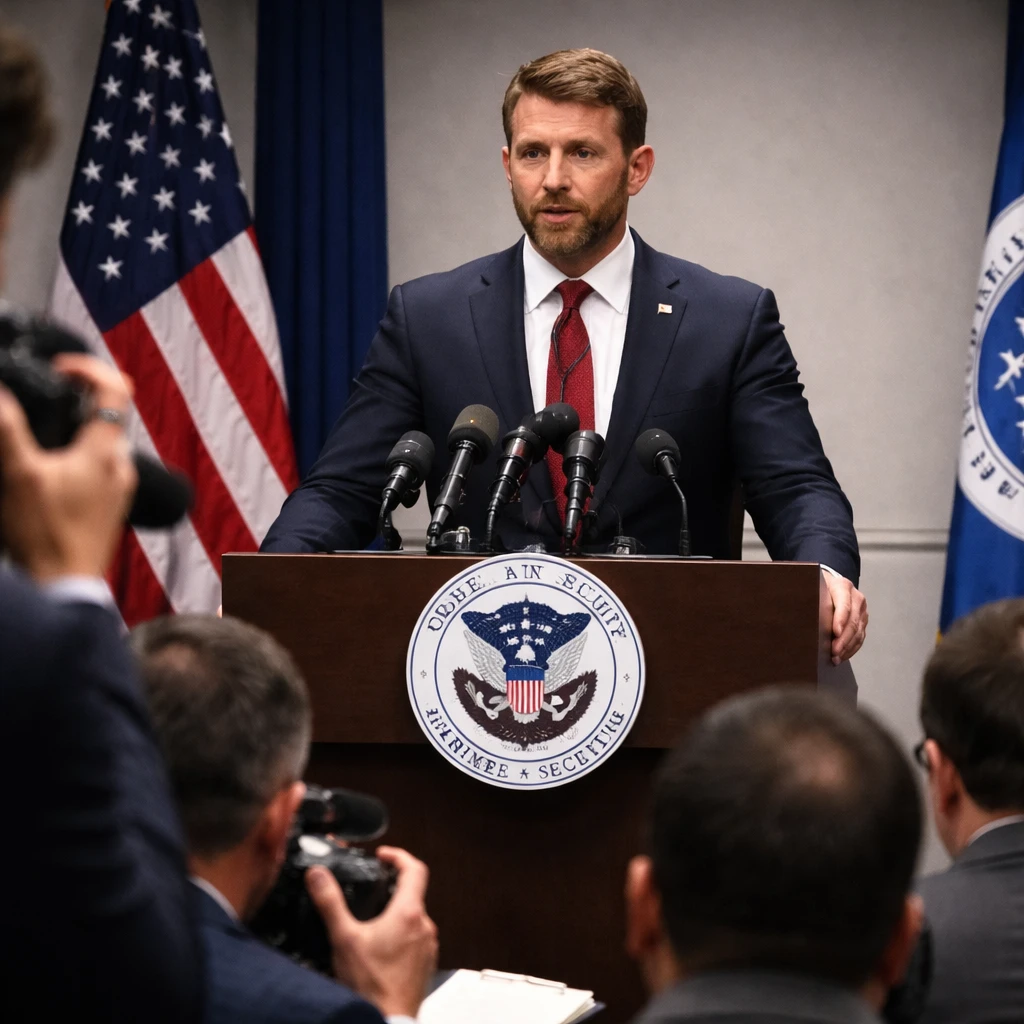
WASHINGTON - U.S. Department of Homeland Security (DHS) Secretary Markwayne Mullin on Friday warned state election officials that they could be subject to fines, penalties and potential criminal prosecution if they fail to implement federal guidance intended to prevent non-citizens from voting and to harden election infrastructure.
Speaking at a news conference held after President Donald Trump’s prime-time address on election security, Mullin outlined a series of actions DHS wants states to take. Those steps include safeguarding voting machines and conducting reviews of voter registration rolls to confirm citizenship status.
"If the election officials, once we gave them the information they need to secure their elections, and they chose not to, then those individuals can also be held accountable by fines, by penalties, and even depending on how far it goes, prison time," Mullin said.
The remarks followed a renewed push by the president to make election security a central theme in the run-up to November’s midterm elections. In his remarks Thursday evening, the president asserted that China interfered in the 2020 presidential campaign - a claim at odds with a U.S. intelligence assessment that found no evidence to back that allegation.
Alleged non-citizen registrations and state pushback
Mullin said DHS had identified more than 250,000 potential non-citizens registered to vote across four states and sent a letter to the secretaries of state in California, New Jersey, Nevada and Pennsylvania asking them to examine their voter rolls and respond within two weeks.
The department listed potential violations in each state but did not produce supporting evidence for its tallies, and Mullin did not disclose the criteria DHS used to arrive at those figures.
Nevada’s top election official disputed the DHS numbers. Secretary of State Francisco Aguilar said in an email that the state "refutes these claims" and described the figures as "wildly speculative at best," adding that DHS has not provided information to substantiate the counts. Aguilar also noted Nevada has supplied DHS with detailed descriptions of how it maintains its list of eligible voters and the safeguards in place to prevent fraud.
Pennsylvania Secretary of State Al Schmidt said his office would examine the information provided by DHS "to evaluate the validity of these claims," but said Pennsylvania would not release citizens’ private data. He emphasized that in Pennsylvania every voter must verify identity before voting and stated that "all evidence has shown that noncitizen voting is extremely rare across the country, including in Pennsylvania."
California did not reply to a request for comment regarding the DHS correspondence. New Jersey pointed to a joint statement from 24 Democratic governors that criticized the president’s assertions about election fraud as attempts to intimidate and silence voters.
Federal efforts, voting machines and evidence
The Trump administration has previously sought to obtain state voter rolls, an effort that courts have blocked, dealing a setback to attempts to expand the federal role in managing elections. The administration’s broader campaign includes repeated claims that the 2020 election was rigged, that mail-in ballots are prone to fraud, that voting machines are unreliable and that non-citizen voting is widespread.
Numerous courts and recounts related to the 2020 election found no evidence of large-scale fraud.
At the news conference, Mullin asserted that foreign adversaries "have parts that are vital pieces in our voting machines," and that they "can access what they consider the key to the back of these machines." He added that such actors "can change voter registration and your vote. We know it’s possible." Mullin did not present evidence to substantiate those claims.
The article’s source material notes there have been no known direct attacks by foreign countries to manipulate U.S. elections.
Mullin also said the Cybersecurity and Infrastructure Security Agency (CISA) will publish an "updated election infrastructure plan within 30 days." CISA did not immediately respond to questions about the updated plan.
Context within the political landscape
The administration’s renewed focus on election security comes as Republicans face the possibility of losing one or both chambers of Congress in the November midterms. The president’s approval ratings have been reported as weighed down by public reactions to the Iran war and elevated energy prices, factors cited alongside election-related messaging as shaping the political environment ahead of November.
As states evaluate DHS’s claims and requests, officials in at least some of the targeted states have publicly contested the department’s assertions or indicated they will review the information while protecting voter privacy.
Reporting in this piece reflects statements and claims as provided by federal and state officials and public remarks; where officials or agencies did not provide supporting evidence for assertions, that limitation is noted.