
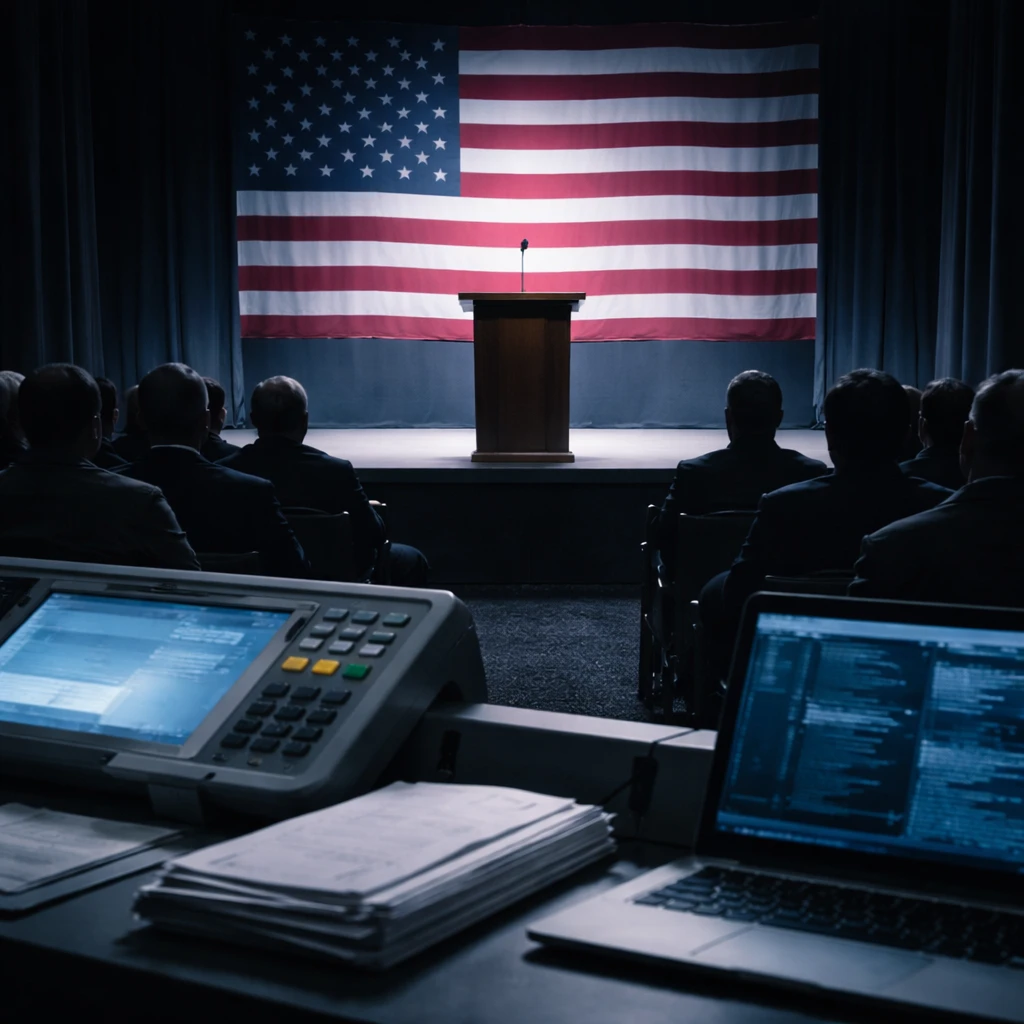
WASHINGTON, July 16 - If President Donald Trump repeats claims in a planned national address that the 2020 presidential election was stolen from him, experts say he would not merely be revisiting previously debunked theories. They warn such rhetoric could pose a direct challenge to the perceived integrity of upcoming U.S. elections, including the November midterms.
Reporting has indicated that the speech could touch on alleged vulnerabilities in voting machines and that the White House was considering releasing contested intelligence related to China’s supposed intentions or capabilities to interfere in the 2020 vote. Those lines of argument are familiar from Republican-aligned conspiracy narratives that suggest Beijing or other foreign powers swung the election in favor of President Joe Biden.
There is no credible evidence that the 2020 balloting suffered meaningful tampering, according to eight academics, analysts and security experts who spoke with Reuters. They described the 2020 contest as one of the more transparent, heavily audited and litigated elections in recent memory. Several of those experts said that resurfacing claims about foreign manipulation appear to be part of a broader strategy to assert control over how elections are perceived and to cast doubt on future outcomes that do not favor the Trump administration.
"The purpose of litigating this is to set the stage for the upcoming midterms so that the Trump administration can claim that any election that does not go their way is illegitimate," said Eva Galperin, director of cybersecurity at the Electronic Frontier Foundation, an organization that works on election security issues.
Eddie Perez, a board member at the OSET Institute, which aims to bolster public confidence in elections, expressed a similar view. Perez said messaging expected from the announcement would likely be calibrated, at least in part, to influence perceptions about future contests. "If his party loses, he can cry foul," he said.
White House spokeswoman Karoline Leavitt has described reports about the speech's content as speculative. "The truth is, nobody knows yet what President Trump will ultimately say," she said.
Trump continues to assert that he won the 2020 election, and three days ago he posted a digitally altered photograph of President Biden wearing an "I Lost to Trump" hat. Trump and his allies have previously argued they were denied victory by widespread fraud.
Experts acknowledge that foreign actors and hackers routinely attempt to influence U.S. elections and that electronic voting technology - like other computerized devices - is not immune to cyberattacks. However, Princeton University professor emeritus Andrew Appel, a long-time election-security researcher, said no credible evidence has been offered to show voting machines were compromised in a way that altered the outcome of the 2020 election.
Appel said outlandish theories advanced by some Trump supporters - including claims involving mysterious satellites, special inks or ballots allegedly imported from China - "make no sense technologically."
On the question of foreign influence, a document created by officials within the current administration's intelligence apparatus was cited as showing limited activity. An unclassified summary of a classified assessment issued by multiple intelligence agencies in early 2021 reported that Russian actors had amplified support for Trump, Iranian actors attempted to undercut him, and that China remained on the sidelines.
Renee DiResta, an associate research professor at Georgetown University who studies digital disinformation, said any effort to revise that intelligence assessment after the fact would serve to advance a narrative that elections are not free and fair and therefore require greater federal oversight. She framed such a revision as a mechanism for promoting increased federal control over election administration.
Analysts and security specialists who reviewed the available evidence emphasized that repackaging previously discredited claims risks eroding voter confidence in institutions and processes that underpin democratic contests. They cautioned that the timing and framing of the planned speech could influence public perceptions well ahead of the midterm elections.
Key takeaways and expert observations are laid out below to clarify how the arguments under discussion relate to election administration and public confidence in the voting process.