
A new Reuters/Ipsos poll finds that just over half of American adults - 53% - say they are worried that advances in artificial intelligence could cause them or another member of their household to lose their job. The six-day survey, completed on Monday, captured opinions across a broad cross-section of the population and found the concern was distributed relatively evenly by age, gender and education level.
Respondents who said they did not worry at all accounted for 37% of the sample, while 10% were either unsure or chose not to answer the question. The poll questioned 4,531 adults nationwide and carries a margin of error of plus or minus 2 percentage points.
Political and educational differences
The survey revealed notable differences by party affiliation. Some 61% of Democrats reported worrying that AI could take jobs in their household, compared with 47% of Republicans. The poll also found patterns tied to educational attainment: 50% of college graduates said they use AI regularly, compared with 34% of people without degrees and 40% of respondents overall.
Personal stories and professional concerns
Some respondents described direct effects or suspected impacts on their employment. Jennifer Schalhoub, a 62-year-old freelance writer in Little Ferry, New Jersey, said she recently lost a job that involved writing letters to government officials advocating for specific policies. Schalhoub said she suspects AI played a role in that loss.
"AI is taking over because people care less and less about the quality of the work that gets produced," Schalhoub said.
The poll comes amid a series of company announcements and workforce moves tied to AI strategies. For example, software maker Intuit notified staff last month that it would eliminate 17% of its global workforce as part of a plan to streamline operations and concentrate on key priorities, including AI efforts.
Many of the publicly disclosed job cuts linked to AI so far have occurred at technology firms, and the poll highlights uncertainty about whether those reductions will translate into a broader hit to the U.S. labor market. The U.S. economy has produced strong job gains in recent months, leaving open the question of how aggregate employment will evolve as AI adoption continues.
Broader anxieties about AI applications
Beyond the employment dimension, the survey documents widespread concern about the increasing use of AI across other domains. Some respondents expressed unease about AI's potential roles in political messaging, entertainment and even warfare - themes that have prompted warnings from elected officials and, as cited in the poll, from Pope Leo XIV.
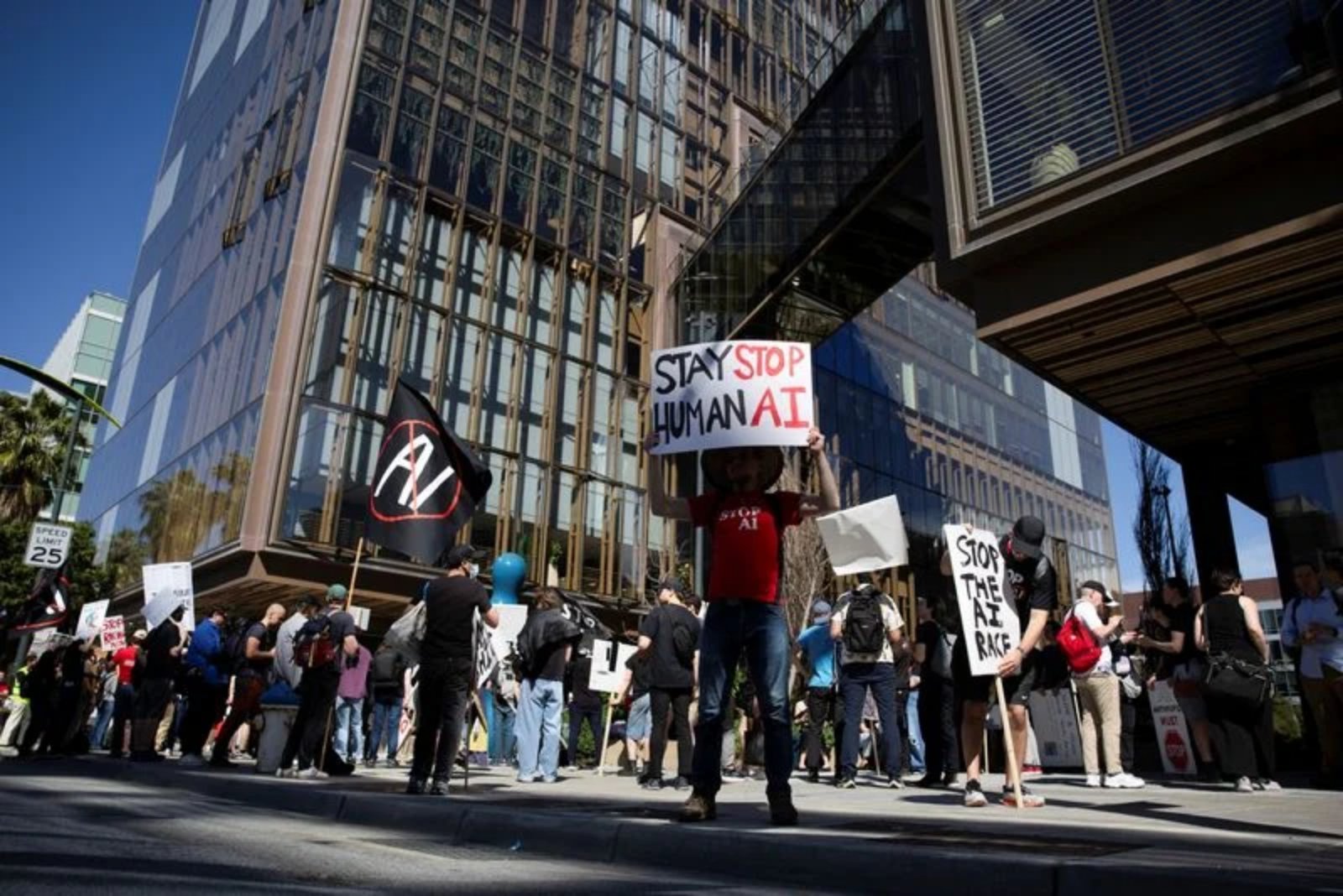
The poll also references episodes of public pushback against AI. For instance, University of Arizona students booed Eric Schmidt when he discussed AI's impact at a graduation ceremony.
Public attention to AI surged after OpenAI released ChatGPT in 2022, a consumer-facing product capable of answering questions in a conversational style and offering a different approach to internet search that presented a challenge to Alphabet. Other major AI companies have also drawn attention: Anthropic has secured corporate customers, including for purchases of its coding assistant Claude Code, and both Anthropic and OpenAI have generated significant market interest with plans to offer shares to the public.
Rising concern and mental health questions
The Reuters/Ipsos poll found that 73% of Americans said they worried about increased use of AI, a figure that edges up from 68% who expressed a similar concern in a 2023 Reuters/Ipsos poll. The survey captures not only economic anxieties but also questions about AI's place in personal services.
Lauren Hayes, a clinical psychologist in Washington state, said some of her clients reported consulting AI between therapy sessions to help with anxiety. Hayes voiced reservations about the technology's capacity to match human nuance.
"I don’t believe that artificial intelligence is able to have the nuance that a person has," Hayes said.
Overall, the poll conveys a mix of practical workplace concern and broader societal unease as AI technologies are adopted more widely. How those attitudes translate into labor market changes, regulatory responses, or shifts in consumer behavior remains to be seen based on the facts captured in this survey.