
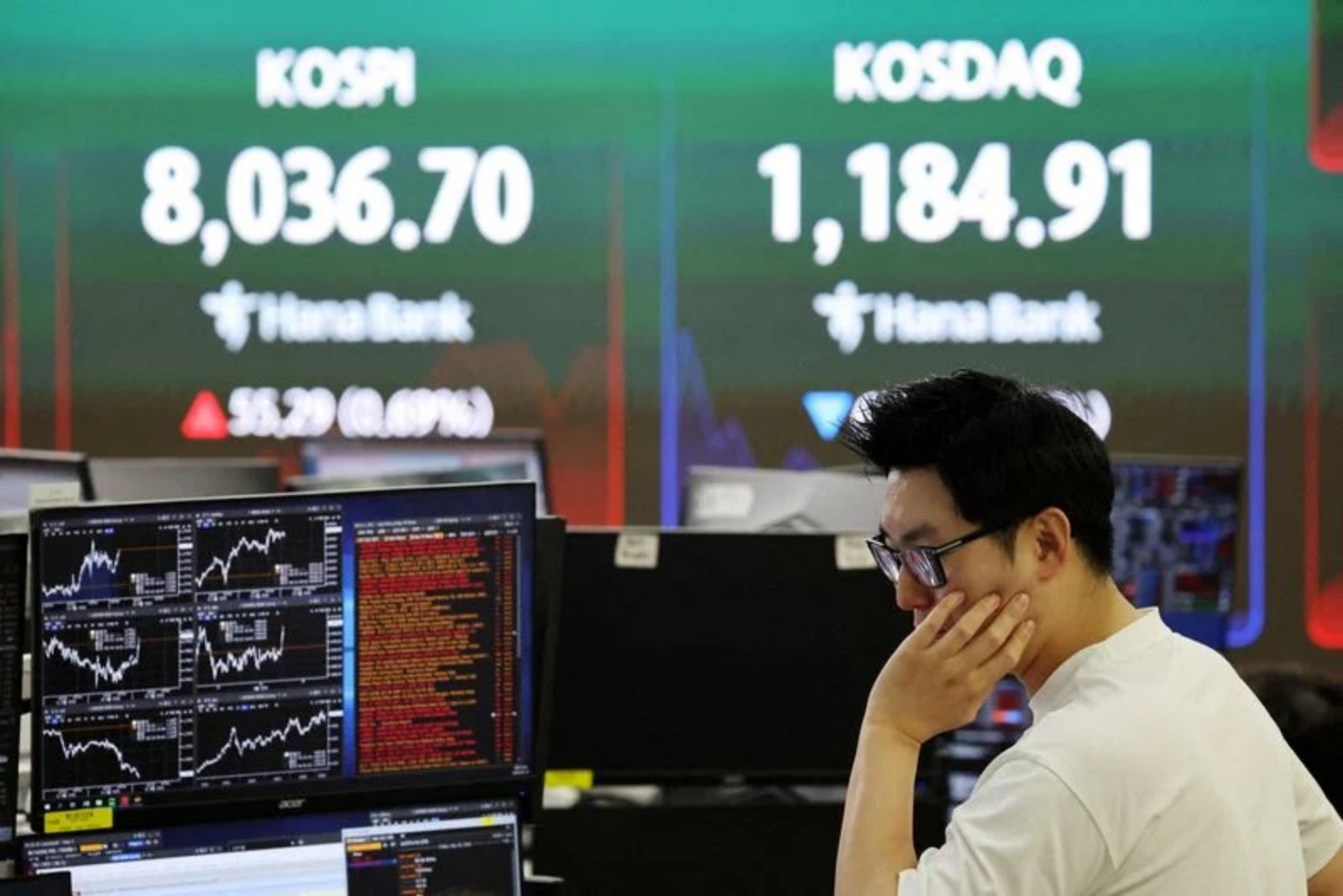
Foreign capital has tipped out of Asian equity markets at an accelerating pace this month as a confluence of rising Middle East tensions and a retreat in AI-linked technology stocks prompted investors to pare exposure.
Data compiled by LSEG for exchanges in South Korea, Taiwan, Thailand, India, Indonesia, Vietnam and the Philippines shows a net withdrawal of $27.08 billion from regional stocks so far in June. That total exceeds the combined net outflow of $24.08 billion recorded in May.
The MSCI Asia Pacific Index, which reached an all-time high of 284.05 last week, has come under strain recently. Lower-than-expected second-quarter results from chipmaker Broadcom and fundraising plans by Meta dented appetite for the technology sector, and the index is down 4.34% so far this month.
Market analysts say the move underlines concentration risks tied to the technology and AI segments. "The recent pullback highlights concentration risk in technology and AI-related stocks," said Linh Tran, a market analyst at XS.com. "These moves show that AI and semiconductor stocks remain a key pillar of market leadership, but also represent the biggest source of risk if growth expectations begin to be repriced," Tran added.
South Korea and Taiwan - two regional exporters of AI hardware and semiconductors - have borne the brunt of foreign selling. Foreign investors have sold a net $12.63 billion of South Korean holdings and $8 billion of Taiwanese holdings so far this month. In May, foreigners sold $27.88 billion of South Korean stocks but were net buyers of $8 billion of Taiwanese shares.
India has also recorded meaningful foreign net outflows, with $5.91 billion withdrawn in June compared with $3.45 billion of selling in May. The Reserve Bank of India last week left its benchmark interest rate unchanged while revising its growth and inflation outlook for the current fiscal year - lowering growth to 6.6% from 6.9% and raising core inflation forecasts to 4.7% from 4.4%.
Elsewhere in the region, foreign investors sold Indonesian and Philippine stocks worth $571 million and $29 million, respectively. Conversely, they were net buyers of Thai and Vietnamese equities, purchasing $55 million and $5 million, respectively.
Some market strategists expect the recent weakness to be temporary. "Despite renewed anxiety over rates, equity issuance, and geopolitics, we expect the rally to resume," said Mark Haefele, chief investment officer at UBS Global Wealth Management. "Although tech stocks have come under pressure in recent days amid concerns about whether expectations can be met, business fundamentals remain strong."
Context and implications
The regional outflows and the retreat in technology-focused shares highlight how concentrated positioning in AI and semiconductor names can amplify market moves. Countries with large semiconductor export profiles have seen the largest investor withdrawals, while other markets experienced mixed flows.
Investors and policymakers will likely watch further earnings reports, corporate funding actions, and geopolitical developments for signals about whether the recent selling is a short-term correction or the start of a broader re-pricing of growth expectations.