
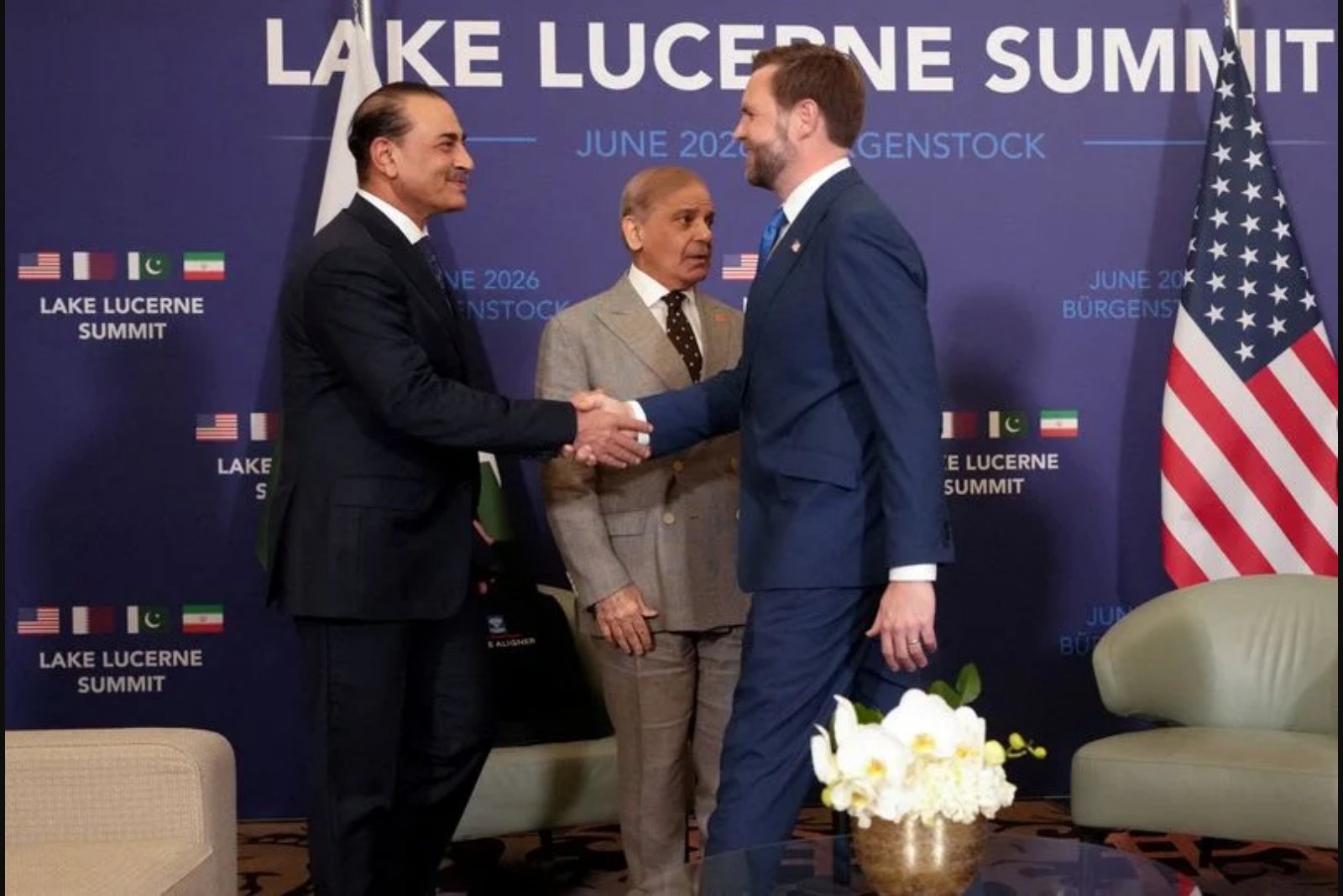
Pakistan’s recent role in brokering a diplomatic breakthrough between Iran and the United States has elevated Islamabad’s standing on the global stage, creating a window for potential economic gains even as experts warn that the country’s entrenched economic problems will not be solved by goodwill alone.
Prime Minister Shehbaz Sharif and army chief Field Marshal Asim Munir attended the high-level talks at the Swiss resort of Buergenstock last weekend, the culmination of months of Pakistani mediation in one of the world’s most delicate diplomatic negotiations. U.S. Vice President JD Vance greeted Munir in the resort town, saying "This guy. What’s up, man?" and embraced the army chief. Leaders and delegations from several countries publicly thanked Pakistan for helping to ease a conflict that risked long-term disruption of the Strait of Hormuz, interruptions to global oil supplies and broader damage to the world economy.
Pakistan, home to roughly 250 million people, now faces the prospect of translating that international recognition into concrete economic benefits. Officials and analysts point to opportunities ranging from deeper regional trade links to expanded cooperation in defence, energy and technology. Yet they caution that such returns will be limited if Islamabad fails to address long-standing structural weaknesses.
Khurran Schehzad, an adviser to Pakistan’s finance minister, said the country’s enhanced reputation as a stabilising actor abroad could make it "a more credible destination for investment." He argued that pairing a growth-oriented economic strategy with a reputation for advancing stability could help attract capital into people, infrastructure, technology and growth sectors.
Analysts have flagged several potential channels for economic benefit. Alex Vatanka, senior fellow and director of the Iran program at the Middle East Institute, highlighted the "huge potential to be a more integrated part of the broader Middle East" and to eventually build wider economic and defence partnerships across the region. Former finance minister Miftah Ismail noted that possible sanctions relief for Iran could enable substantial trade flows across the Balochistan land border between the two countries.
Despite these possibilities, several commentators recalled that diplomatic alignment with major powers has produced limited economic transformation in the past if domestic weaknesses remained unaddressed. After the September 11, 2001 attacks and the U.S. invasion of Afghanistan, Pakistan’s alignment with Washington facilitated debt rescheduling from multiple bilateral creditors, renewed support from the IMF and other multilaterals, and U.S. assistance. Yet, analysts say, Pakistan did not fully capitalise on that moment because persistent structural issues undercut sustained progress.
Khurram Husain, an economic commentator and journalist, contrasted the current role as a peacemaker with Pakistan’s earlier position as a frontline participant in a protracted conflict. He described the present dynamic as one in which Pakistan can be simultaneously useful to multiple powers - including Washington, Tehran, Gulf states, Turkey and China - enhancing its diplomatic leverage in new ways.
Still, former finance minister Miftah Ismail underlined the limits of prestige in addressing the country’s immediate fiscal pressures. "Our house is in such disorder that foreigners can’t really help us unless we help ourselves," he said, arguing that high domestic costs, weak exports and looming external repayments would leave Pakistan dependent on IMF support despite diplomatic gains.
Academic voices urged caution about pursuing short-term financial sweeteners. Asim Ijaz Khawaja, a Harvard professor and director of the Harvard Center for International Development, recommended that Pakistan avoid accepting transient fiscal concessions that do not raise productivity. Instead, he advised seeking long-term partnerships in areas such as academic exchanges, scholarships, preferential market access for textiles and IT services, technology transfer, and frameworks for green investment.
Practical diplomatic signs of interest have emerged. Britain’s minister for the Middle East, Hamish Falconer, thanked Pakistan for its role and told Reuters that the UK saw "huge scope for deepening trade links," with a British trade minister expected to visit in the coming months. Diplomats from two other Western governments also said their countries are exploring stronger economic engagement with Pakistan after its mediation efforts; those diplomats asked not to be named.
Atif Mian, a professor of economics, public policy and finance at Princeton University, urged Pakistan to avoid treating diplomacy as a lever for short-term deposits, rollovers or IMF-style relief. He described the more durable prize as a "peace pivot" - an outward- and inward-facing strategy that emphasises regional trade, energy connectivity with Iran, and deeper economic integration with the Gulf and Turkey through exports, technology transfer and interdependent industries.
Analysts stressed, however, that even tangible new economic ties would not by themselves remedy Pakistan’s underlying vulnerabilities. Adeel Malik, an associate professor of development economics at Oxford University, warned that absent structural reforms the country could face severe social and economic strains over coming decades. He pointed to deep-seated grievances among youth and a shrinking middle class directed at the ruling elite, arguing that the prevailing system has prolonged elite control while leaving the broader population economically and socially insecure.
Pakistan has set macroeconomic targets for the coming fiscal year that reflect its need to stabilise growth and inflation. The government is aiming for economic growth of 4.0% and inflation of 8.2% for the next fiscal year. That compares with projected growth of 3.7% in fiscal 2026, which ends in June, and an average inflation rate of 6.7% in the July-May period of the outgoing year. Analysts caution that reaching these targets will depend largely on policy choices and the implementation of reforms that raise productivity and broaden the tax base.
In short, Pakistan’s recent diplomatic achievement has opened new diplomatic and economic doors. But analysts and former officials concur that international goodwill alone is unlikely to resolve the structural economic imbalances that have required repeated IMF support. To translate high-profile diplomacy into lasting economic dividend, Pakistan would need to pursue reforms and partnerships that enhance productivity, expand export capacity and strengthen public finances.
Key points
- Pakistan’s mediation in Iran-U.S. talks has improved its international profile and created opportunities for deeper regional trade, defence ties, and technology cooperation; sectors likely to be affected include energy, textiles, IT services and defence.
- Government targets for the coming fiscal year aim for 4.0% growth and 8.2% inflation, against projected growth of 3.7% for fiscal 2026 and 6.7% average inflation in the July-May period of the outgoing year.
- Analysts recommend focusing on long-term productivity-enhancing measures such as market access for textiles and IT, academic exchanges, technology transfer and green investment rather than short-term fiscal concessions.
Risks and uncertainties
- Structural weaknesses - a narrow tax base, high costs, and weak export performance - could prevent diplomatic gains from translating into sustained economic improvement, impacting public finances and external repayments.
- Continued reliance on IMF support is likely unless Pakistan implements reforms that increase productivity and broaden revenue sources, affecting sovereign financing and investor confidence.
- Social and political tensions driven by grievances among the young and a shrinking middle class could intensify if economic benefits fail to reach broad segments of society, creating risks for domestic stability and long-term growth.