
Economy July 14, 2026 07:44 AM

Britain and EU Finalize Treaty to Streamline Gibraltar Border Crossings

Agreement signed in Brussels sets new ID rules for crossings and outlines airport passport checks as parties look to reduce long-running political uncertainty

By Leila Farooq
Share
Twitter Reddit Facebook LinkedIn

A treaty signed in Brussels on Tuesday by senior British, EU, Spanish and Gibraltar officials formalizes arrangements intended to simplify movements across the Gibraltar-Spain frontier. The agreement allows Gibraltar residents to use residence cards to enter Spain without passport stamps, permits Spanish citizens to cross with a government ID card, and requires arriving air passengers to present passports to both Gibraltar and Spanish border officers. Britain is seeking a model similar to French controls at St Pancras for cross-border checks.

Britain and EU Finalize Treaty to Streamline Gibraltar Border Crossings
Summarize with
ChatGPT Perplexity Claude Grok Gemini

Key Points

  • A treaty signed in Brussels on Tuesday seeks to ease border crossings and clarify Gibraltar's status after years of political uncertainty.
  • Gibraltar residents can enter Spain using residence cards without passport stamps; Spanish citizens may cross using a government ID card.
  • Arrivals at Gibraltar airport will require travellers to present passports to both Gibraltar and Spanish border officers; Britain aims to mirror the St Pancras Eurostar model for cross-border checks.

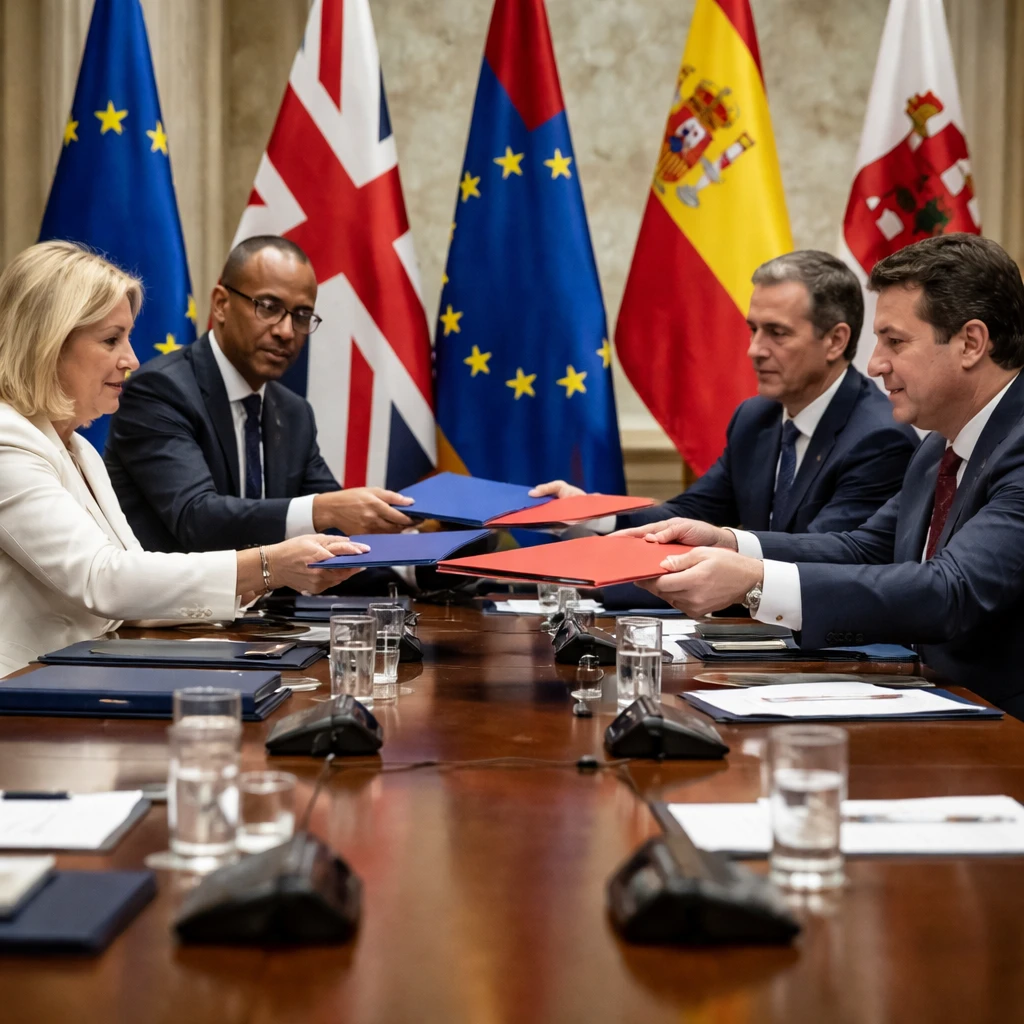
Officials from Britain, the European Union, Spain and Gibraltar signed a treaty in Brussels on Tuesday designed to address the status of Gibraltar and to make crossing the border with Spain easier for residents and visitors.

The document was signed in the Belgian capital by European Trade Commissioner Maros Sefcovic, British Minister of State for Europe Stephen Doughty, Spain's foreign minister Jose Manuel Albares Bueno, and Gibraltar's chief minister Fabian Picardo. The accord follows a separate deal reached last year and is presented as bringing to an end years of political uncertainty surrounding the British overseas territory.

Under the terms of the treaty, people who live in Gibraltar will be able to cross into Spain using residence cards without the need for passport stamps. Spanish citizens will be entitled to use a government-issued ID card to cross the border. The agreement also establishes specific procedures for arrivals at Gibraltar airport: travellers will present passports to border officers representing both Gibraltar and Spain.

Separately, Britain has expressed its intention to put in place a system akin to the arrangement at St Pancras railway station in London, where French police conduct border controls for Eurostar services. The treaty text and the signatories frame that approach as a model Britain seeks to emulate for checks related to Gibraltar.

The origins of British sovereignty over Gibraltar are reflected in the treaty text, which notes that Britain gained control of the territory at the southern tip of Spain through the 1713 Treaty of Utrecht, which concluded the War of Spanish Succession.

The treaty's signatories and the provisions laid out in Brussels mark a formal step toward operational change at land and air points of entry. Further detail on implementation timelines and the specific mechanics of procedures referenced in the agreement was not provided in the text signed on Tuesday.


Sector implications: The provisions have direct relevance to cross-border travel and transport operations, and to the administrative functions of border control authorities. How the provisions are implemented may affect airport procedures and land frontier operations.

Risks

  • Implementation uncertainty - the treaty lays out procedures but does not specify implementation timelines or detailed mechanics for the changes, which could affect operational rollout for border and airport authorities.
  • Operational complexity at Gibraltar airport - the requirement for travellers to present passports to both Gibraltar and Spanish border officers may introduce administrative frictions that will need coordination between the two authorities.
  • Uncertainty over replication of the St Pancras model - Britain seeks a system similar to French checks at St Pancras, but whether and how such a model will be established for Gibraltar remains an open question.

More from Economy

Warsh Signals Fed's Resolve to Prevent Persistent Inflation as Economy Shows Mixed Strength Jul 14, 2026 Australia to Create Central Office for AI Policy and Standards Jul 14, 2026 Australia to centralise AI regulation with new Office of AI in PM's department Jul 14, 2026 U.S. Consumer Inflation Sees Sharp Monthly Drop in June, Led by Lower Gas Prices Jul 14, 2026 Citi Posts 45% Rise in Quarterly Profit as Trading and Deal Fees Surge Jul 14, 2026