
Overview
Deutsche Bank published an analysis indicating SpaceX could reach cost parity between orbital and ground-based data centers in the early 2030s. The bank ties this outcome to SpaceX’s vertical integration strategy, anticipated scale of Starship launches, and incremental improvements to satellite and launch economics.
Starmind architecture and satellite communications
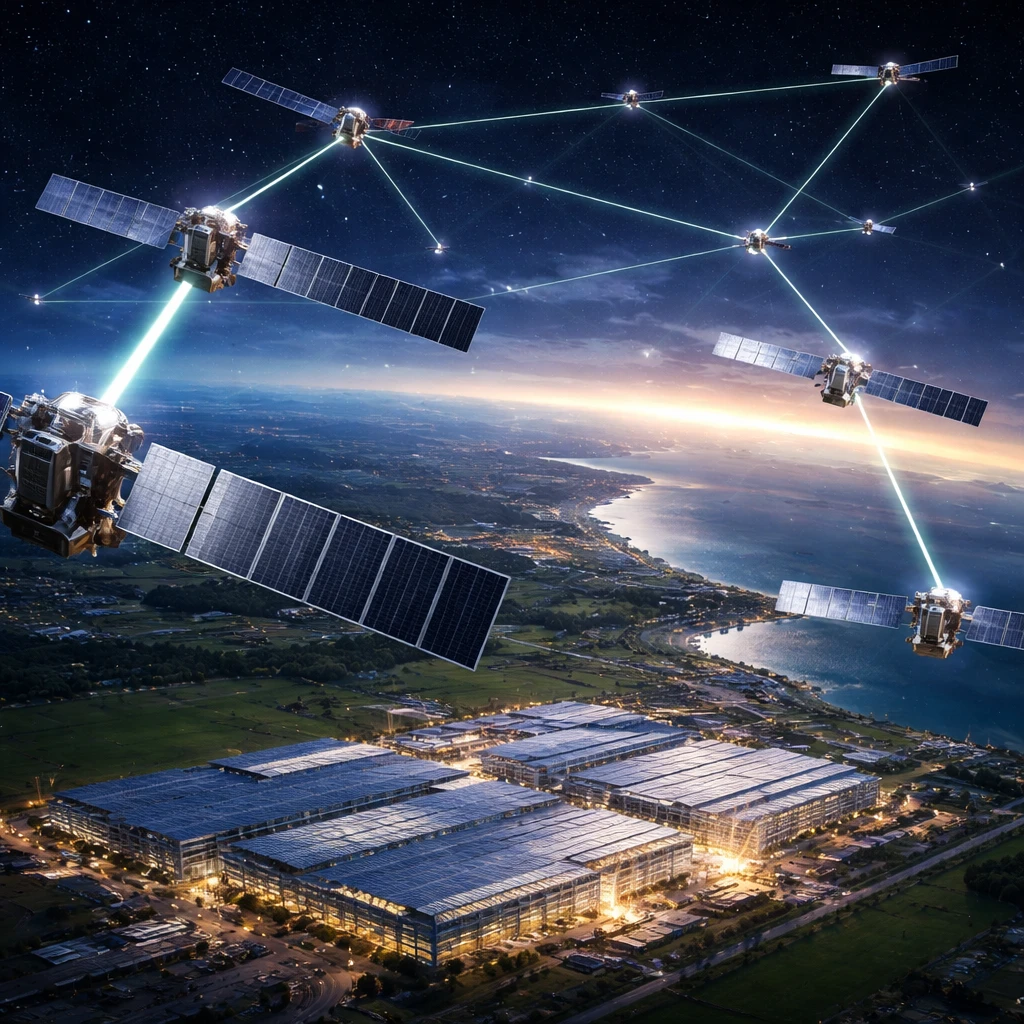
The bank examined SpaceX’s Starmind architecture, built around so-called AI1 satellites that will route traffic via optical inter-satellite links and leverage the existing Starlink network. According to the analysis, AI1 satellites will depend on optical terminals for their primary communications and will not require complex phased-array antennas for inter-satellite routing. The design may include a Ka-band fallback channel for telemetry.
Deutsche Bank estimates the current Starlink constellation exceeds 10,000 satellites in orbit. The bank describes V2 mini satellites as carrying three optical terminals each, with a per-satellite capacity of roughly 600 gigabits per second. It expects V3-class satellites to offer materially higher throughput, possibly in the 2-3 terabits per second range per satellite.
The analysis lists leading suppliers of optical terminals as Tesat-Spacecom (an Airbus subsidiary), Mynaric, SA Photonics (acquired by CACI in 2021), and SpaceX itself.
Spectrum and regulatory changes
SpaceX is reported to be using higher-frequency bands for gateway backhaul, including E-band, V-band, W-band and proposed D-band, in addition to the more traditional Ku and Ka bands. Deutsche Bank notes recent FCC rule updates that replace 1990s-era limits and that, in the bank’s view, could enable up to seven times more capacity from the same satellite count.
On-orbit power, thermal design and prototypes
The bank’s write-up states each AI1 satellite will incorporate a double-sided active deployable liquid radiator spanning 110 square meters, with a dissipation capability of 1,400 watts per square meter. SpaceX is targeting prototype deployments of AI1 satellites late next year and has filed documents with the FCC that describe a potential constellation sizing up to one million satellites in low Earth orbit.
Per the analysis, an AI1 satellite is expected to draw about 120 kilowatts of power - a level Deutsche Bank equates to the consumption of a NVIDIA GB300 NVL72 rack. SpaceX has indicated it would be open to hosting a variety of accelerator hardware, naming Nvidia GPUs, Google TPUs, Amazon Trainium and Tesla AI chips as possible guests.
Onsite solar manufacturing
The bank notes SpaceX is building a solar cell manufacturing facility in Bastrop, Texas, with a target nameplate capacity of 10 gigawatts distributed across two floors. Construction reportedly began in late March and equipment installation is underway. The plant aims to ramp production by the end of 2027 and will initially produce silicon solar cells with about 19% efficiency.
Economics: ground versus orbital compute
Deutsche Bank draws on Epoch AI’s analysis to estimate upfront capital expenditure for 1 gigawatt of AI compute on the ground at $38 billion, with approximately $900 million in annual operating expenses. The bank totals these figures to about $42.5 billion over five years.
Using its model, Deutsche Bank calculates that deploying a 1 gigawatt space-based compute constellation currently costs roughly six times more than the terrestrial alternative when excluding the costs of compute hardware itself. The bank projects that improved Starship reusability and satellite optimization could compress that multiple to about 1.0-1.5 times by the end of the decade, and that orbital deployments could become less costly than ground equivalents in the early-to-mid 2030s.
Implications
The analysis highlights a potential path for orbital compute to move from a significant premium today to cost parity or advantage over the coming decade-plus, conditional on SpaceX meeting expectations for launch scale, satellite efficiency improvements and benefiting from relaxed spectrum constraints.