
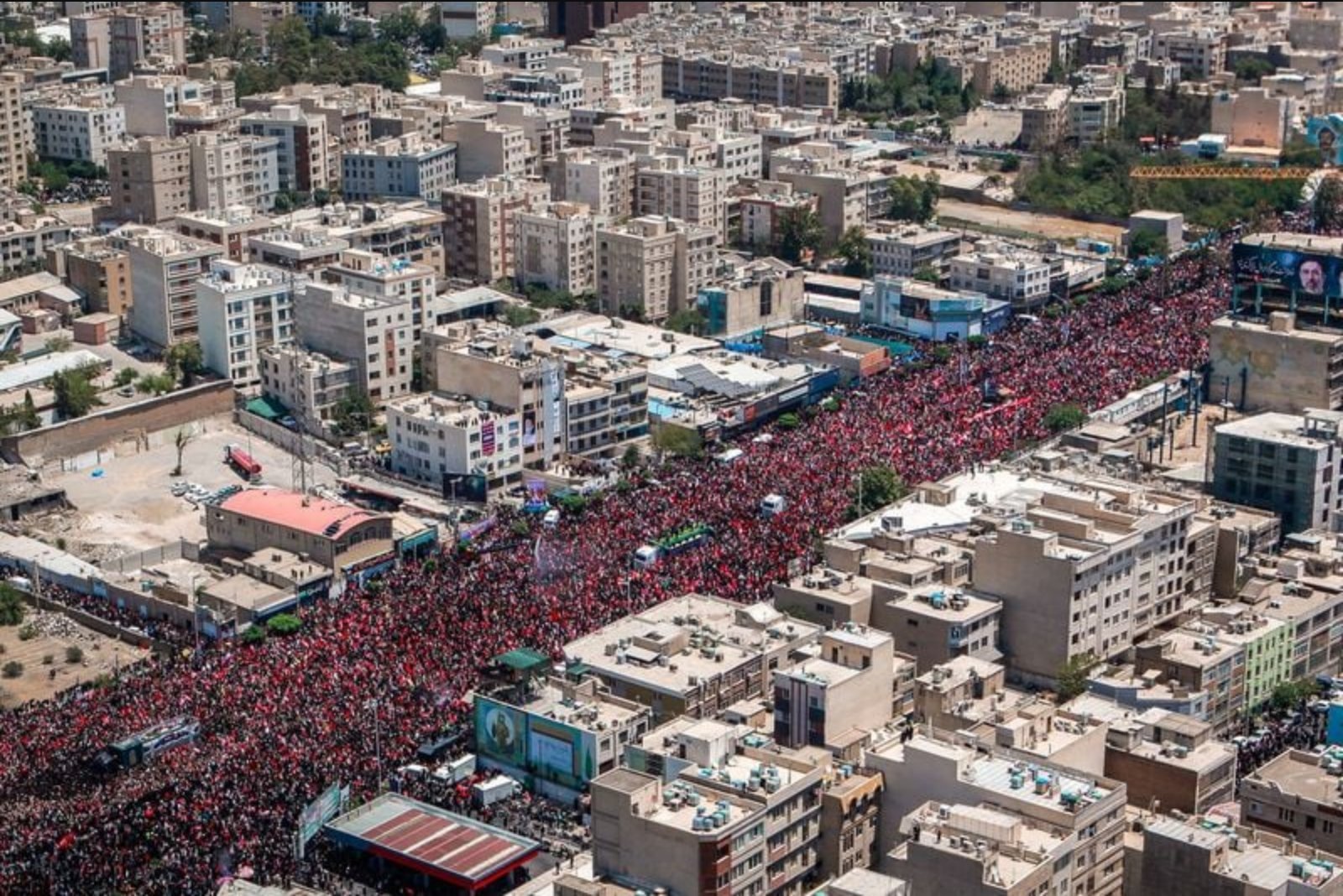
Tehran has been filled with large crowds attending a week of funeral rites and public ceremonies for Supreme Leader Ayatollah Ali Khamenei, who was killed in U.S.-Israeli strikes at the start of the war. The state is presenting the gatherings as a powerful sign of unity and a message of defiance to external adversaries and domestic critics. Yet within and beyond the city, observers and some senior figures warn that the turnout does not necessarily translate into renewed legitimacy for the Islamic Republic.
Officials arranged discounted transport, food and lodging to facilitate attendance, and the scale of the rallies has been described by a top cleric as a kind of referendum on the government. Drone footage circulating online on Monday appeared to show hundreds of thousands of people, though independent verification of precise numbers was not immediately available.
Several analysts and even some Iranian officials have urged caution in interpreting the scenes. "If anyone’s thinking this is a litmus test for the popularity of the Islamic Republic, history tells us otherwise. It’s a funeral, and Iranians do funerals very well," said Ali Ansari, professor of modern history at St Andrews University in Scotland.
People Reuters spoke to at the events said many were there as observers or out of a sense of religious duty rooted in the country’s strong Shi’ite traditions rather than as an explicit political endorsement of the theocratic system.
"My attendance does not mean that I am pro-regime, this big event happened in my country and I wanted to witness history," said Hamidreza, 63, a retired teacher in Tehran who said he always attends funerals of major national figures and asked to withhold his family name.
Those who plan and promote the events are framing the gatherings as evidence of resilience. Authorities highlight a core base of ideological supporters that analysts commonly estimate at roughly 15-20% of Iran’s population of 93 million - a figure that they derive in part from voting patterns that favour hardline candidates. In the 2024 presidential election, for example, the hardline contender Saeed Jalili received around 13.5 million votes.
For Iran, a national funeral for a supreme leader is rare. The last comparable occasion was in 1989 when Ayatollah Ruhollah Khomeini, leader of the 1979 revolution, was buried amid mass displays of public grief and intense ideological fervour. Khamenei’s burial had been deferred until now because Islamic practice calls for a fast funeral and the war delayed interment. That delay also allowed the state to orchestrate an elaborate commemoration.
Supporters of the Islamic Republic have described the recent conflict as existential. During the war’s early days, the U.S. President said that "a whole civilization will die," a line that state-aligned voices have used to underscore the stakes. For some Iranians, attending the ceremonies reflected that sense of shared threat. "If we do not respect our leaders, the world will not respect us," said Houshang Dabiri, 51, who travelled from Shiraz to Tehran for the funeral.
At the same time, several sources acknowledge that the crowds are heterogeneous in motivation. One senior source said the events draw a mix of participants - those who feel religious obligation, those who back the state, and the same cohort who routinely join official demonstrations aimed at supporting the government’s campaigns and policies.
Economic strain and continuing unrest
Underlying the public displays are unresolved and deep economic and social tensions. Four months of war with the United States have compounded pressures on a population already grappling with long-running sanctions, soaring inflation and a weakening currency. Those trends have eroded real wages and heightened economic insecurity.
"I did not attend the ceremony. Why should I be part of their staged show? Instead of such funerals, think about people’s economic problems. We are suffering," said Maryam, 33, a housewife in Tehran.
Anger over economic conditions helped trigger the last round of nationwide protests, which later escalated into broader demands for the end of the theocratic state. Security forces quelled that unrest in January with force, and thousands of demonstrators were killed. Executions of people accused of taking part in the unrest have continued through the year.
When word of Khamenei’s death first spread at the start of the war, some neighbourhoods in Tehran reportedly rang out with cheers, an expression of the complex and sometimes contradictory public emotions at play.
Another former senior official who has attended the funeral events described Iran as divided into several camps: staunch supporters, clear opponents, and a sizeable group in the middle whose primary concerns are economic. Comparing the current funeral to the burial of a patriarch, he said: "Children attend the funeral, but afterwards their disputes begin."
Historical echoes and the fragility of mass displays
Observers note that previous large-scale funerals have not insulated the government from later upheaval. When General Qassem Soleimani was killed in a U.S. airstrike in 2020, central Tehran filled with mourners. Yet two years later, protests ignited by the death of a young Kurdish woman detained over dress code enforcement spread widely and morphed into large-scale demonstrations against the ruling system, which were suppressed with hundreds killed.
The current funeral week is also the first series of public commemorations since the end of the recent war, an interval that has allowed both state planners and critics to reassess their positions. Authorities present a consolidated front, but analysts and several senior sources maintain that public attendance at funerals is not a definitive barometer of political consent.
As Iran moves beyond the funeral events, the core questions identified by participants and observers remain: whether the authorities can translate mobilization into durable public support, whether economic pain will continue to drive dissent, and how the state’s handling of protest and repression will shape stability going forward.
For now, the streets of Tehran offer a visible demonstration of the state’s ability to gather mass support for a national occasion. Beneath that surface, however, political, social and economic grievances persist and are likely to continue shaping Iran’s short-term trajectory.