
Commodities September 23, 2026 10:42 AM

Iran’s President Tells U.N. Iran Will Not Surrender to U.S., But Seeks Diplomatic End to Conflict

Masoud Pezeshkian warns against permanent naval deployments in Strait of Hormuz and calls for negotiations as tensions linger following U.S. statements

By Ajmal Hussain
Share
Twitter Reddit Facebook LinkedIn

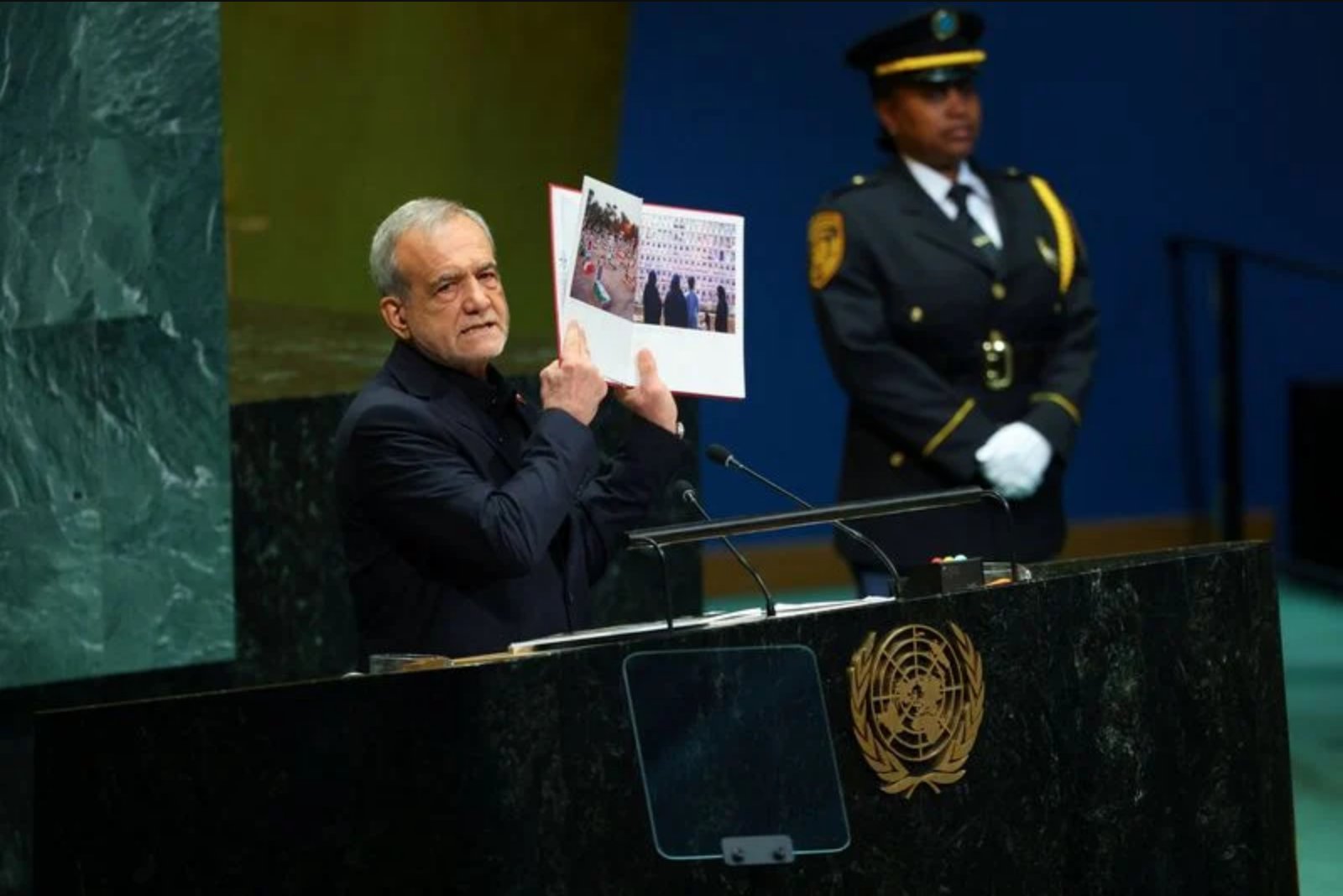
Speaking to the U.N. General Assembly, Iranian President Masoud Pezeshkian said Iran will not capitulate in its war with the United States but emphasized Tehran’s preference for diplomacy to try to end the fighting. His address drew a walkout from the U.S. delegation, and he singled out access to the Strait of Hormuz as a core grievance amid heightened tensions.

Iran’s President Tells U.N. Iran Will Not Surrender to U.S., But Seeks Diplomatic End to Conflict
Summarize with
ChatGPT Perplexity Claude Grok Gemini

Key Points

  • Iran’s president declared that Iran will not surrender in its war with the United States and said Tehran prefers diplomacy to try to end the conflict - impacts diplomatic relations and conflict resolution forums.
  • The U.S. delegation walked out at the start of the Iranian president’s speech; the U.S. mission to the U.N. did not immediately reply to a request for comment - impacts diplomatic engagement and U.N. session dynamics.
  • The Strait of Hormuz, which previously carried about one-fifth of global oil and liquefied natural gas, was highlighted as a focal point of tension between Iran and the U.S. - impacts energy markets and maritime shipping sectors.

At the annual assembly of world leaders at the United Nations, Iranian President Masoud Pezeshkian stated that Iran would not surrender in its war with the United States, while also expressing a belief in using diplomacy to seek an end to the conflict.

Pezeshkian delivered his remarks to the 193-member General Assembly on Wednesday. The United States delegation left the chamber at the beginning of his speech. Officials from the U.S. mission to the United Nations did not immediately respond to a request for comment.

Central to Pezeshkian’s address was the Strait of Hormuz, a waterway that served as a conduit for one-fifth of global oil and liquefied natural gas before the outbreak of war. He described access to that shipping lane as a matter of contention between Tehran and Washington.

"It cannot be the case that everyone benefits from the Strait of Hormuz while we are denied access to shipping through this waterway. The permanent deployment of hostile fleets and the expansion of the war will not lead to peace," Pezeshkian said.

The Iranian leader spoke one day after U.S. President Donald Trump addressed the General Assembly. In his speech on Tuesday, Trump framed the conflict with Iran as necessary to prevent Tehran from obtaining a nuclear weapon and warned that he could "annihilate the Islamic Republic" if no deal is reached to end the fighting.

Pezeshkian’s remarks and the U.S. walkout underscore the strained interaction between the two delegations at this year’s U.N. session. The focus on the Strait of Hormuz highlights the intersection of geopolitical tensions with global energy and maritime routes.

This account is limited to statements made at the U.N. General Assembly and the public reactions described during the session. Where no immediate response could be obtained from the U.S. mission to the United Nations, that lack of comment is noted.

Risks

  • Denial of access to shipping through the Strait of Hormuz could disrupt oil and liquefied natural gas flows - this risk affects the global energy sector and commodity markets.
  • Permanent deployment of hostile naval forces in the region could expand the scope of the conflict and increase instability - this uncertainty affects maritime trade, insurance costs, and energy market volatility.
  • Continued diplomatic standoffs between Iran and the United States, illustrated by the U.S. walkout and contrasting speeches at the General Assembly, leave outcomes uncertain - this affects international diplomatic channels and market sentiment.

More from Commodities

Trump and Venezuela’s Delcy Rodriguez Hold Brief Talks on Restructuring Nation’s Debt Sep 23, 2026 U.S. Energy Secretary Warns Diesel Export Ban Would Backfire, Raising Fuel Costs Sep 23, 2026 Metals Reprice After Pullback: Gold Anchors, Silver Offers Volatility, Platinum for Contrarians, Palladium Remains Speculative Sep 23, 2026 Diplomacy Drives Oil Retreat as Markets Weigh UN Talks and Political Headwinds Sep 23, 2026 Diplomatic Opening Between Washington and Tehran Brings Tentative Hope - Oil Markets Stay on Edge Sep 23, 2026