
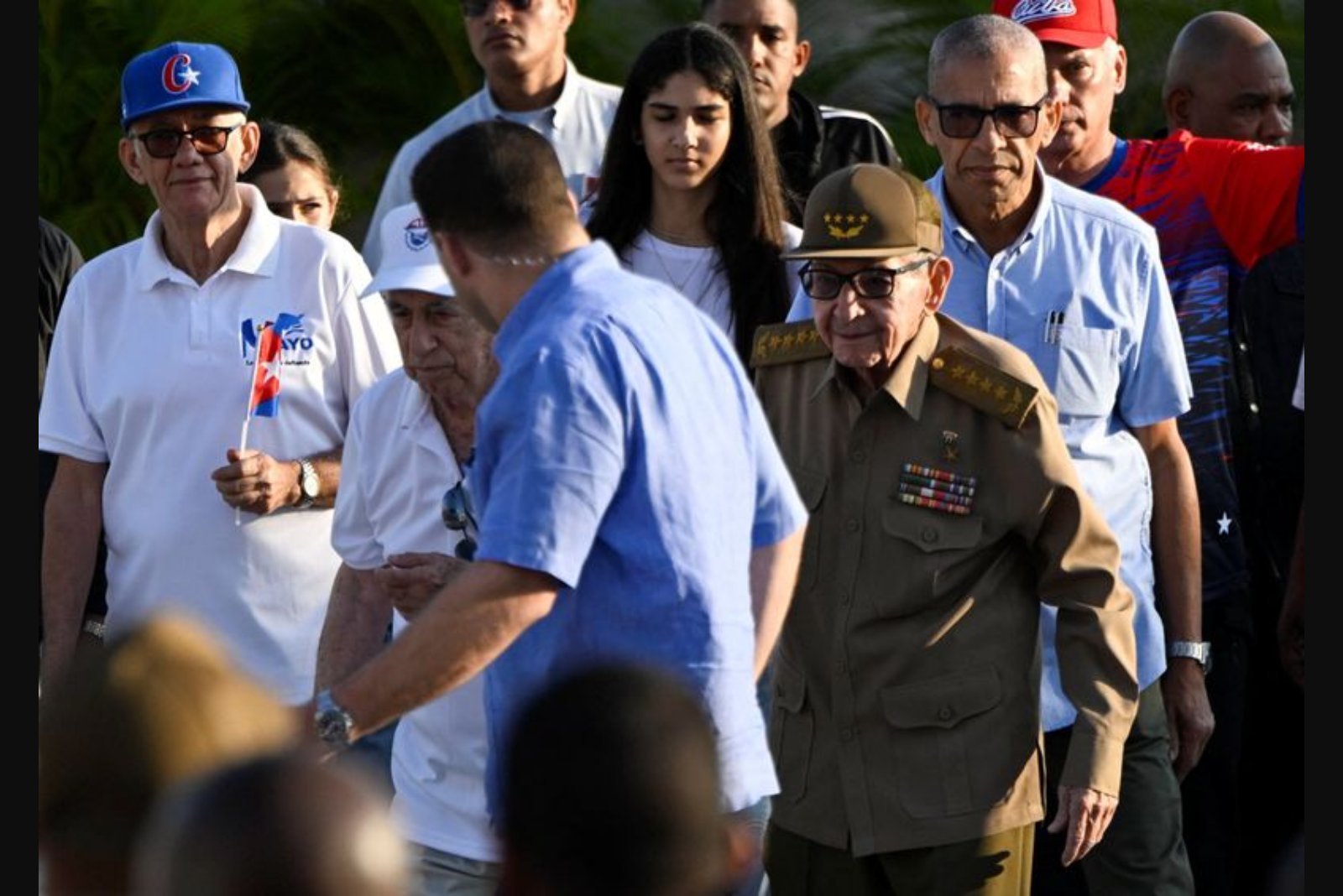
Ninety-four-year-old Raul Castro appeared among thousands of marchers in Havana on International Workers' Day, taking part in a procession that followed the capital's waterfront and passed by the U.S. embassy as tensions between Washington and Havana have risen to near-unprecedented levels.
Washington has repeatedly indicated it could consider military options toward the communist-run Caribbean island, and since January has imposed an oil blockade that Cuban authorities say has forced rationing of essential services. The strain on supplies prompted a warning from the U.N. about a possible humanitarian crisis.
White House officials said President Donald Trump is expanding sanctions to target individuals, entities and affiliates that support Cuba's security apparatus. The announcement came as the May Day events unfolded in Havana.
Castro - who handed over the presidency in 2018 and is the brother of Fidel Castro - was presented during the march with a book reportedly containing more than 6 million Cuban signatures, a figure described as nearly two-thirds of the island's population and framed by organizers as evidence of popular will to oppose any direct military intervention.
Participants in the march voiced a mix of resolve and a desire for peace. "Today Cuba demonstrated once again that this people does not give up, and that we will defend our homeland tooth and nail, even though we want peace," said Milagros Morales, 34, a Havana resident who took part in the procession.
Organizers acknowledged the event was scaled back compared with previous years. Officials said limitations on transportation and the inability to establish special routes - measures typically arranged by the government - were a result of the U.S. oil blockade. Despite those constraints, authorities reported that more than half a million people gathered in Havana for the march.
Diplomatic activity between the two countries has continued alongside public demonstrations. Delegations from the U.S. and Cuba met on the island this month, with the United States pressing Cuba to undertake economic reforms, but officials have not announced any agreement from those talks.
Reports in various media outlets have said members of Castro's family remain engaged with U.S. officials - including his son Alejandro Castro and his grandson Raul Rodriguez - a detail cited to illustrate the ongoing political role of the family despite Raul Castro's retirement from the presidency.
During the march, Raul Castro walked in a military uniform, accompanied by President Miguel Diaz-Canel and other officials as flags were waved under the Caribbean sun. Observers noted he appeared tired at times and had to sit down suddenly during the ceremony.
Summary of key developments:
- Raul Castro joined a large May Day march in Havana that passed the U.S. embassy.
- An oil blockade imposed since January has led to rationing of services and prompted a U.N. warning of a humanitarian crisis.
- White House officials said President Trump is broadening sanctions aimed at those supporting Cuba's security apparatus, while bilateral talks this month produced no announced agreement.