
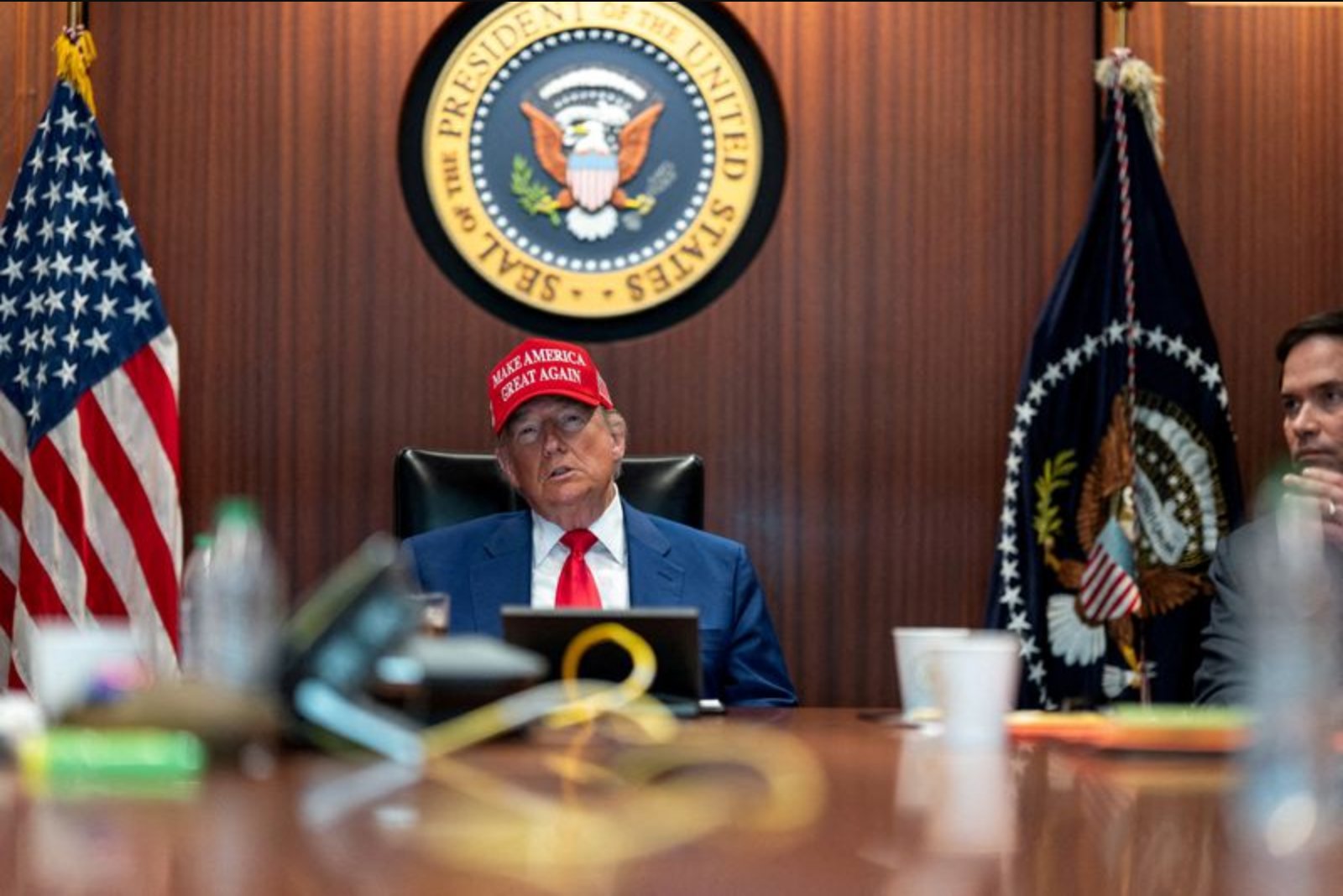
More than two months into a confrontation that has yielded neither a decisive battlefield victory nor a diplomatic breakthrough, the standoff between the United States and Iran threatens to extend indefinitely and to leave the world worse off than before the conflict began. Public posturing on both sides suggests confidence, yet their demands remain far apart and no obvious path to resolution has emerged.
That impasse was underscored when Iran submitted a new proposal aimed at restarting negotiations. The White House rejected the offer quickly on Friday, keeping the door closed to the specific sequence Tehran proposed. For President Donald Trump and his Republican Party, a prolonged stalemate carries significant political and economic downsides. Persistent disruption to global energy supplies and elevated U.S. gasoline prices are likely to continue to weigh on public opinion and dim prospects for Republican candidates as congressional midterm elections approach in November.
Unmet objectives and shifting war aims
The costs of a drawn-out confrontation highlight a central problem: many of the president’s stated goals remain unachieved. U.S. and Israeli strikes have, by most accounts, significantly degraded Iran’s military capabilities. Still, a number of Mr. Trump’s often-changing objectives - including regime change and preventing Iran’s pathway to a nuclear weapon - have not been realized.
Fears about a prolonged deadlock intensified after the White House called off a planned trip by its negotiators to Islamabad last weekend and then dismissed an Iranian offer tied to the ceasefire. That ceasefire, intact since April 8, had briefly paused major hostilities but did not resolve the underlying disputes.
Tehran’s proposal envisioned postponing discussions over its nuclear program until after a formal end to the conflict and a negotiated reopening of the Strait of Hormuz. The administration rejected that sequencing, with the president insisting the nuclear question be addressed immediately. State news agency IRNA later reported a revised Iranian proposal had been sent via Pakistani channels, a move that briefly eased global oil prices that had surged after Iran effectively closed the strait.
Yet the president said he was "not satisfied" with the offer, even as he acknowledged ongoing telephone contacts. To Mr. Trump, failing to regain secure, reliable access to the vital oil-shipping waterway at the conclusion of the dispute would represent a major blow to his record. Laura Blumenfeld, a Middle East expert at Johns Hopkins University in Washington, said the president could be remembered as "the U.S. president who made the world less safe," if control of the strait remained contested.
On the administration’s side, White House spokeswoman Olivia Wales argued Iran was increasingly desperate under sustained military and economic pressure and that the president "holds all the cards and has all the time he needs to make the best deal."
Options on the table and the risk of renewed hostilities
Behind closed doors, the president has weighed a range of next steps. In private meetings, he has discussed the possibility of extending a naval blockade of Iran for months to further curtail its oil exports and pressure Tehran into a denuclearization agreement, according to a White House official who spoke on condition of anonymity. At the same time, Mr. Trump has left open the prospect of renewed military action.
U.S. Central Command has prepared operational options that include a "short and powerful" series of strikes as well as plans for taking control of part of the Strait to reopen it to shipping, Axios reported. European diplomats, whose relations with the administration have been strained by the conflict, told Reuters they expect the current impasse to persist. "It’s hard to see how this will end soon," one diplomat said on condition of anonymity.
Iran, for its part, has exerted substantial leverage. By effectively choking off shipping through the Strait of Hormuz - a route that previously saw tankers transit freely and that carries about a fifth of the world’s oil - Tehran has triggered an energy supply shock with global consequences. Analysts and officials warn that Iran will be emboldened by the knowledge it can again use this chokepoint as leverage, even if its military position is diminished.
Jon Alterman of the Center for Strategic and International Studies in Washington said Iran’s realization that it can shut the strait at will leaves Tehran in a stronger bargaining position than before the conflict.
Nuclear pathway and remaining hard power
One of the administration’s principal rationales for military action was to block Iran’s path to a nuclear weapon. That objective has not been achieved. A stockpile of highly enriched uranium is believed to remain in hidden caches despite U.S. and Israeli airstrikes last June, and that material could be recovered and further processed into bomb-grade uranium, according to accounts cited in the reporting. Iran maintains its position that it seeks to enrich uranium for peaceful purposes and wants recognition of that right from the United States.
Wales said the president had "met or surpassed" military objectives, including steps "to ensure that Iran can never have a nuclear weapon." But other goals such as forcing Tehran to halt support for proxy groups - including Hezbollah in Lebanon, the Houthis in Yemen and Hamas in the Palestinian territories - remain unfulfilled.
Defense Secretary Pete Hegseth, testifying before Congress, rejected characterizations that the conflict had become a "quagmire," even though Mr. Trump had originally forecast the confrontation would conclude within four to six weeks.
Domestic politics, economic pain and international fallout
At home, the president faces growing pressure to extricate the United States from a war that has driven his approval rating to the lowest point of his term - 34% in a Reuters/Ipsos poll - while also driving retail gasoline prices above $4 a gallon. Those economic and political pressures are particularly acute ahead of November’s midterms, where Republicans risk losing control of Congress.
A second White House spokeswoman, Taylor Rogers, said the president was focused on preserving his party’s congressional majority and characterized high gasoline prices as "short-term disruptions" that would ease as the conflict waned.
European and Gulf Arab diplomats have also raised alarm. Traditional alliances have frayed because allies were not consulted before the administration initiated military operations. The president has criticized NATO partners for not committing their navies to reopen the strait and has discussed the possibility of reducing troop presences in Germany, Spain and Italy.
Washington also now faces the prospect of a more hardline Iranian leadership dominated by the Islamic Revolutionary Guard Corps, which consolidated power after strikes killed several Iranian figures, including Supreme Leader Ayatollah Ali Khamenei. Mr. Trump’s initial call for the Iranian people to overthrow their rulers has not been heeded.
Frozen conflict and the limits of negotiation
Analysts warn the war could settle into a protracted, frozen conflict that defies a permanent diplomatic solution. Such an outcome would complicate any effort to significantly scale down U.S. forces in the region and could impose long-term strategic costs on Washington. Already, the United States is contending with diplomatic ruptures and a more volatile energy market.
Renewed peace talks seem unlikely to yield quick results given the large gaps between demands. Although Mr. Trump has at times signaled an interest in an exit plan from an unpopular confrontation, he has also insisted on solid, long-term concessions from Tehran.
U.S. intelligence agencies, at the request of the president’s aides, are studying how Iran might react if the president were to declare a unilateral victory and withdraw. Independent analysts caution that Tehran would likely view such a unilateral U.S. pullback as a strategic success for surviving the military campaign.
European and Gulf Arab diplomats worry the administration may ultimately accept a flawed bargain that leaves a weakened but still threatening Iran in place. With negotiations stalled, the prospect of a frozen conflict grows, as do the attendant economic and political risks.
What Tehran is banking on
Iran appears to be betting on time. Observers note Tehran’s leadership understands the domestic pressures facing the president and may be prepared to outwait him. The key uncertainty is how long Iran can stave off economic collapse under sustained pressure.
"Iran isn’t fractured or folding, it’s playing for time," wrote Sina Toossi, a senior fellow at the Center for International Policy in Washington, on the social platform X.
For the United States, the near-term consequences are clear: continuing risks to global energy supplies, persistent high fuel prices at the pump for American consumers, and mounting political headwinds that could harm Republican prospects at the ballot box. For the administration, the dilemma is stark - press military and economic pressure with uncertain end results, or seek a negotiated settlement that may fall short of stated objectives. Either course carries costs that could reverberate for months or years.
Bottom line
The standoff with Iran has so far failed to produce the strategic outcomes the administration outlined when it began military action. With both sides dug in and a wide gulf separating their demands, there is no clear off-ramp. That reality risks leaving President Trump and the United States confronting a more intractable and costly situation than the one that precipitated the conflict.