
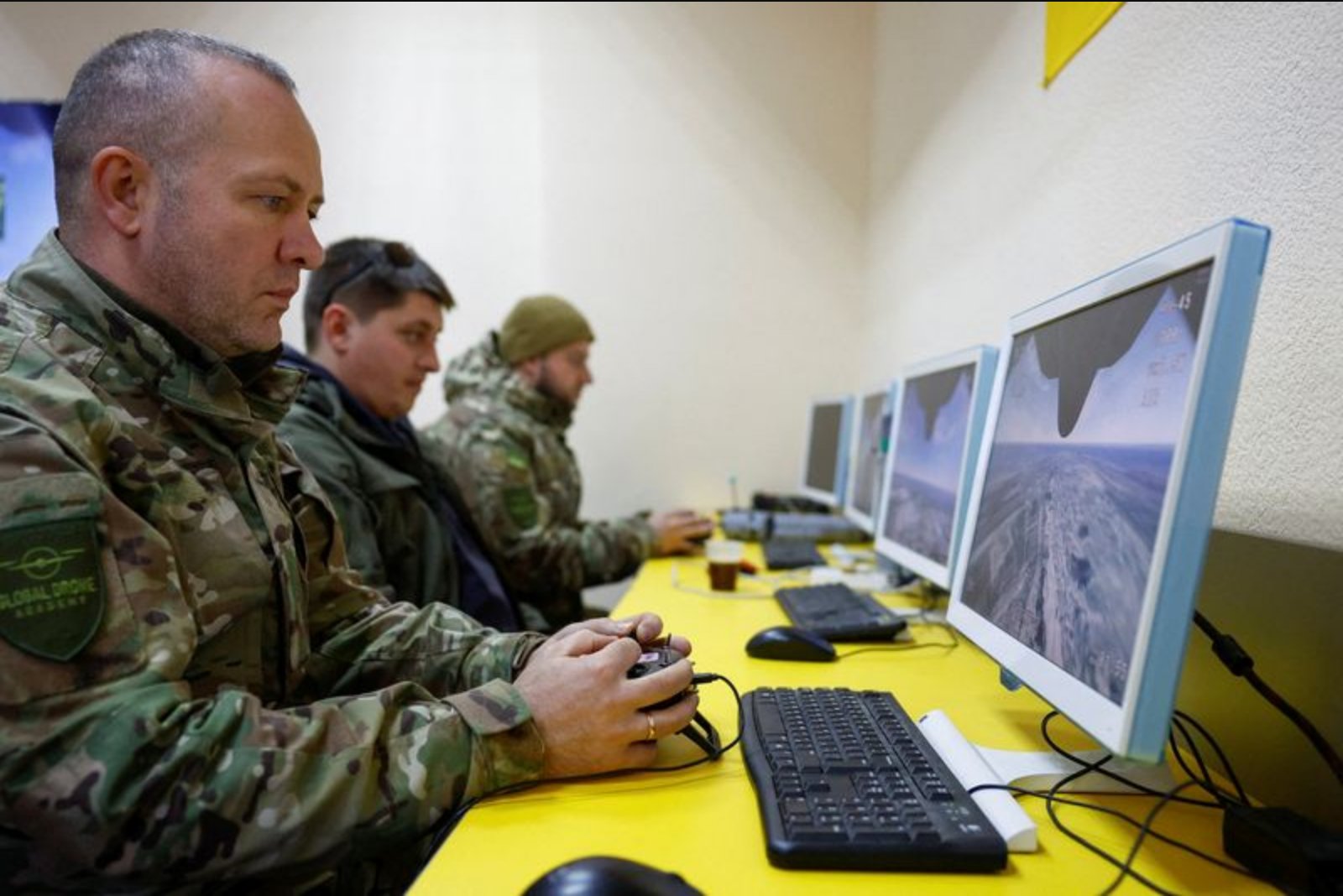
Ukraine is expanding its air defence architecture by permitting private companies to establish their own airborne defence teams to shield industrial sites and critical infrastructure from repeated Russian drone strikes. A pilot programme initiated last year has produced 20 company registrations, and defence authorities report that two of those firms are already conducting air defence operations.
One of the active operators, Carmine Sky, describes a multi-tiered approach tailored to each client. The company says it deploys a combination of interceptor drones and fixed automated turrets equipped with M2 Browning heavy machine guns, adjusting layers of protection to the threat profile of a given facility. A company representative who gave only his first name, Ruslan, likened the arrangement to an onion composed of layers, saying - "It’s like an onion, made of layers."
Operators from Carmine Sky were observed by a reporter working in a dim control room where staff monitor the sky for incoming drones. Comfortably reclined in padded chairs, technicians used gamepad controllers while scanning displays. The walls of the room were covered with masking nets. Ruslan said the company operates in Ukraine’s northeastern Kharkiv region and in other, unspecified regions, but he declined to name any clients.
The new private units are designed to augment Ukraine’s existing state air defence system. Ruslan said - "We are only complementing the traditional state air defence model." He added that the state retains a more strategic function while the private teams concentrate on local protection - "State air defence has a more strategic role, while we are local."
To begin operations, companies must obtain formal authorisation from the Ministry of Defence and are integrated into the Ukrainian air force’s command-and-control system. Ruslan emphasised that decisions on targets and whether to open fire rest with the military command - "Targets and the decision to open fire is made solely by them," he said. "We cannot do so on our own."
Ukraine faces a persistent threat from hundreds or more low-cost, long-range attack drones launched by Russia every month. While the majority are intercepted, those that breach defences have caused significant damage to military infrastructure, factories and energy facilities, contributing to widespread outages that left millions without heating and lighting last winter.
Defence Minister Mykhailo Fedorov has highlighted early successes from private units. Last month he said an unnamed private firm shot down Russian drones in the Kharkiv region. On April 17 he reported that a private air defence unit had shot down a jet-powered Shahed drone.
Civilian recruits for private air defence work are subject to strict vetting. Ruslan said candidates must pass a rigorous screening process, which includes a polygraph test and quarterly retesting. Training requirements vary by role. Roman Korzh of Gvardiia, another company providing air defence services, said it takes about three weeks to train a person with no prior experience to become a drone interceptor pilot. Those who do not meet pilot standards are reassigned within crews as spotters or technicians.
Gvardiia draws heavily on existing volunteer air defence formations, which have battlefield experience. Korzh, who oversees training, said the volunteer units form the organisation’s backbone - "The volunteer units are, as they say, our backbone." Schedules are arranged with flexibility in mind; duty rosters can be organised to accommodate participants who also hold civilian jobs.
The private-company initiative represents a localised component of Ukraine’s broader air defence efforts. Firms operate only with military authorisation and under the military’s targeting control, while recruiting and training remains a key focus for sustaining operations and integrating volunteer experience into structured defence services.