
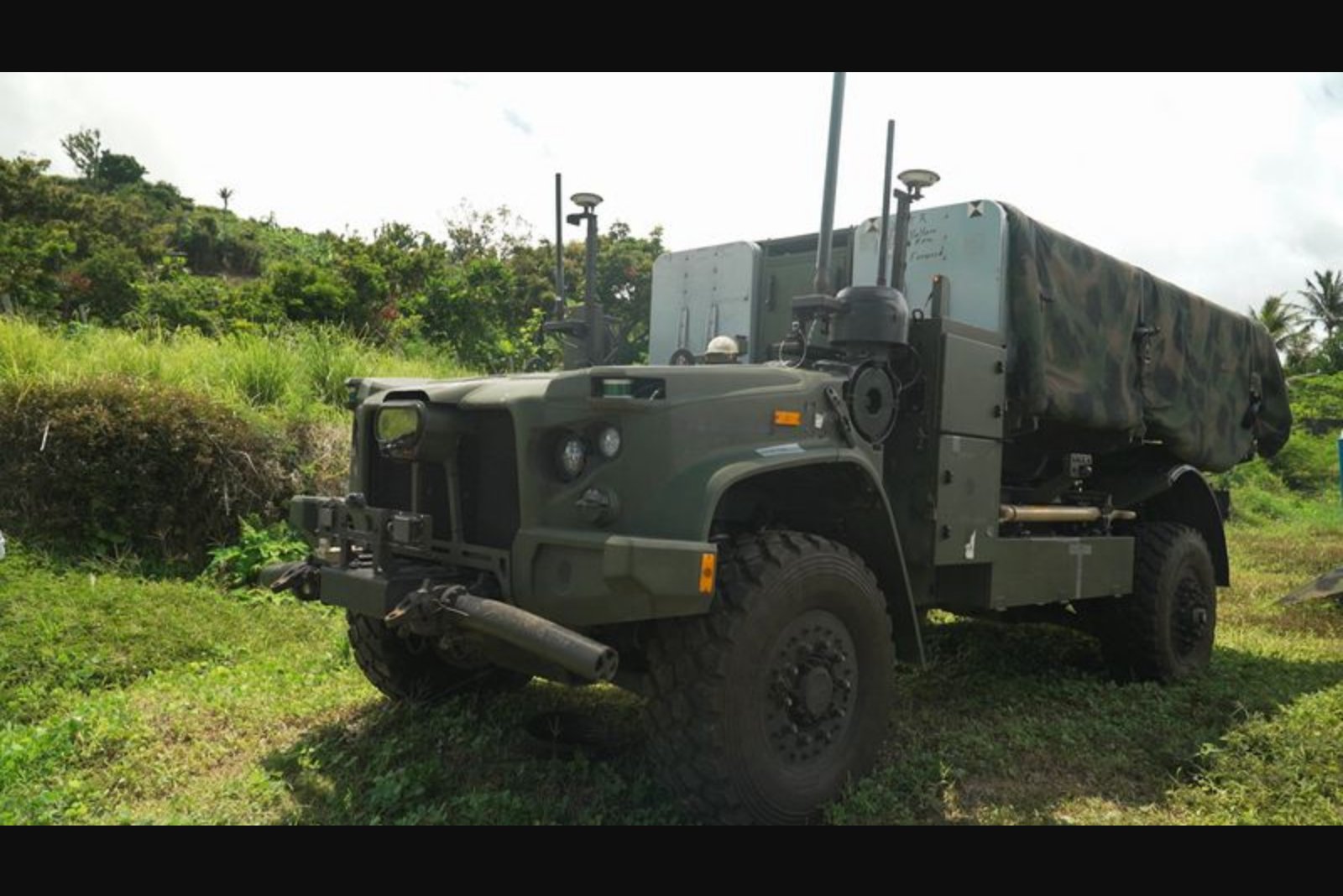
Philippine and U.S. forces staged the NMESIS coastal anti-ship missile system in Batanes province on Saturday as part of their annual Balikatan war games, positioning the system in the northern island chain close to Taiwan.
The Philippine province of Batanes, home to roughly 20,000 people, lies about 100 miles south of Taiwan and faces the Luzon Strait, a strategic maritime corridor that sits at the intersection of major power competition in the Asia-Pacific region.
U.S. Staff Sergeant Darren Gibbs described the training environment in Batanes as distinct from routine exercises and said it provided unusual opportunities to operate the NMESIS in conditions not typically available in day-to-day training.
"Training out here in Batanes allows us a different environment than what we’re normally allowed to operate in," Gibbs said. "So it gives us unique opportunities to actually utilize the system and train within our capabilities, and it offers experiences we don’t normally get offered in our day-to-day training."
Gibbs also explained that the NMESIS is built for remote operation and autonomy, emphasizing that it is intended to operate without a driver or passenger onboard the vehicle.
"The NMESIS is designed for remote operation, and that the purpose of this system is for it to be fully autonomous, for us not to require a driver or passenger inside the vehicle itself," he said. "We will tell it where to go and then we program what it needs to do."
The NMESIS is a highly mobile coastal anti-ship missile system, capable of engaging surface vessels from land-based locations at ranges of about 185 km (115 miles). U.S. forces airlifted the system into Batanes aboard a U.S. C-130 transport aircraft and sited it in the provincial capital, Basco, which hosts one of the island group's two small runways.
Francisco Lorenzo, the Philippine exercise director, said the movement of U.S. weapons such as the NMESIS to Batanes is intended to assess operational feasibility and rehearse deployments in remote settings. He noted that the same system was mobilized to Batanes during last year’s exercises.
"It is part of training so as to test the feasibility or rehearse their deployment there when need arises," Lorenzo said.
One stated purpose of the Balikatan drills - the annual "shoulder-to-shoulder" exercises between Philippine and U.S. forces - is to practice defence of territory together with allied partners, Lorenzo added.
Officials stressed that the NMESIS in Batanes would not be employed in live-fire operations during the drills. Its role was limited to deployment rehearsal and to provide simulation support throughout the exercises, and authorities said the system would be withdrawn from the island once the drills conclude.
The United States also deployed a Typhon missile system to the Philippines in 2024 for use during joint exercises. The stationing or movement of U.S. weapons in the Philippines has drawn repeated criticism from Beijing, which says such deployments raise regional tensions.
Security analyst Chester Cabalza, founder and president of the Manila-based think tank International Development and Security Cooperation, warned that the presence of a system like the NMESIS in Batanes has strategic implications for the narrow waters between the Philippines and Taiwan.
"The NMESIS can spark a powder keg for Beijing and asymmetric deterrence for Manila and Taipei in the Bashi Channel along the Luzon Strait," Cabalza said.
Cabalza added that the NMESIS can be airlifted and moved to any coastline within the Philippine archipelago within hours, and that its placement in Batanes is likely to be perceived by Beijing as part of a wider U.S.-led encirclement strategy.
The Balikatan drills this year involve more than 17,000 troops in total, including about 10,000 personnel from the United States. Philippine and U.S. forces also conducted maritime strike drills in Itbayat, a municipality in Batanes that sits roughly 155 km from Taiwan and represents the northernmost point of the country.
The deployment to Batanes and the wider exercise take place amid a backdrop of heightened Chinese activity in nearby waters. Chinese forces have stepped up operations in the South China Sea and the Taiwan Strait, including an increased naval presence around Taiwan and a transit by an aircraft carrier through the strait. Satellite images reviewed by authorities indicate a barrier erected this month at the mouth of the Scarborough Shoal.
Philippine President Ferdinand Marcos Jr has said that Filipinos working and living in Taiwan would have to be evacuated if conflict over the self-governed island broke out, and that such an event would "drag the Philippines kicking and screaming into the conflict."
Philippine Defense Secretary Gilberto Teodoro said in an April 28 interview that Manila maintains a contingency plan to evacuate Filipinos in Taiwan should hostilities erupt, but offered no further details.
What are the best investment opportunities in 2026? The best investments start with better data. Going with your gut has its place, but when excitement masquerades as intuition, it can lead to costly mistakes - or analysis paralysis. InvestingPro combines institutional-grade data with AI-powered insights that you don't need a finance PhD to understand. It won't guarantee winners, but it will certainly help you find more of them, more often. So what are the best investments of 2026 so far? Ask WarrenAI, then decide.