
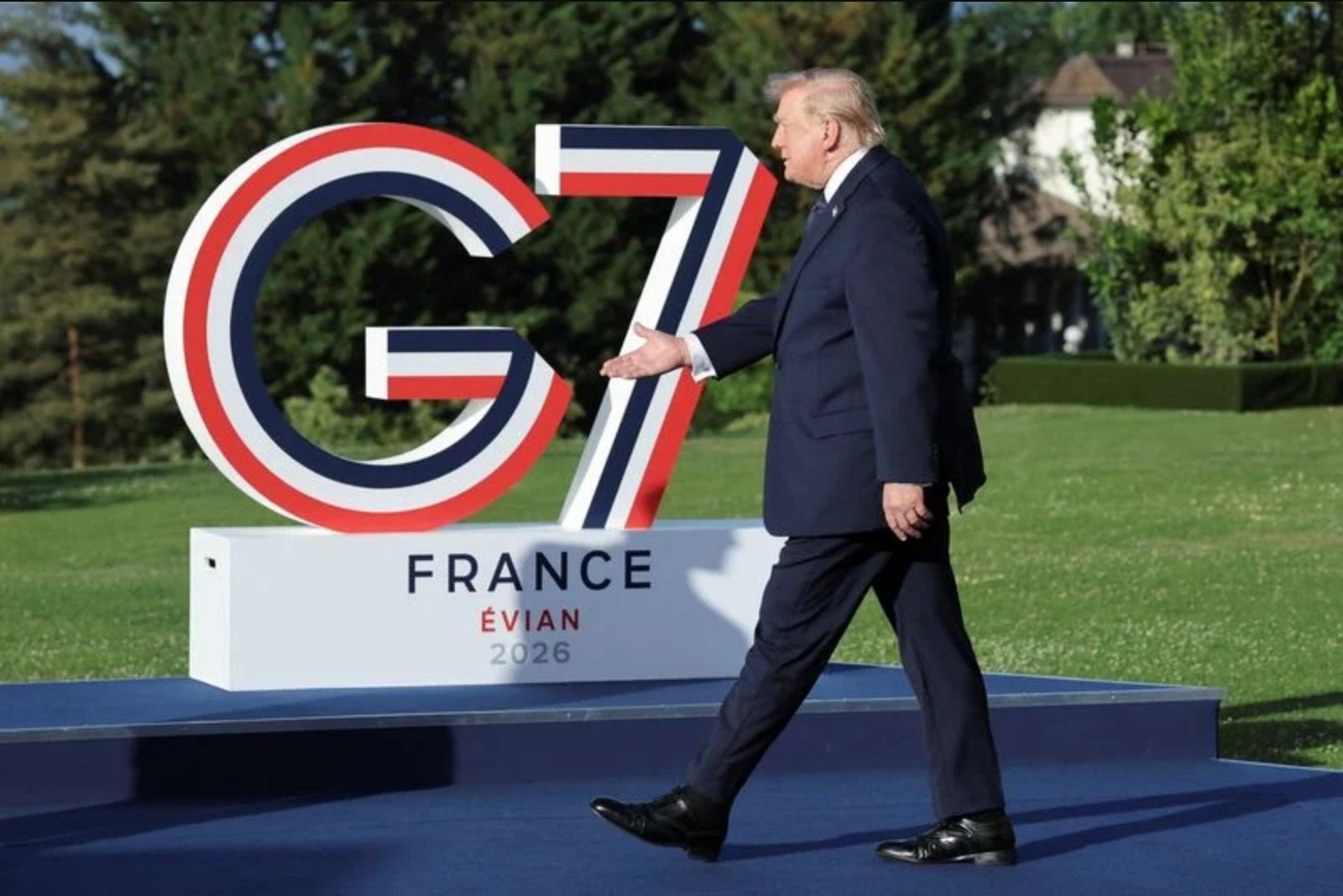
European leaders meeting at the G7 summit in Evian-les-Bains are set to press U.S. President Donald Trump on two interlinked diplomatic challenges - the durability of a preliminary Iran agreement and the need for a change in strategy toward resolving the conflict in Ukraine.
The three-day summit, taking place from June 15 to 17 on the shores of Lake Geneva, brings together the heads of state of France, Britain, Canada, Germany, Italy, Japan and the United States, together with representatives of the European Union. The gathering is expected to foreground concerns that a superficial interim arrangement with Tehran could allow Iran's nuclear and ballistic missile programmes to become more deeply entrenched unless it is followed by a rigorous, enforceable final settlement.
President Trump arrived in France on Monday evening following an announcement that Washington and Tehran had reached a preliminary agreement intended to end the wider conflict, with a formal signing targeted for Friday. Shortly after arriving in Evian-les-Bains, the president said: "The Iran deal will bring a lot of success." He also predicted that the strategically vital Strait of Hormuz would be "completely open" on Friday.
French President Emmanuel Macron underscored a contrasting view of priorities, telling colleagues the imperative was to secure a "solid, serious agreement that is finalised." Macron indicated that a Tuesday lunch session would concentrate on measures to safely reopen the Strait of Hormuz. That discussion is due to include consideration of a possible Franco-British-led maritime mission and efforts to identify alternative energy routes that bypass the waterway.
Diplomats said leaders of the United Arab Emirates, Qatar and Egypt will attend Tuesday's talks. While those delegations are not expected to enter detailed negotiations on Iran's nuclear programme, they may set out expectations for regional security and the practicalities of reopening transit routes.
The interim arrangement is intended to create a 60-day window for complex technical talks. Those negotiations are to address questions such as the disposition of Iran's stocks of highly enriched uranium and the sequencing of sanctions relief. European allies, however, have voiced concern that an inexperienced U.S. negotiating team could fail to secure a durable nuclear settlement or to confront Iran's ballistic missile programme in subsequent talks, leaving the parties mired in a prolonged standoff.
France, Britain and Germany have made clear they want to play a substantive role shaping the next phase of negotiations after being sidelined in recent months. Those three countries first engaged Iran on its nuclear programme in 2003 and later collaborated with the Obama administration to reach a 2015 accord that exchanged curbs on Tehran's nuclear activities for sanctions relief. President Trump has criticized that earlier deal and withdrew the United States from it during his first presidency, calling it flawed. Before a bilateral meeting with President Macron he said of his new arrangement: "It’s not like the Obama document, that was a terrible document."
European diplomats are also using the summit to press Washington for a recalibration of its posture toward Ukraine. They want to convince the United States that prior U.S. proposals for ending the fighting have been overly generous to Moscow. The European position being advanced at Evian is one of conditional engagement with Russia - signalling willingness to pursue talks with President Vladimir Putin while at the same time tightening sanctions on Russia and bolstering military support for Ukraine.
European officials emphasise that, in their judgment, it is Russia rather than Ukraine that is obstructing progress toward a settlement. President Trump said he believed Putin and Ukrainian President Volodymyr Zelenskiy were "open to do something about the war." President Zelenskiy is scheduled to participate in the summit's first session of the day, devoted to "building peace in Ukraine," and he may hold a separate conversation with President Trump.
With formal negotiations stalled, Mr. Zelenskiy has sought renewed momentum and a larger European role in driving talks. He told summit participants on Monday that he had offered to meet President Putin at the G7 gathering for direct talks to end the nearly four-year conflict, but said Mr. Putin was not prepared to engage.
European Commission President Ursula von der Leyen outlined the battlefield dynamics and economic pressures that frame the discussions on Ukraine, saying: "Ukraine is holding the front line and even partially regaining territory. Ukraine has developed the capability to strike strategic targets deep inside Russia. And Ukraine has become a world-leading producer of cutting-edge military equipment." She added: "On the other hand, Russia is feeling the strain and pressure of sanctions ... Putin’s war economy has never been as weak."
President Zelenskiy has expressed concern that the new conflict resolution efforts with Iran may have diverted U.S. attention from Ukraine. On the ground, battlefield dynamics are shifting, with Ukrainian drones conducting strikes deeper into Russian territory that aim to disrupt supply lines and to damage energy-related infrastructure. A Kremlin foreign policy adviser says President Putin holds that intensified Ukrainian strikes on Russian targets will not alter the overall situation on the battlefield.
Summary
European leaders at the G7 in Evian-les-Bains intend to press President Trump to ensure a robust, enforceable follow-up to a preliminary Iran agreement to prevent Tehran's nuclear and ballistic missile programmes from becoming entrenched, and to persuade him to reassess U.S. proposals on Ukraine which European diplomats view as having been too accommodating to Moscow.
Key points
- European leaders seek a "solid, serious agreement" on Iran and expect a 60-day technical negotiation window to address enriched uranium and sanctions relief - sectors affected: diplomatic relations, energy markets.
- G7 discussions will include reopening the Strait of Hormuz, with proposals for a possible Franco-British maritime mission and alternative energy routes - sectors affected: energy, shipping.
- Summit participants aim to push the U.S. to recalibrate its Ukraine diplomacy, pairing willingness to talk with Putin alongside tightened sanctions and increased military backing for Kyiv - sectors affected: defence, sanctions-sensitive industries.
Risks and uncertainties
- An interim Iran deal that lacks robust follow-up could leave Tehran's nuclear and ballistic missile capabilities unaddressed, prolonging geopolitical uncertainty - impacting energy markets and defence planning.
- Concerns that an inexperienced U.S. negotiating team may not secure a comprehensive final agreement could result in a prolonged standoff and persistent sanctions disputes - impacting international trade and sanctions enforcement sectors.
- Stalled progress on Ukraine negotiations, and the possibility that U.S. attention shifts toward Iran, could prolong the conflict and heighten defence spending and regional instability - impacting defence contractors and regional energy supply chains.
Note: This report confines itself to the facts and statements presented at the summit and does not introduce additional assertions or outside analysis beyond those remarks.