
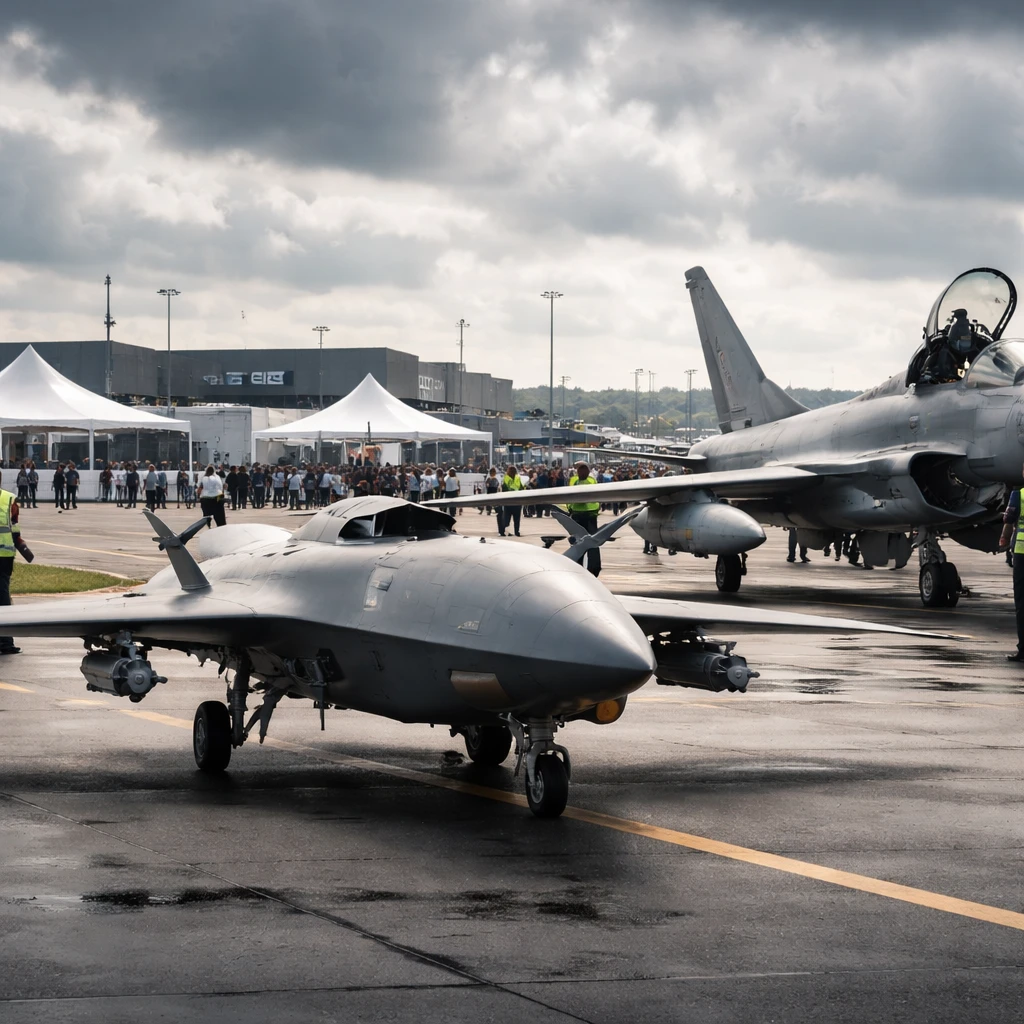
At a recent airshow in Berlin, defence industry attention concentrated on so-called "wingman" drones - unmanned platforms intended to accompany and augment crewed fighter jets. The technology, sometimes called collaborative combat aircraft (CCA) or "loyal wingman" systems, is being promoted by major defence contractors and newer entrants alike as a way to expand situational awareness and electronic warfare capabilities without placing additional pilots in harm's way.
Four companies presented or promoted current designs and concepts to European armed forces: Airbus, Boeing, Helsing and General Atomics. These systems vary in size and role, from relatively small interceptor-style craft to larger unmanned jets capable of carrying sensors, jammers and weapons. In operation they would fly alongside manned aircraft, acting as force multipliers by collecting and fusing data and supporting human decision-making.
Industry participants emphasized the growing operational importance of electronic warfare and resilient sensor networks, a theme reinforced by the conflict in Ukraine. Helsing, a German defence start-up, described an electronic attack drone intended to operate with strike drones in autonomous formations. Stephanie Lingemann, head of air domain at Helsing, said the AI component - described as the brain of these systems - needs to be controlled in a sovereign manner.
Boeing Australia presented its MQ-28 Ghost Bat, which the company characterizes not simply as a drone but as an unmanned jet that enhances the capabilities of crewed platforms. Amy List, Boeing Australia’s managing director, highlighted its ability to go ahead of crewed assets to collect and analyse information, fuse sensor inputs and deliver decision-quality information to human operators. Boeing is collaborating with German firm Rheinmetall on the platform.
Despite the publicity, none of these wingman systems are yet operational on the battlefield. Boeing has set a target of placing its model into service with the German Luftwaffe by 2029. Airbus is preparing its U760b Ravenstorm design, which the company says will not be available until the 2030s. General Atomics' YFQ-42A is currently in testing and was selected in 2024 by the U.S. Air Force among other technologies to receive funding and support for prototype development.
Other defence firms are expected to display similar capabilities at upcoming events. Lockheed Martin and U.S. defence technology start-up Anduril are due to showcase comparable technologies at forthcoming airshows, including the large Farnborough event scheduled to begin on July 20.
Underlying the commercial and technical push is a political and industrial discussion in Europe about maintaining sovereign defence capabilities and reducing dependence on external partners. Germany and France have recently paused joint development of a new fighter jet, but are exploring ways to continue parts of their Future Combat Air System programme by focusing on related drone platforms and a supporting data network.
For now, wingman aircraft remain largely in development and testing stages. Manufacturers and defence ministries are advancing prototypes and partnerships with an eye to equipping future air forces with systems that combine manned and unmanned assets, but timelines to operational deployment vary considerably across projects.
Summary
Next-generation wingman drones were a central focus at the Berlin airshow, with Airbus, Boeing, Helsing and General Atomics promoting CCA concepts that pair unmanned systems with crewed fighters. Key technical roles include sensing, electronic attack and data fusion. While prototypes are progressing, the platforms are not yet combat-proven and availability ranges from the late 2020s into the 2030s.
Key points
- Wingman drones - collaborative combat aircraft - are being advanced by European and U.S. firms to augment fighter jets with sensors, jammers and weapons.
- Companies on display include Airbus, Boeing, Helsing and General Atomics; other firms such as Lockheed Martin and Anduril plan public demonstrations at upcoming airshows.
- Development timelines vary: Boeing projects service entry for its model by 2029, Airbus expects its Ravenstorm in the 2030s, and General Atomics' YFQ-42A is in testing after selection for U.S. Air Force prototype support in 2024.
Risks and uncertainties
- Operational readiness - None of the wingman platforms described are yet operational in combat, creating uncertainty around real-world effectiveness and deployment schedules.
- Programme timelines - Companies provide differing availability forecasts, with some systems not expected until the 2030s, generating schedule risk for armed forces seeking rapid capability upgrades.
- Sovereign control - The debate over sovereign control of AI and data networks for these systems may influence procurement decisions and international collaborations, affecting defence industry contracts and supply chains.