
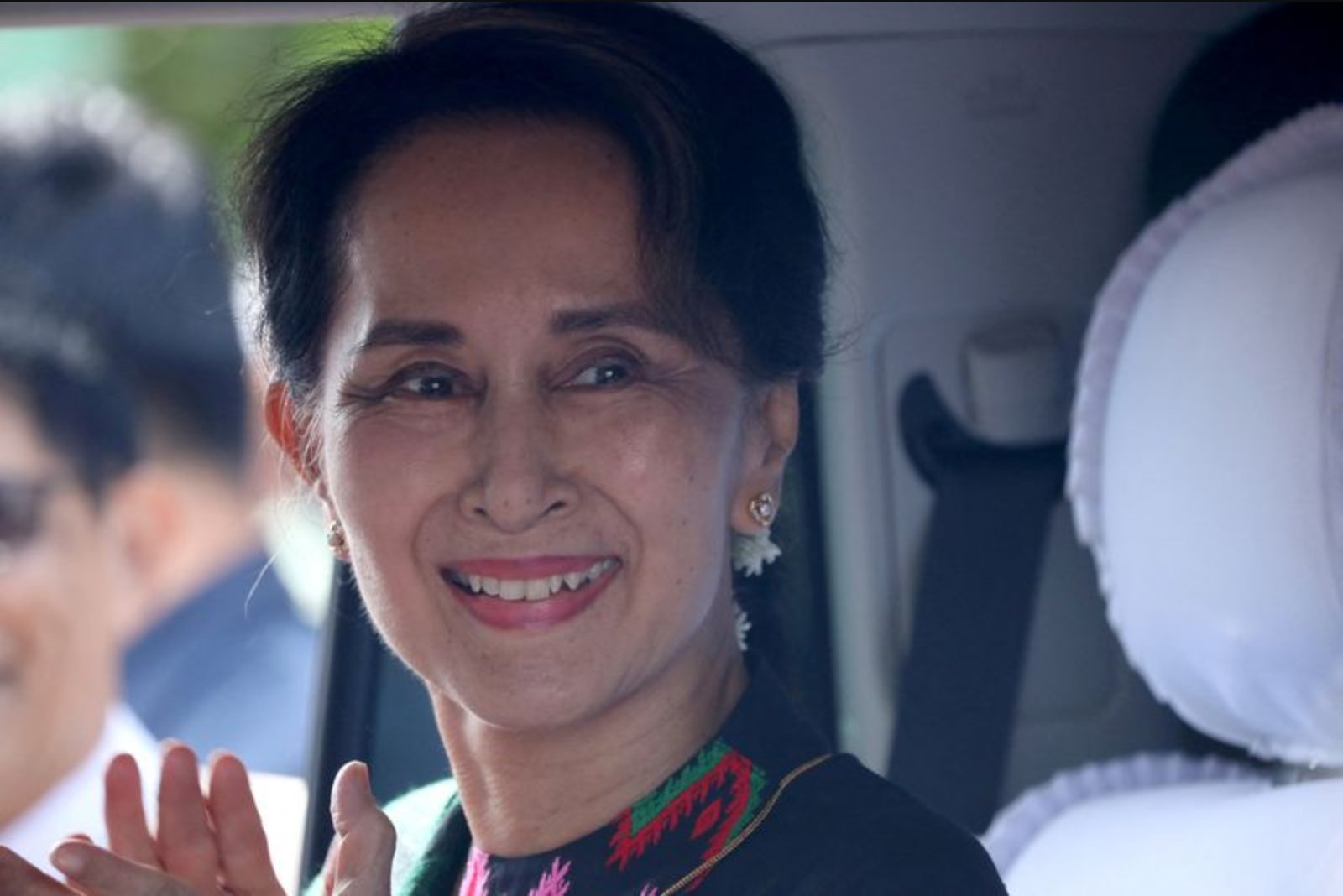
Myanmar’s Nobel laureate and ex-leader Aung San Suu Kyi has been transferred from detention to house arrest in Naypyidaw, her legal representatives said on Friday, and they plan to meet her this weekend.
A member of Suu Kyi’s legal team confirmed her location and the change in custody, saying: "Daw Aung San Suu Kyi is currently still in Naypyidaw," using an honorific for the veteran politician, and adding that she had been moved to house arrest on Thursday night.
Her whereabouts had been unclear until the transfer was disclosed. State media had reported on Thursday that she would be shifted to house arrest but offered no details on the location. The state broadcasts also included a photograph of Suu Kyi seated on a wooden bench accompanied by two uniformed personnel - the first public image of her in several years.
The legal team said they were scheduled to see the 80-year-old on Sunday to discuss her legal position and to bring her certain supplies. A legal representative characterized the visit as more than a routine prison visit: "The situation has shifted. I think it will no longer be just a standard prison visit, but rather a meeting where the legal team will go and discuss matters with her."
Suu Kyi has been detained since the military removed her civilian government in a February 2021 coup. That seizure of power set off a conflict that has grown into a deadly civil war affecting large parts of the impoverished Southeast Asian country.
In the months after the coup, Suu Kyi faced a series of secret trials. She was initially sentenced to a cumulative 33 years after being convicted on multiple charges that included corruption, inciting election fraud and violating state secrecy rules. Her supporters have said the charges were politically motivated and intended to keep her out of the political arena.
Authorities later reduced that sentence to 27 years. On April 17, during a Myanmar New Year amnesty, her term was cut by a further one-sixth, a move that also saw the release of her ally and co-defendant, former president Win Myint. On Thursday, ahead of the announcement of her transfer to house arrest, her sentence was again reduced by another one-sixth as part of a broader amnesty for prisoners in the country’s jails.
Min Aung Hlaing, the junta chief who led the coup and now serves as president, has faced ongoing international calls to free political detainees following a recent election, including pressure from the Association of Southeast Asian Nations. He has indicated a desire to reengage with the regional bloc, after Myanmar was excluded from its summits because of the coup.
Suu Kyi’s experience with house arrest is not new. Under a previous military junta she was confined at her family residence on Yangon’s Inya Lake for a total of 15 years. During that earlier period she addressed supporters from the gates of the property, delivering impassioned speeches over the metal fencing that enclosed the compound.
Contextual note: The transfer to house arrest and the planned legal meeting occur against a backdrop of sustained legal proceedings, sentence reductions via amnesties, and continued international scrutiny of the junta’s handling of political detainees.