
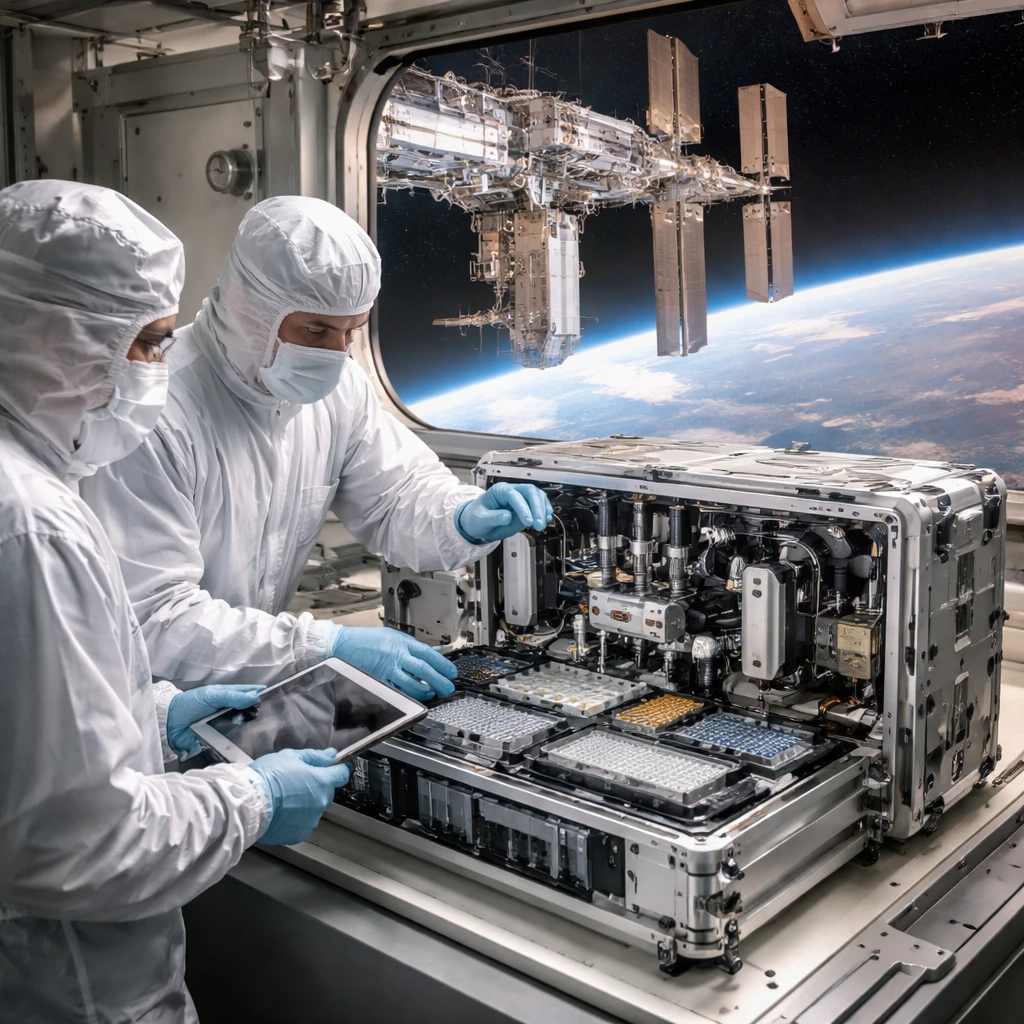
Voyager Technologies' stock advanced in early trading after the company disclosed a new mission management agreement with Exobiosphere. Under the terms of the arrangement, Voyager’s European division will serve as mission integrator for Exobiosphere’s Orbital High-Throughput Screener platform aboard the International Space Station - a platform the company says can run in excess of 2,000 simultaneous drug screening samples per mission.
The Exobiosphere contract adds another commercial biotech payload to Voyager’s portfolio of ISS mission management work and reinforces the company’s role as a commercial operator for complex on-orbit research.
Today’s development follows a robust first quarter for Voyager. Management reported Q1 bookings of $45 million, which helped lift the company’s backlog to a record $275 million, representing a 54% increase year-over-year. On the Q1 earnings call, CEO Dylan Taylor said, "Voyager had an outstanding first quarter with record backlog, a book-to-bill ratio of 1.3 and significant traction on new contracts, including Golden Dome." The company subsequently raised its full-year 2026 revenue guidance to a range of $230 million to $255 million.
Investors have pointed to several additional program milestones and partnerships as supporting the company's positive outlook. Those include a preproduction contract with Raytheon on the SM-3 interceptor program, a collaboration with Anduril on space-based interceptors, and NASA’s selection of Voyager for the seventh private astronaut mission, VOYG-1. Collectively, these engagements have contributed to momentum in the contract pipeline.
Still, the broader market offered a mild headwind during the stock move. Major U.S. benchmarks were slightly lower in the session, with the S&P 500 down about -0.30%, the Dow Jones down roughly -0.36%, and the NASDAQ off near -0.28%. On the macro front, April 2026 CPI data released the prior day showed headline inflation at 3.8% year-over-year, above forecasts. That hotter-than-expected inflation print has introduced added uncertainty around the Federal Reserve’s rate path and has exerted pressure on rate-sensitive growth names.
Despite those cross-currents, Voyager outperformed the market on the day as investors focused on the accelerating contract pipeline and the company’s expanding footprint where defense, space infrastructure, and commercial biotech research intersect. Market participants cited the combination of the new Exobiosphere ISS assignment and lingering momentum from the Q1 bookings and upgraded guidance as dual drivers lifting the shares in the session.
While today’s price action reflects investor enthusiasm for contract wins and backlog growth, market conditions and macro developments, including elevated inflation readings and associated rate uncertainty, remain relevant background considerations for Voyager and other growth-oriented, rate-sensitive companies.
Key points
- Voyager’s European arm will integrate Exobiosphere’s Orbital High-Throughput Screener on the ISS - a system capable of running over 2,000 simultaneous drug screening samples per mission.
- Q1 bookings totaled $45 million, pushing backlog to a record $275 million, up 54% year-over-year; full-year 2026 revenue guidance was raised to $230 million-$255 million.
- Additional catalysts cited by the company include contracts and partnerships with Raytheon and Anduril, and NASA’s selection of Voyager for the VOYG-1 private astronaut mission - developments spanning defense, space infrastructure, and commercial biotech.
Risks and uncertainties
- Macro uncertainty stemming from April 2026 CPI data showing 3.8% year-over-year inflation may influence the Federal Reserve’s rate path and put pressure on rate-sensitive growth stocks, including space and tech-related companies.
- Broader U.S. equity market softness - with modest declines in the S&P 500, Dow Jones, and NASDAQ - can act as a headwind for individual stock performance despite company-level contract wins and guidance revisions.
- Investor focus on Voyager’s contract pipeline and backlog momentum is sensitive to execution and future bookings; continued momentum is a factor for sustaining positive share performance.