
Raymond James reported that the U.S. Department of Agriculture recorded 243 new cases of New World Screwworm in the week ending April 26. That figure represents an acceleration in the weekly case count after a period of steady rises that began in early March, when weekly totals were in the low 100s and commonly increased by about 10 to 20 cases from week to week. In the most recent reporting period the weekly increase was roughly 50 cases compared with the prior week, according to Raymond James.
The distribution of new infections is drawing closer to the United States. This week a new case was identified in Coahuila, which lies west of Nuevo Leon and Tamaulipas and is outside the current sterile fly dispersal zone. Active infections are also growing in states that border Texas. Tamaulipas now reports 132 active cases, including 48 newly recorded cases in the latest week. Nuevo Leon has 11 active cases with 3 new in the most recent week.
Further northward spread is evident in states extending from Veracruz. Hidalgo reported 107 active cases and 56 new cases in the latest week, while San Luis Potosi reported 146 active cases and 53 new cases in that same period. Raymond James characterized these figures as reflecting continued movement of the infestation north from Veracruz.
The ongoing outbreak has had trade and supply consequences. U.S. cattle imports from Mexico were halted, and that pause has placed pressure on U.S. beef supplies over the last year. Cattle imported from Mexico made up approximately 4% of total U.S. cattle in 2024. The accelerating pattern of spread reduces clarity about when Mexican cattle imports might resume and raises the risk that the infestation could reach Texas, which could lead to restrictions on cattle movement and additional supply pressure.
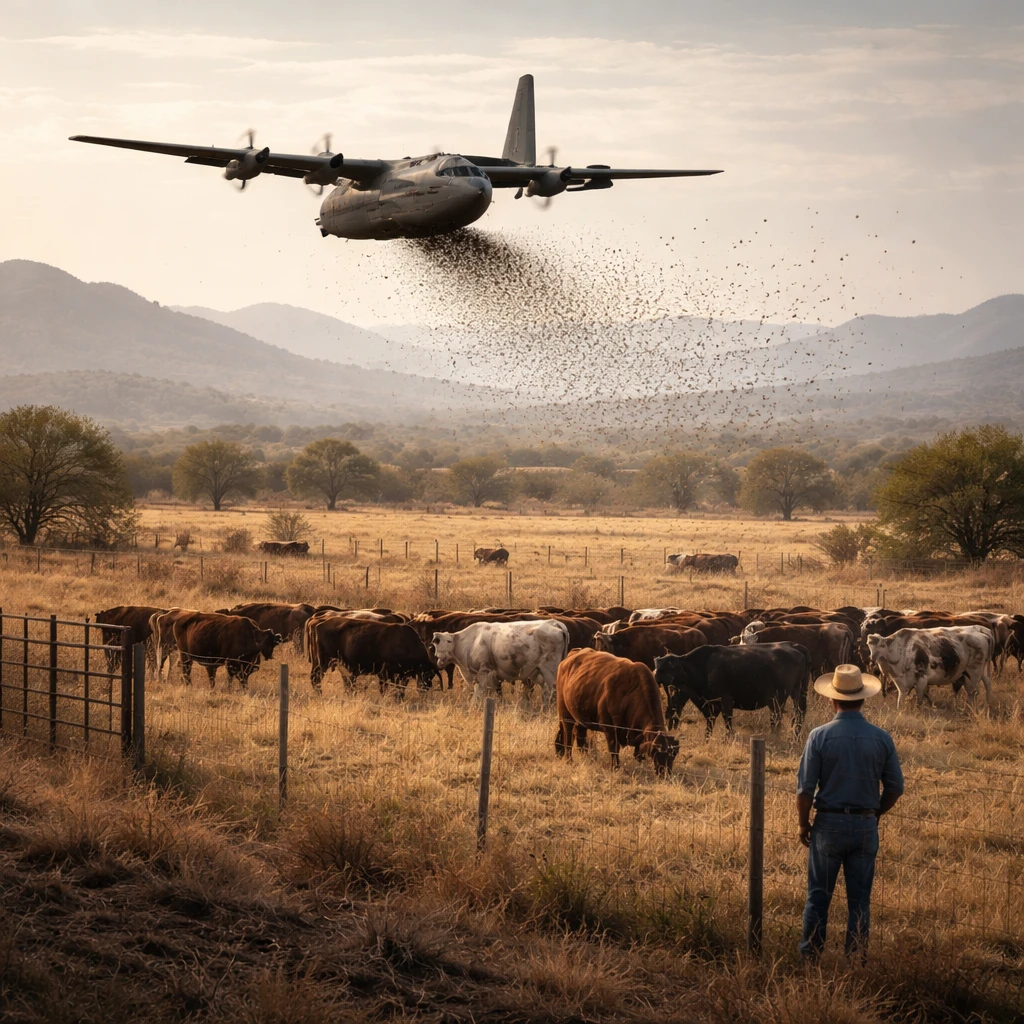
Authorities in both countries are deploying established control measures. The sterile insect technique remains a central response, with the United States dispersing sterile flies from Moore Air Base as part of suppression efforts. Earlier this week the U.S. Food and Drug Administration issued multiple Emergency Use Authorizations for medications appropriate for prevention and treatment of New World Screwworm, expanding available pharmaceutical tools in the response. In mid-April the U.S. Department of Agriculture and the Army Corps of Engineers broke ground on a new sterile fly production facility, which is expected to open by the end of 2027.
These developments outline a dynamic public-health and agriculture challenge that continues to evolve. The reported week-to-week increases, the appearance of cases outside current dispersal zones, and the clustering of active infections in border states frame both the operational response and the economic pressures tied to cattle trade and beef supply.
Summary
USDA data cited by Raymond James show an acceleration to 243 new New World Screwworm cases in the week ending April 26. Cases are appearing closer to the U.S. border, including a new case in Coahuila outside the sterile fly dispersal zone, and active infections are rising in Tamaulipas, Nuevo Leon, Hidalgo, and San Luis Potosi. The outbreak has led to halted U.S. cattle imports from Mexico, which accounted for about 4% of U.S. cattle in 2024, and authorities are responding with sterile fly releases, Emergency Use Authorizations for medications, and plans for a new production facility scheduled to open by the end of 2027.
Key points
- Weekly cases rose to 243 for the period ending April 26, marking a sharper weekly increase than the 10-20 case rises seen since early March - impacts: agriculture and livestock supply chains.
- New case identified in Coahuila outside the sterile fly dispersal zone, while active cases are increasing in border states including Tamaulipas (132 active, 48 new), Nuevo Leon (11 active, 3 new), Hidalgo (107 active, 56 new), and San Luis Potosi (146 active, 53 new) - impacts: cross-border trade and regional animal health operations.
- Response measures include sterile fly dispersal from Moore Air Base, multiple FDA Emergency Use Authorizations for medications, and construction of a sterile fly production facility expected by the end of 2027 - impacts: public agencies and veterinary pharmaceutical sectors.
Risks and uncertainties
- Potential spread into Texas could lead to restrictions on cattle movement and further pressure on U.S. beef supplies - affected sectors: livestock and meat markets.
- The accelerating and geographically expanding case counts reduce clarity on when Mexican cattle imports may resume, sustaining uncertainty for supply planning - affected sectors: cattle trade and food supply chains.
- Current sterile dispersal zones may not cover all newly affected areas, as evidenced by the new Coahuila case outside the dispersal zone, creating operational uncertainty for containment efforts - affected sectors: agricultural control operations and cross-border coordination.