
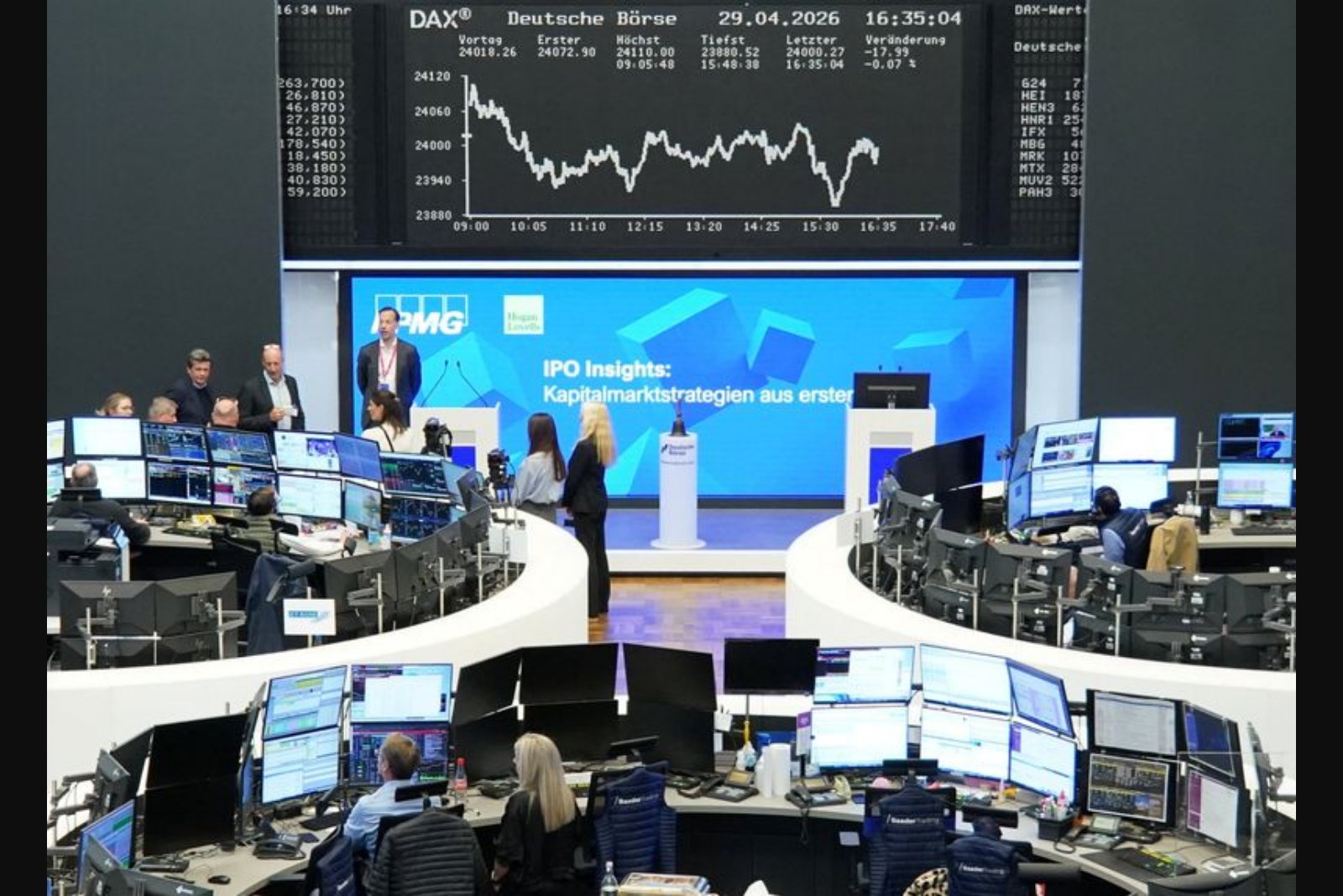
Financial markets rallied on Wednesday following a news report that said the United States and Iran are nearing a one-page memo intended to end the war, a development that coincided with a drop in oil prices. The report said the U.S. expects Iranian responses on several key points within the next 48 hours, while also cautioning that no agreement has yet been finalized and describing the moment as the closest the parties have come to a deal since the conflict began. The report could not be immediately verified.
European equities posted clear gains, with the STOXX 600 index rising sharply and finishing the session about 2.2% higher. Stocks tied to broad economic activity such as banks and miners were among the best performers, benefiting from the risk-on move. By contrast, shares in the oil and gas sector fell as the prospect of a de-escalation weighed on crude prices.
Government bonds rallied alongside equities. In the United States, yields on benchmark 10-year Treasury notes declined by 6 basis points to 4.35%, reflecting increased demand for duration assets amid the improved geopolitical outlook. European sovereign bonds outperformed recent peers, having been under pressure in recent weeks.
In Germany, 10-year Bund yields dropped 7.5 basis points to 2.99%. Shorter-dated, rate-sensitive German two-year yields fell about 10 basis points to 2.658% as market participants pared back expectations for the total number or magnitude of interest rate increases by the European Central Bank this year.
Yields in other major European markets also moved lower. British 10-year yields were down roughly 10 basis points and Italian 10-year yields fell about 12.5 basis points on the day, reflecting broad European bond strength in the session.
The U.S. dollar weakened against major currencies amid the risk-on shift. The euro and the pound each gained approximately 0.6%, trading near $1.1762 and $1.3618 respectively, as investors rotated into risk assets and currencies perceived as more sensitive to global growth and rate expectations.
Context and market dynamics
This market move linked to the reported diplomatic development produced a clear sectoral divergence: financials and materials outperformed given their sensitivity to economic activity, while energy names underperformed as oil prices reacted to the report. Fixed income markets showed a pronounced decline in yields across both U.S. and European sovereigns, pointing to a short-term reduction in perceived geopolitical risk and a reassessment of future central bank policy paths in Europe.