
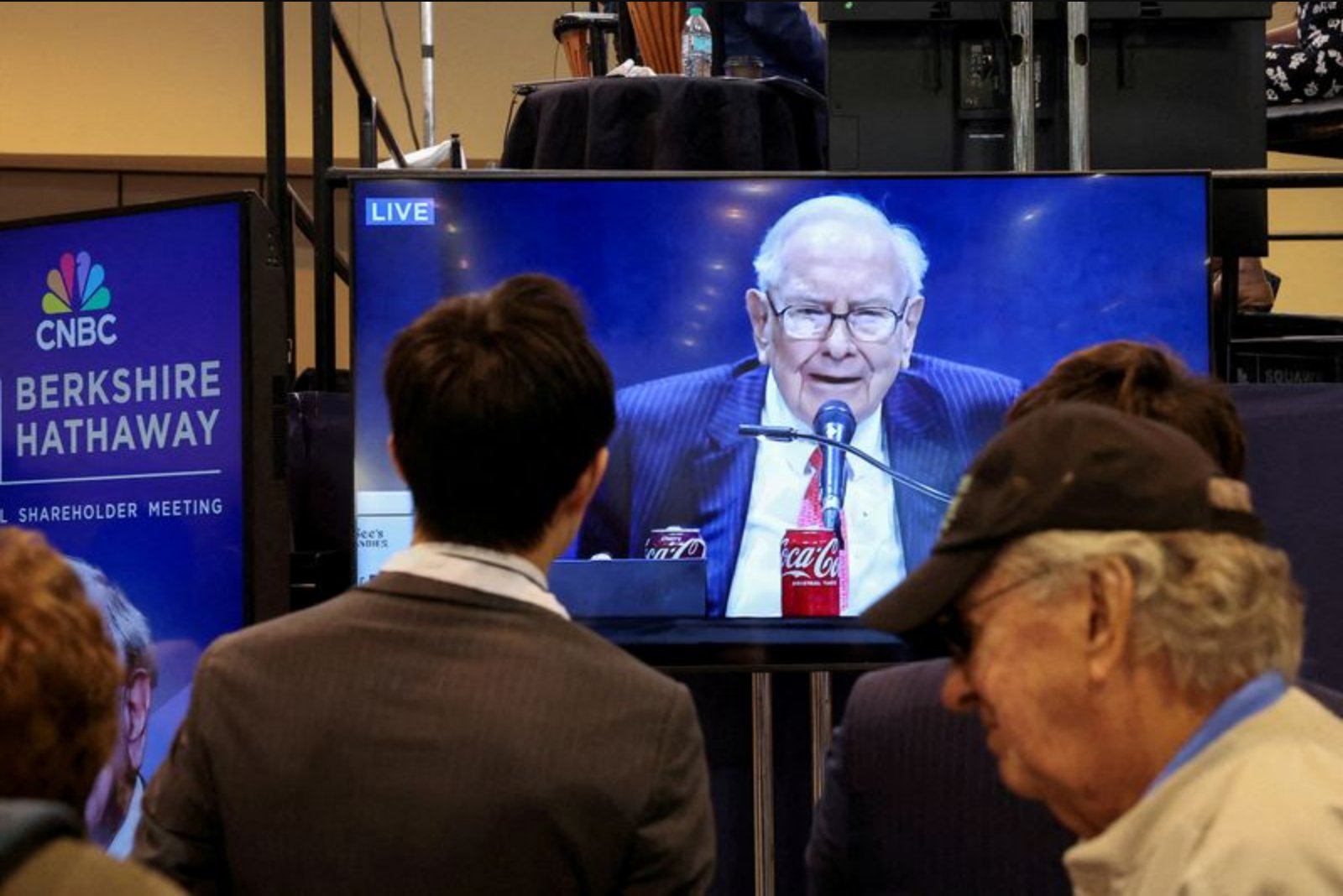
OMAHA, Nebraska - Berkshire Hathaway’s signature shareholder weekend will look familiar in many ways - discount shopping, the 5K run and tens of thousands of investors converging on the city - but the focal point has shifted. Warren Buffett will attend, yet for the first time in 60 years he will not lead the proceedings. Greg Abel, who took over as CEO when Buffett handed over operational control, will run Saturday’s annual meeting while Buffett remains chairman and listens from the audience.
The transition comes amid noticeable portfolio underperformance. Since Buffett unexpectedly announced last year that he was stepping aside, Berkshire’s shares have lagged the S&P 500. Berkshire is down 12% while the S&P 500 is up 25% over that period. Longtime Berkshire investor Steve Check of Check Capital Management in Costa Mesa, California, observed: "It was overpriced a year ago. It is not overpriced anymore. Overall, we’re still big fans." Berkshire did not provide a comment for this article.
On a book-value basis, Berkshire trades at roughly 1.4 times book value based on reported financials, though Buffett historically emphasized intrinsic value rather than book multiples when weighing stock repurchases. Abel restarted share buybacks in March - the first repurchases since May 2024.
Investors and analysts are watching how broader economic pressures affect Berkshire’s diverse operations, but the company has provided limited public comment on how tariffs, elevated oil prices and record-low consumer sentiment are influencing specific businesses.
Lawrence Cunningham, a law and governance professor at the University of Delaware who has written extensively about Berkshire, framed market caution succinctly: "Some investors may want to see Greg prove himself in his job before they double down. I’m confident, but the market is expressing caution."
Even as many shareholders still travel to Omaha for the weekend, organizers and hotels note slightly softer demand compared with recent years. In 2025, Visit Omaha reported that 95% of hotel rooms in Douglas County were booked for the Berkshire weekend. This year, hotels say reservations are down a bit and there are fewer international visitors. Ernie Goss, a professor and regional economist at Creighton University, emphasized Buffett’s centrality to the city’s identity: "You say, ’OK, what do you know about Omaha,’ and the answer is ’Warren Buffett.’ I can’t think of another city Omaha’s size that you can identify with one person." Jasmyn Goodwin, Visit Omaha’s executive director, noted his significance to the city: "He’s part of this city’s DNA."
Abel inherits a conglomerate Berkshire estimates at roughly $1.03 trillion in market capitalization, a portfolio of dozens of operating businesses and a large public equity portfolio. The company’s operating breadth spans insurance through Geico, rail via BNSF, energy with Berkshire Hathaway Energy, manufactured homes at Clayton, Dairy Queen ice cream, Fruit of the Loom apparel, Pilot truck stops and Squishmallows plush toys, among others.
Abel is widely seen as a more hands-on manager who is less inclined to tolerate lagging performance, yet he remains committed to Berkshire’s long-standing approach of granting managers day-to-day autonomy. He faces several substantial challenges, perhaps chief among them the deployment of a very large cash stockpile. Berkshire ended 2025 with about $373 billion in cash, a sum Paul Lountzis, president of Lountzis Asset Management in Wyomissing, Pennsylvania, calls pivotal to the company’s future. "That will play a pivotal role in Berkshire’s future," Lountzis said. He is attending his 34th Berkshire annual meeting.
Berkshire’s dealmaking cadence has been muted. In January the company paid $9.5 billion for Occidental Petroleum’s chemicals business, but the conglomerate has not announced a major acquisition in about a decade and it has not paid a cash dividend since 1967. Investors often view Berkshire as a buyer or lender of last resort - a role illustrated when the company provided a $5 billion investment in Goldman Sachs during the 2008 financial crisis - yet growth proved elusive across many operations in 2025. Operating profit declined 6% that year while revenue remained essentially flat.
Given those dynamics, some shareholders and market observers expect Abel may consider strategic pruning or divestitures. Lountzis suggested Abel might sell smaller or underperforming businesses as one option to reallocate capital.
Shareholders are also seeking more clarity about Berkshire’s roughly $300 billion stock portfolio, which holds major positions in Apple, American Express, Coca-Cola and stakes in five Japanese trading houses. Abel now oversees roughly 94% of that portfolio, taking on much of the responsibility that Todd Combs had managed before Combs left in December to join JPMorgan Chase. Ted Weschler, who had been considered a potential successor to help manage the asset portfolio, currently oversees about 6%.
In 2025 Berkshire resumed buying back stock in March, marking its first repurchases since May 2024. How repurchases, potential acquisitions, or divestitures will unfold under Abel’s leadership is a central question for investors.
The format of the annual meeting will change with the new leadership. More than two dozen Berkshire businesses will still showcase products in the arena and convention center as usual; Dairy Queen plans to serve nearly 26,300 ice cream bars, and those tend to sell out. Abel will open with roughly an hour-long overview about Berkshire and then spend about two and a half hours taking shareholder questions. He will be accompanied by insurance chief Ajit Jain, BNSF chief Katie Farmer and Adam Johnson, who runs consumer, services and retail businesses.
That contrasts with the era when Buffett and the late vice chairman Charlie Munger, who died in 2023, would typically field questions for five hours together. Their exchanges and concise judgments on the economy, markets and life drew large crowds. Visit Omaha data show that last year nearly 30,000 people traveled more than 60 miles to attend the meeting, excluding international visitors, based on cellphone movement data. Steve Check predicted that attendance could fall by half within a couple of years because many attendees historically came largely to hear Buffett and Munger rather than to learn granular details about Berkshire. "People came to hear Warren and Charlie," he said. "They didn’t really come to hear about Berkshire. And I expect Abel and the other executives to talk about Berkshire."
As Abel assumes public stewardship of Berkshire’s management and capital allocation decisions, shareholders and markets will watch closely to see how he balances the company’s cash, the public equity stakes and the operating businesses. The annual meeting in Omaha will offer one of the earliest extended opportunities for investors to assess how the new leadership team approaches those priorities.