
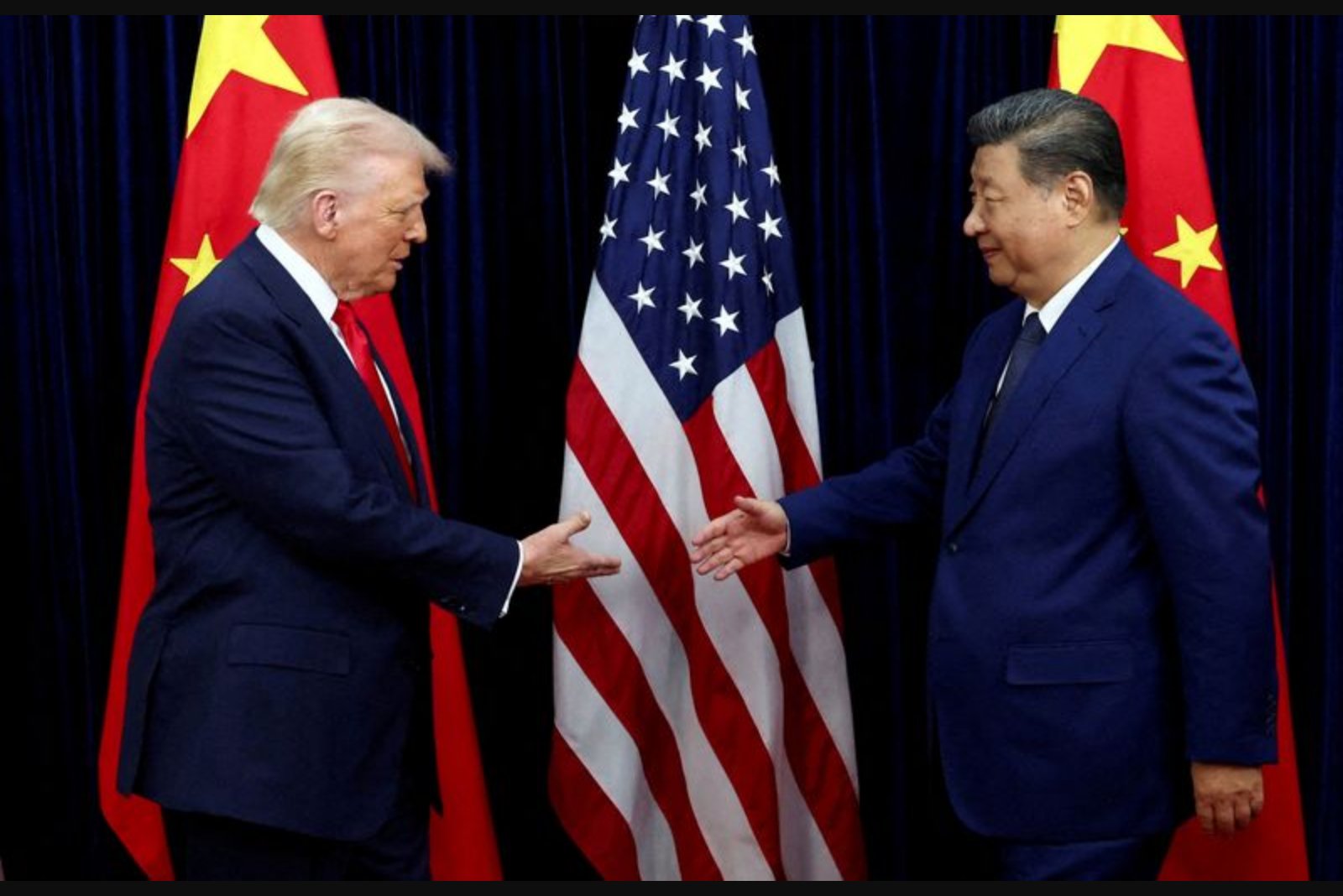
U.S. President Donald Trump intends to place artificial intelligence at the forefront of talks with Chinese leader Xi Jinping during his state visit, a notable shift that underscores the technology’s elevated strategic importance. Two U.S. officials with knowledge of the summit preparations told sources that, despite AI’s prominence on the agenda, officials do not anticipate sweeping, substantive commitments emerging from the meetings.
The Trump visit takes place amid an increasingly hardened U.S.-China rivalry over advanced AI, a competition that some observers have likened to a Cold War-style arms race. Tensions have been heightened recently by the introduction of powerful new AI systems, notably Anthropic’s Mythos model, which analysts say has raised the stakes for both governments and private firms.
Concerns have mounted because China did not receive early access to a preview of Mythos, sparking fears the model could be misused by malicious actors to probe vulnerabilities in Chinese software and financial infrastructure. Anthropic reported that Mythos identified "thousands" of major vulnerabilities in operating systems and other software, prompting banks and governments worldwide to rush to strengthen cybersecurity defenses.
White House officials have argued that the capabilities revealed by systems like Mythos make a formalized channel of communication with China essential to prevent incidents stemming from their deployment. Market research firm IDC China warned that excluding Chinese firms from Mythos could widen a "generational gap" in AI defense capabilities between China and Western countries.
Signs that AI discussion could be more than ceremonial at the summit include the announced participation of Nvidia Chief Executive Jensen Huang and White House tech policy advisor Michael Kratsios in President Trump’s delegation. Their presence raises the possibility of detailed exchanges about advanced AI hardware, including Nvidia’s H200 chips.
Separately, Beijing has reportedly proposed a formal bilateral AI dialogue that would be led on the U.S. side by Treasury Secretary Scott Bessent and on the Chinese side by Vice Finance Minister Liao Min, according to a source briefed on China’s outreach. The move appears intended to institutionalize communications on AI governance and risks, although expectations for the mechanism’s depth and technical focus remain modest - in part because neither treasury offices specialize in AI oversight and because the current U.S. administration has only recently shifted toward model safety vetting.
Experts and officials alike have highlighted a range of escalating risks associated with frontier AI systems. These include accelerated design of biological agents, amplified prospects for financial disruptions, enhanced cyber and disinformation operations, and theoretical concerns about advanced systems acting without human control. Given these risks, analysts have urged practical measures - for example, a no-blame hotline between senior officials to flag suspected AI-driven incidents or agreed guardrails for frontier models.
Kwan Yee Ng, head of international AI governance at Beijing-based Concordia AI, suggested a hotline could help de-escalate incidents and that a positive signal from the Xi-Trump summit might prompt senior Western engagement with China on AI governance. Ng noted that a military hotline already exists between the two countries, but U.S. officials have complained in the past that China has often not answered calls.
Other analysts have proposed commitments to lower AI-enabled malicious activities or to set boundaries for cutting-edge models along the lines of earlier U.S.-China understandings on cyber conduct. Sun Chenghao of Tsinghua University - a participant in unofficial Track II U.S.-China AI talks - said China likely wants the United States to draw a clearer line between governance measures and technological containment.
Talks over AI take place against a backdrop of intensified efforts in Washington to control China’s access to advanced semiconductors. U.S. lawmakers are advancing legislation that would impose tighter limits on China’s participation in the semiconductor supply chain, even as the Trump administration has relaxed some restrictions on advanced chip exports to China. The MATCH Act in particular has drawn protests in Beijing and could become a topic during summit discussions alongside existing U.S. chip export controls, according to sources familiar with the matter.
Geopolitical strategists say Beijing faces a narrow window to press the United States for concessions. Reva Goujon of Rhodium Group described the summit as an important moment for Beijing to seek a U.S. commitment to halt escalatory measures, reflecting the urgency with which both sides view technological competition.
China’s domestic push for AI self-reliance has been hampered by constrained access to chipmaking equipment and by production scaling challenges in local fabrication plants. Some Chinese AI companies, including DeepSeek, have emphasized their reliance on domestic chips, but industry observers note that U.S. curbs on sales of chipmaking equipment are complicating Beijing’s path to self-sufficiency. In recent months, shortages of computing power have forced some Chinese AI models to ration user access.
Relations are further strained by U.S. accusations that China has carried out industrial-scale theft of intellectual property from American AI research labs. In a pointed commentary last week, a Communist Party journal argued that Western AI policies have moved beyond targeted restrictions to what it called a "systematic ecosystem blockade" of Chinese tech development.
Analysts warn that the two sides view AI through different lenses - one treating advanced AI as a proliferation risk to be contained, the other viewing containment as an assault on a general-purpose technology. That divergence, experts say, makes arriving at clear, shared outcomes during the summit especially difficult.
Summary: President Trump will emphasize AI in talks with Xi, but officials familiar with the preparations do not expect major agreements. Recent AI developments, regulatory bids, and trust deficits complicate chances for meaningful cooperation. The summit could yield dialogue mechanisms or communications protocols, but persistent policy and security frictions limit prospects for substantive commitments.